Clinical Focus ›› 2026, Vol. 41 ›› Issue (7): 626-631.doi: 10.3969/j.issn.1004-583X.2026.07.008
Previous Articles Next Articles
Efficacy of repetitive transcranial magnetic stimulation combined with levodopa and benserazide hydrochloride tablets in the treatment of Parkinson’s disease
Xu Chongli( ), Zhang Xiaoying, Wang Yingya, Zhao Jing
Department of Neurology ,Parkinson's and Movement Disorders Ward, Nanyang Central Hospital
-
Received:2026-02-27Online:2026-07-20Published:2026-07-20 -
Contact:Xu Chongli,Email:xcl090842@126.com

CLC Number:
Cite this article
Xu Chongli, Zhang Xiaoying, Wang Yingya, Zhao Jing. Efficacy of repetitive transcranial magnetic stimulation combined with levodopa and benserazide hydrochloride tablets in the treatment of Parkinson’s disease[J]. Clinical Focus, 2026, 41(7): 626-631.
share this article
Add to citation manager EndNote|Ris|BibTeX
URL: https://www.lchc.cn/EN/10.3969/j.issn.1004-583X.2026.07.008
| 指标 | 例数 | 性别 (男/女) | 年龄 (岁) | 病程 (年) | Hoehn-Yahr分期[例(%)] | |||||||||
|---|---|---|---|---|---|---|---|---|---|---|---|---|---|---|
| Ⅰ期 | Ⅱ期 | Ⅲ期 | Ⅳ期 | |||||||||||
| 试验组 | 123 | 61/62 | 70.47±4.34 | 2.78±0.34 | 28(22.76) | 45(36.59) | 32(26.02) | 18(14.63) | ||||||
| 对照组 | 123 | 60/63 | 71.12±4.28 | 2.71±0.36 | 30(24.39) | 43(34.96) | 31(25.20) | 19(15.45) | ||||||
| t/χ2值 | 0.033 | 1.073 | 1.562 | 0.268 | ||||||||||
| P值 | 0.856 | 0.284 | 0.120 | 0.966 | ||||||||||
| 指标 | UPDRS- 精神行为(分) | UPDRS- 运动功能(分) | UPDRS-日常 生活能力(分) | MMSE (分) | HAMD (分) | HAMA (分) | LED (mg/d) | |||||||
| 试验组 | 12.36±1.12 | 46.87±3.91 | 57.56±5.12 | 26.34±2.21 | 18.23±3.45 | 17.89±3.21 | 412.35±45.67 | |||||||
| 对照组 | 12.21±1.04 | 46.50±3.46 | 58.05±4.34 | 26.51±2.08 | 18.09±3.52 | 18.02±3.34 | 408.92±46.23 | |||||||
| t/χ2值 | 1.073 | 0.796 | 0.810 | 0.620 | 0.319 | 0.316 | 0.589 | |||||||
| P值 | 0.284 | 0.427 | 0.419 | 0.536 | 0.750 | 0.752 | 0.556 | |||||||
Tab.1 Comparison of baseline data between the two groups
| 指标 | 例数 | 性别 (男/女) | 年龄 (岁) | 病程 (年) | Hoehn-Yahr分期[例(%)] | |||||||||
|---|---|---|---|---|---|---|---|---|---|---|---|---|---|---|
| Ⅰ期 | Ⅱ期 | Ⅲ期 | Ⅳ期 | |||||||||||
| 试验组 | 123 | 61/62 | 70.47±4.34 | 2.78±0.34 | 28(22.76) | 45(36.59) | 32(26.02) | 18(14.63) | ||||||
| 对照组 | 123 | 60/63 | 71.12±4.28 | 2.71±0.36 | 30(24.39) | 43(34.96) | 31(25.20) | 19(15.45) | ||||||
| t/χ2值 | 0.033 | 1.073 | 1.562 | 0.268 | ||||||||||
| P值 | 0.856 | 0.284 | 0.120 | 0.966 | ||||||||||
| 指标 | UPDRS- 精神行为(分) | UPDRS- 运动功能(分) | UPDRS-日常 生活能力(分) | MMSE (分) | HAMD (分) | HAMA (分) | LED (mg/d) | |||||||
| 试验组 | 12.36±1.12 | 46.87±3.91 | 57.56±5.12 | 26.34±2.21 | 18.23±3.45 | 17.89±3.21 | 412.35±45.67 | |||||||
| 对照组 | 12.21±1.04 | 46.50±3.46 | 58.05±4.34 | 26.51±2.08 | 18.09±3.52 | 18.02±3.34 | 408.92±46.23 | |||||||
| t/χ2值 | 1.073 | 0.796 | 0.810 | 0.620 | 0.319 | 0.316 | 0.589 | |||||||
| P值 | 0.284 | 0.427 | 0.419 | 0.536 | 0.750 | 0.752 | 0.556 | |||||||
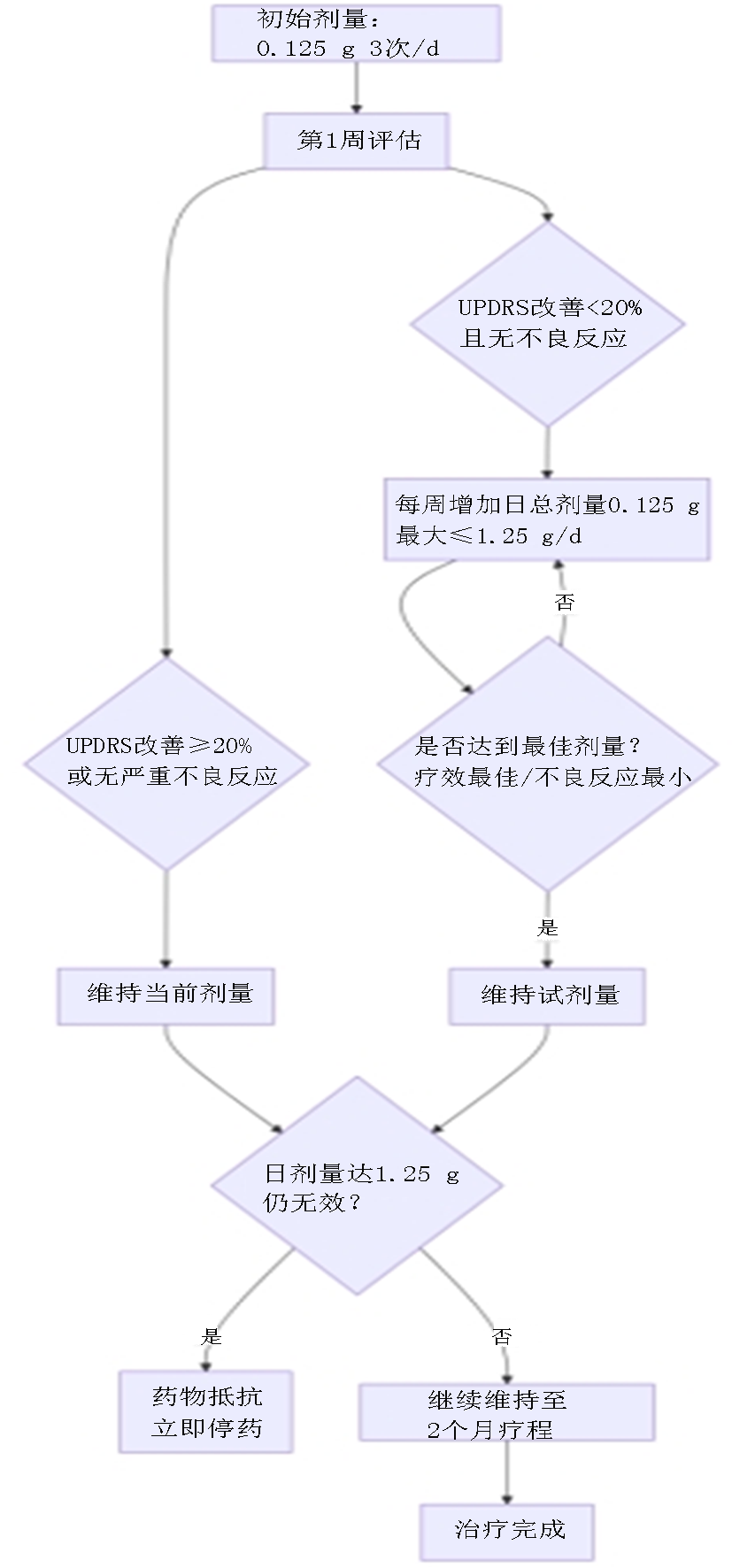
Fig.1 Drug treatment workflow
| 组别 | 例数 | 精神行为 | 运动功能 | 日常生活能力 | |||||
|---|---|---|---|---|---|---|---|---|---|
| 治疗前 | 治疗后 | 治疗前 | 治疗后 | 治疗前 | 治疗后 | ||||
| 试验组 | 123 | 12.36±1.12 | 5.34±1.06* | 46.87±3.91 | 30.01±4.06* | 57.56±5.12 | 37.57±5.17* | ||
| 对照组 | 123 | 12.21±1.04 | 7.51±1.48* | 46.50±3.46 | 34.98±5.64* | 58.05±4.34 | 42.54±6.74* | ||
| t值 | 1.073 | 13.328 | 0.796 | 7.764 | 0.810 | 6.618 | |||
| P值 | 0.284 | <0.01 | 0.427 | <0.01 | 0.419 | <0.01 | |||
Tab.2 Comparison of clinical efficacy between the two groups (point)
| 组别 | 例数 | 精神行为 | 运动功能 | 日常生活能力 | |||||
|---|---|---|---|---|---|---|---|---|---|
| 治疗前 | 治疗后 | 治疗前 | 治疗后 | 治疗前 | 治疗后 | ||||
| 试验组 | 123 | 12.36±1.12 | 5.34±1.06* | 46.87±3.91 | 30.01±4.06* | 57.56±5.12 | 37.57±5.17* | ||
| 对照组 | 123 | 12.21±1.04 | 7.51±1.48* | 46.50±3.46 | 34.98±5.64* | 58.05±4.34 | 42.54±6.74* | ||
| t值 | 1.073 | 13.328 | 0.796 | 7.764 | 0.810 | 6.618 | |||
| P值 | 0.284 | <0.01 | 0.427 | <0.01 | 0.419 | <0.01 | |||
| 组别 | 例数 | EGF(ng/L) | NSE(μg/L) | |||
|---|---|---|---|---|---|---|
| 治疗前 | 治疗后 | 治疗前 | 治疗后 | |||
| 试验组 | 123 | 4.34±0.55 | 7.03±0.77* | 18.42±2.31 | 7.76±1.39* | |
| 对照组 | 123 | 4.37±0.52 | 6.24±0.71* | 18.24±4.34 | 9.05±1.34* | |
| t值 | 0.521 | 9.428 | 0.472 | 8.937 | ||
| P值 | 0.603 | <0.01 | 0.637 | <0.01 | ||
Tab.3 Comparison of serum indicators between the two groups
| 组别 | 例数 | EGF(ng/L) | NSE(μg/L) | |||
|---|---|---|---|---|---|---|
| 治疗前 | 治疗后 | 治疗前 | 治疗后 | |||
| 试验组 | 123 | 4.34±0.55 | 7.03±0.77* | 18.42±2.31 | 7.76±1.39* | |
| 对照组 | 123 | 4.37±0.52 | 6.24±0.71* | 18.24±4.34 | 9.05±1.34* | |
| t值 | 0.521 | 9.428 | 0.472 | 8.937 | ||
| P值 | 0.603 | <0.01 | 0.637 | <0.01 | ||
| 组别 | 例数 | STEF(分) | MBI(分) | MAS(级) | |||||
|---|---|---|---|---|---|---|---|---|---|
| 治疗前 | 治疗后 | 治疗前 | 治疗后 | 治疗前 | 治疗后 | ||||
| 试验组 | 123 | 60.31±10.22 | 76.46±13.16* | 56.65±7.65 | 78.24±10.51* | 2.52±0.21 | 2.12±0.14* | ||
| 对照组 | 123 | 60.32±10.17 | 69.09±12.57* | 57.67±7.67 | 70.73±13.64* | 2.54±0.24 | 2.28±0.17* | ||
| t值 | 0.008 | 4.892 | 1.044 | 4.837 | 0.832 | 9.143 | |||
| P值 | 0.994 | <0.01 | 0.297 | <0.01 | 0.406 | <0.01 | |||
Tab.4 Comparison of gait indicators between the two groups
| 组别 | 例数 | STEF(分) | MBI(分) | MAS(级) | |||||
|---|---|---|---|---|---|---|---|---|---|
| 治疗前 | 治疗后 | 治疗前 | 治疗后 | 治疗前 | 治疗后 | ||||
| 试验组 | 123 | 60.31±10.22 | 76.46±13.16* | 56.65±7.65 | 78.24±10.51* | 2.52±0.21 | 2.12±0.14* | ||
| 对照组 | 123 | 60.32±10.17 | 69.09±12.57* | 57.67±7.67 | 70.73±13.64* | 2.54±0.24 | 2.28±0.17* | ||
| t值 | 0.008 | 4.892 | 1.044 | 4.837 | 0.832 | 9.143 | |||
| P值 | 0.994 | <0.01 | 0.297 | <0.01 | 0.406 | <0.01 | |||
| 组别 | 例数 | 躯体功能 | 社会功能 | 心理状态 | 物质生活 | |||||||
|---|---|---|---|---|---|---|---|---|---|---|---|---|
| 治疗前 | 治疗后 | 治疗前 | 治疗后 | 治疗前 | 治疗后 | 治疗前 | 治疗后 | |||||
| 试验组 | 123 | 59.23±6.31 | 86.72±8.41* | 57.58±6.42 | 84.95±8.39* | 59.82±6.13 | 85.61±8.84* | 61.42±6.91 | 82.21±8.12* | |||
| 对照组 | 123 | 58.22±6.34 | 79.29±8.37* | 56.59±6.41 | 77.64±8.38* | 61.23±6.31 | 79.63±8.52* | 60.71±6.51 | 75.52±7.87* | |||
| t值 | 1.421 | 7.843 | 1.382 | 7.592 | 1.982 | 6.129 | 0.932 | 7.241 | ||||
| P值 | 0.157 | <0.01 | 0.168 | <0.01 | 0.049 | <0.01 | 0.352 | <0.01 | ||||
Tab.5 Comparison of quality of life between the two groups (point)
| 组别 | 例数 | 躯体功能 | 社会功能 | 心理状态 | 物质生活 | |||||||
|---|---|---|---|---|---|---|---|---|---|---|---|---|
| 治疗前 | 治疗后 | 治疗前 | 治疗后 | 治疗前 | 治疗后 | 治疗前 | 治疗后 | |||||
| 试验组 | 123 | 59.23±6.31 | 86.72±8.41* | 57.58±6.42 | 84.95±8.39* | 59.82±6.13 | 85.61±8.84* | 61.42±6.91 | 82.21±8.12* | |||
| 对照组 | 123 | 58.22±6.34 | 79.29±8.37* | 56.59±6.41 | 77.64±8.38* | 61.23±6.31 | 79.63±8.52* | 60.71±6.51 | 75.52±7.87* | |||
| t值 | 1.421 | 7.843 | 1.382 | 7.592 | 1.982 | 6.129 | 0.932 | 7.241 | ||||
| P值 | 0.157 | <0.01 | 0.168 | <0.01 | 0.049 | <0.01 | 0.352 | <0.01 | ||||
| 组别 | 例数 | 头痛 | 胃肠道反应 | 其他 | 总发生率 |
|---|---|---|---|---|---|
| 试验组 | 123 | 6(4.88) | 4(3.25) | 6(4.88) | 16(13.01) |
| 对照组 | 123 | 5(4.06) | 3(2.44) | 6(4.88) | 14(11.38) |
| χ2值 | 0.452 | ||||
| P值 | 0.697 |
Tab.6 Comparison of adverse reactions between the two groups (n, %)
| 组别 | 例数 | 头痛 | 胃肠道反应 | 其他 | 总发生率 |
|---|---|---|---|---|---|
| 试验组 | 123 | 6(4.88) | 4(3.25) | 6(4.88) | 16(13.01) |
| 对照组 | 123 | 5(4.06) | 3(2.44) | 6(4.88) | 14(11.38) |
| χ2值 | 0.452 | ||||
| P值 | 0.697 |
| [1] |
孛学平, 吴鸣, 秦汉, 等. 帕金森病认知障碍康复的研究进展[J]. 中华物理医学与康复杂志, 2024, 46(3):269-272.doi:10.3760/cma.j.issn.0254-1424.2024.03.017.
|
| [2] | |
| [3] |
郑秀琴, 于苏文, 何益民, 等. 高频重复经颅磁刺激对帕金森病患者临床症状及其细胞衰老相关因子的影响[J]. 中华物理医学与康复杂志, 2022, 44(5):427-432.doi:10.3760/cma.j.issn.0254-1424.2022.05.010.
|
| [4] |
|
| [5] |
|
| [6] |
陈海波, 武冬冬. 帕金森病基层诊疗指南(2019年)[J]. 中华全科医师杂志, 2020, (1):5-6.doi:10.3760/cma.j.issn.1671-7368.2020.01.003.
|
| [7] |
|
| [8] |
|
| [9] |
张晓雪, 王睿月, 樊虹玉, 等. 上肢功能测试量表的汉化及其在脑卒中患者中的信效度研究[J]. 中国全科医学, 2023, 26(8):1022-1027.doi:10.12114/j.issn.1007-9572.2022.0391.
|
| [10] |
闵瑜, 吴媛媛, 燕铁斌. 改良Barthel指数(简体中文版)量表评定脑卒中患者日常生活活动能力的效度和信度研究[J]. 中华物理医学与康复杂志, 2008(3):185-188.doi:10.3321/j.issn:0254-1424.2008.03.010.
|
| [11] |
|
| [12] |
|
| [13] |
陈秋霞, 李蒙燕, 王婷. 帕金森病治疗现状及新进展[J]. 中华行为医学与脑科学杂志, 2024, 33(9):807-812.doi:10.3760/cma.j.cn371468-20240512-00220.
|
| [14] |
|
| [15] |
pmid: 35125106 |
| [16] |
时洁, 耿晓康, 李潇, 等. rTMS联合普拉克索治疗老年帕金森病患者疗效及对步态指标和血清S100βNSEBDNF水平的影响[J]. 河北医学, 2024, 30(8):1362-1367.doi:10.3969/j.issn.1006-6233.2024.08.025.
|
| [17] |
|
| [18] |
|
| [19] |
葛静雅, 刘慧群, 刘畅, 等. 疏风平颤汤加减联合STN-DBS手术对帕金森病病人EGF, 抗氧化功能的影响[J]. 中西医结合心脑血管病杂志, 2022, 20(11):2069-2073.doi:10.12102/j.issn.1672-1349.2022.11.033.
|
| [20] |
赵轶, 左博, 贾佳, 等. 血清S100β, NSE, BDNF水平与帕金森病合并认知功能障碍的相关性>BDNF水平与帕金森病合并认知功能障碍的相关性[J]. 中国临床医学, 2023, 30(4):652-657.doi:10.12025/j.issn.1008-6358.2023.20230782.
|
| [21] |
|
| [22] |
李晓莉, 李冬春, 王昌图, 等. 重复经颅磁刺激治疗帕金森的临床疗效[J]. 川北医学院学报, 2024, 39(10):1317-1320.doi:10.3969/j.issn.1005-3697.2024.10.005.
|
| [23] |
康乐乐, 苗婵婵, 高海茸. 多巴丝肼联合重复经颅直流电刺激治疗对帕金森疾病患者运动和非运动功能的影响[J]. 川北医学院学报, 2024, 39(8):1059-1063.doi:10.3969/j.issn.1005-3697.2024.08.013.
|
| Viewed | ||||||
|
Full text |
|
|||||
|
Abstract |
|
|||||