Clinical Focus ›› 2026, Vol. 41 ›› Issue (10): 881-890.doi: 10.3969/j.issn.1004-583X.2026.10.003
Previous Articles Next Articles
A prospective cohort study of time-updated discrepancies between subjective and objective health and incident depressive symptoms in Chinese middle-aged and older adults
Wang Qilong, Qi Xin, Zhao Dongrong( )
Department of Mental Health ,Gansu Provincial Hospital Lanzhou 730000, China
-
Received:2026-09-30Online:2026-10-20Published:2026-10-10 -
Contact:Zhao Dongrong E-mail:13919131767@163.com

CLC Number:
Cite this article
Wang Qilong, Qi Xin, Zhao Dongrong. A prospective cohort study of time-updated discrepancies between subjective and objective health and incident depressive symptoms in Chinese middle-aged and older adults[J]. Clinical Focus, 2026, 41(10): 881-890.
share this article
Add to citation manager EndNote|Ris|BibTeX
URL: https://www.lchc.cn/EN/10.3969/j.issn.1004-583X.2026.10.003
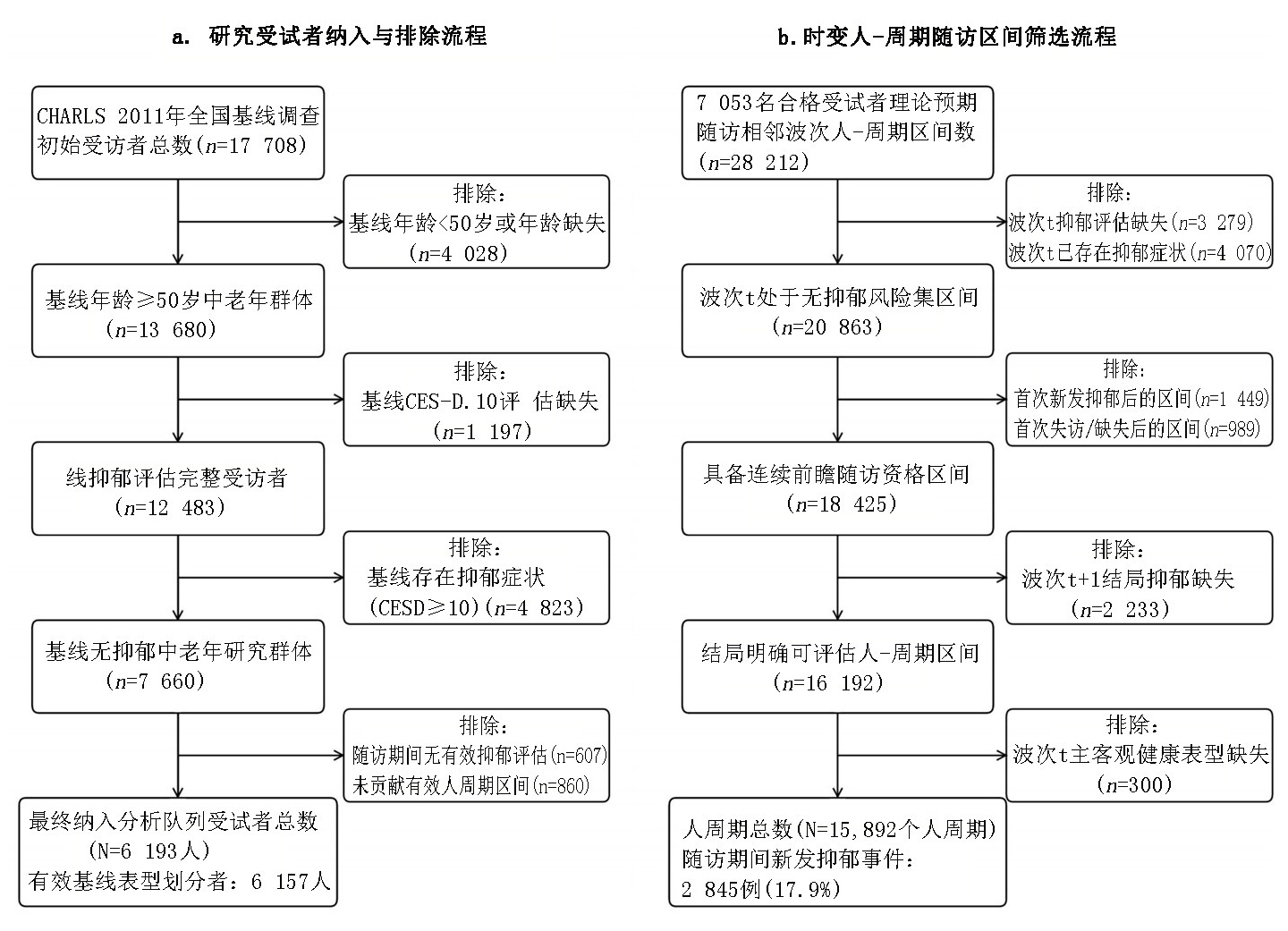
Fig. 1 Flowchart of cohort selection in Chinese middle-aged and older adults and construction of the person-period follow-up interval a. Participant inclusion and exclusion flow; b. Flowchart for selection based on time-updated person-period follow-up intervals and incident depression outcome
| 特征指标 | 总体 (N=6157) | 自评良好-无共病 (n=1 614) | 自评不良-无共病 (n=3 242) | 自评良好-伴共病 (n=202) | 自评不良-伴共病 (n=1099) | 统计量 | P值 | |||||
|---|---|---|---|---|---|---|---|---|---|---|---|---|
| 例数[例(%)] | 6 157(100.0) | 1 614(26.2) | 3 242(52.7) | 202(3.3) | 1 099(17.8) | - | - | |||||
| 年龄(岁) | 61.5±7.9 | 60.7±7.7 | 61.2±7.8 | 63.5±8.8 | 63.4±7.7 | F=34.60 | <0.001 | |||||
| 年龄分段[例(%)] | χ2=81.43 | <0.001 | ||||||||||
| <65岁 | 4 230(68.7) | 1 182(73.2) | 2 285(70.5) | 120(59.4) | 643(58.5) | |||||||
| ≥65岁 | 1 927(31.3) | 432(26.8) | 957(29.5) | 82(40.6) | 456(41.5) | |||||||
| 性别[例(%)] | χ2=27.65 | <0.001 | ||||||||||
| 男 | 2 764(44.9) | 660(40.9) | 1 446(44.6) | 100(49.5) | 558(50.8) | |||||||
| 女 | 3 393(55.1) | 954(59.1) | 1 796(55.4) | 102(50.5) | 541(49.2) | |||||||
| 受教育程度[例(%)] | χ2=17.21 | 0.009 | ||||||||||
| 初中及以下 | 5 359(87.0) | 1 371(84.9) | 2 847(87.8) | 173(85.6) | 968(88.1) | |||||||
| 高中/中专 | 676(11.0) | 203(12.6) | 343(10.6) | 20(9.9) | 110(10.0) | |||||||
| 大专及以上 | 122(2.0) | 40(2.5) | 52(1.6) | 9(4.5) | 21(1.9) | |||||||
| 家庭人均年收入[例(%)] | χ2=32.57 | <0.001 | ||||||||||
| 低收入组 | 2 058(33.4) | 514(31.8) | 1 125(34.7) | 59(29.2) | 360(32.8) | |||||||
| 中等收入组 | 2 052(33.3) | 507(31.4) | 1 134(35.0) | 55(27.2) | 356(32.4) | |||||||
| 高收入组 | 2 047(33.2) | 593(36.7) | 983(30.3) | 88(43.6) | 383(34.8) | |||||||
| 在业状态[例(%)] | χ2=150.06 | <0.001 | ||||||||||
| 非在业 | 2 306(37.5) | 525(32.5) | 1 110(34.2) | 86(42.6) | 585(53.2) | |||||||
| 在业 | 3 851(62.5) | 1 089(67.5) | 2 132(65.8) | 116(57.4) | 514(46.8) | |||||||
| 婚姻状况[例(%)] | χ2=10.96 | 0.012 | ||||||||||
| 无伴侣(离异/丧偶/未婚) | 661(10.7) | 179(11.1) | 314(9.7) | 23(11.4) | 145(13.2) | |||||||
| 已婚/有伴侣 | 5 496(89.3) | 1 435(88.9) | 2 928(90.3) | 179(88.6) | 954(86.8) | |||||||
| 与子女同住情况[例(%)] | χ2=11.74 | 0.008 | ||||||||||
| 否 | 2 696(43.8) | 714(44.2) | 1 367(42.2) | 104(51.5) | 511(46.5) | |||||||
| 是 | 3 461(56.2) | 900(55.8) | 1 875(57.8) | 98(48.5) | 588(53.5) | |||||||
| 体质量指数(BMI, kg/m2) | 23.6±3.7 | 23.6±3.6 | 22.9±3.6 | 25.2±3.9 | 25.0±4.0 | F=102.60 | <0.001 | |||||
| 体质量分类[例(%)] | χ2=225.49 | <0.001 | ||||||||||
| 正常(18.5~23.9) | 3 260(52.9) | 869(53.8) | 1 900(58.6) | 74(36.6) | 417(37.9) | |||||||
| 消瘦(<18.5) | 353(5.7) | 72(4.5) | 228(7.0) | 6(3.0) | 47(4.3) | |||||||
| 超重/肥胖(≥24.0) | 2 544(41.3) | 673(41.7) | 1 114(34.4) | 122(60.4) | 635(57.8) | |||||||
| 吸烟状况[例(%)] | χ2=44.43 | <0.001 | ||||||||||
| 否 | 4 083(66.3) | 1 029(63.8) | 2 091(64.5) | 146(72.3) | 817(74.3) | |||||||
| 是 | 2 074(33.7) | 585(36.2) | 1 151(35.5) | 56(27.7) | 282(25.7) | |||||||
| 饮酒状况[例(%)] | χ2=50.94 | <0.001 | ||||||||||
| 否 | 3 936(63.9) | 933(57.8) | 2 088(64.4) | 135(66.8) | 780(71.0) | |||||||
| 是 | 2 221(36.1) | 681(42.2) | 1 154(35.6) | 67(33.2) | 319(29.0) | |||||||
| 高血压[例(%)] | χ2=1 889.99 | <0.001 | ||||||||||
| 否 | 4 525(73.5) | 1 412(87.5) | 2 771(85.5) | 48(23.8) | 294(26.8) | |||||||
| 是 | 1 632(26.5) | 202(12.5) | 471(14.5) | 154(76.2) | 805(73.2) | |||||||
| 心脏病[例(%)] | χ2=1 426.44 | <0.001 | ||||||||||
| 否 | 5 478(89.0) | 1 583(98.1) | 3 114(96.1) | 142(70.3) | 639(58.1) | |||||||
| 是 | 675(11.0) | 31(1.9) | 128(3.9) | 60(29.7) | 456(41.5) | |||||||
| 糖尿病[例(%)] | χ2=699.89 | <0.001 | ||||||||||
| 否 | 5 760(93.6) | 1 589(98.5) | 3 168(97.7) | 153(75.7) | 850(77.3) | |||||||
| 是 | 383(6.2) | 25(1.5) | 74(2.3) | 47(23.3) | 237(21.6) | |||||||
| 脑卒中[例(%)] | χ2=312.72 | <0.001 | ||||||||||
| 否 | 6 029(97.9) | 1 607(99.6) | 3 229(99.6) | 190(94.1) | 1 003(91.3) | |||||||
| 是 | 126(2.0) | 7(0.4) | 13(0.4) | 12(5.9) | 94(8.6) | |||||||
| 慢性肺部疾患[例(%)] | χ2=503.90 | <0.001 | ||||||||||
| 否 | 5 610(91.1) | 1 555(96.3) | 3 074(94.8) | 163(80.7) | 818(74.4) | |||||||
| 是 | 543(8.8) | 59(3.7) | 168(5.2) | 39(19.3) | 277(25.2) | |||||||
| 恶性肿瘤[例(%)] | χ2=64.86 | <0.001 | ||||||||||
| 否 | 6 089(98.9) | 1 610(99.8) | 3 223(99.4) | 196(97.0) | 1 060(96.5) | |||||||
| 是 | 61(1.0) | 4(0.2) | 19(0.6) | 5(2.5) | 33(3.0) | |||||||
| 关节炎/风湿病[例(%)] | χ2=1 024.91 | <0.001 | ||||||||||
| 否 | 4 388(71.3) | 1 398(86.6) | 2 517(77.6) | 78(38.6) | 395(35.9) | |||||||
| 是 | 1 769(28.7) | 216(13.4) | 725(22.4) | 124(61.4) | 704(64.1) | |||||||
| 累积慢性病种数[例(%)] | χ2=6 291.62 | <0.001 | ||||||||||
| 0种 | 2 714(44.1) | 1 070(66.3) | 1 644(50.7) | 0(0) | 0(0.8) | |||||||
| 1种 | 2 142(34.8) | 544(33.7) | 1 598(49.3) | 0(0) | 0(0) | |||||||
| ≥2种 | 1 301(21.1) | 0(0.0) | 0(0.0) | 202(100.0) | 1 099(100.0) | |||||||
| 基线CES-D-10评分(分) | 4.5±2.8 | 3.5±2.7 | 4.7±2.7 | 3.9±2.8 | 5.1±2.7 | F=92.40 | <0.001 | |||||
Tab. 1 Comparison of baseline characteristics distribution and psychosomatic health phenotypes in Chinese middle-aged and older adults (N=6 157)
| 特征指标 | 总体 (N=6157) | 自评良好-无共病 (n=1 614) | 自评不良-无共病 (n=3 242) | 自评良好-伴共病 (n=202) | 自评不良-伴共病 (n=1099) | 统计量 | P值 | |||||
|---|---|---|---|---|---|---|---|---|---|---|---|---|
| 例数[例(%)] | 6 157(100.0) | 1 614(26.2) | 3 242(52.7) | 202(3.3) | 1 099(17.8) | - | - | |||||
| 年龄(岁) | 61.5±7.9 | 60.7±7.7 | 61.2±7.8 | 63.5±8.8 | 63.4±7.7 | F=34.60 | <0.001 | |||||
| 年龄分段[例(%)] | χ2=81.43 | <0.001 | ||||||||||
| <65岁 | 4 230(68.7) | 1 182(73.2) | 2 285(70.5) | 120(59.4) | 643(58.5) | |||||||
| ≥65岁 | 1 927(31.3) | 432(26.8) | 957(29.5) | 82(40.6) | 456(41.5) | |||||||
| 性别[例(%)] | χ2=27.65 | <0.001 | ||||||||||
| 男 | 2 764(44.9) | 660(40.9) | 1 446(44.6) | 100(49.5) | 558(50.8) | |||||||
| 女 | 3 393(55.1) | 954(59.1) | 1 796(55.4) | 102(50.5) | 541(49.2) | |||||||
| 受教育程度[例(%)] | χ2=17.21 | 0.009 | ||||||||||
| 初中及以下 | 5 359(87.0) | 1 371(84.9) | 2 847(87.8) | 173(85.6) | 968(88.1) | |||||||
| 高中/中专 | 676(11.0) | 203(12.6) | 343(10.6) | 20(9.9) | 110(10.0) | |||||||
| 大专及以上 | 122(2.0) | 40(2.5) | 52(1.6) | 9(4.5) | 21(1.9) | |||||||
| 家庭人均年收入[例(%)] | χ2=32.57 | <0.001 | ||||||||||
| 低收入组 | 2 058(33.4) | 514(31.8) | 1 125(34.7) | 59(29.2) | 360(32.8) | |||||||
| 中等收入组 | 2 052(33.3) | 507(31.4) | 1 134(35.0) | 55(27.2) | 356(32.4) | |||||||
| 高收入组 | 2 047(33.2) | 593(36.7) | 983(30.3) | 88(43.6) | 383(34.8) | |||||||
| 在业状态[例(%)] | χ2=150.06 | <0.001 | ||||||||||
| 非在业 | 2 306(37.5) | 525(32.5) | 1 110(34.2) | 86(42.6) | 585(53.2) | |||||||
| 在业 | 3 851(62.5) | 1 089(67.5) | 2 132(65.8) | 116(57.4) | 514(46.8) | |||||||
| 婚姻状况[例(%)] | χ2=10.96 | 0.012 | ||||||||||
| 无伴侣(离异/丧偶/未婚) | 661(10.7) | 179(11.1) | 314(9.7) | 23(11.4) | 145(13.2) | |||||||
| 已婚/有伴侣 | 5 496(89.3) | 1 435(88.9) | 2 928(90.3) | 179(88.6) | 954(86.8) | |||||||
| 与子女同住情况[例(%)] | χ2=11.74 | 0.008 | ||||||||||
| 否 | 2 696(43.8) | 714(44.2) | 1 367(42.2) | 104(51.5) | 511(46.5) | |||||||
| 是 | 3 461(56.2) | 900(55.8) | 1 875(57.8) | 98(48.5) | 588(53.5) | |||||||
| 体质量指数(BMI, kg/m2) | 23.6±3.7 | 23.6±3.6 | 22.9±3.6 | 25.2±3.9 | 25.0±4.0 | F=102.60 | <0.001 | |||||
| 体质量分类[例(%)] | χ2=225.49 | <0.001 | ||||||||||
| 正常(18.5~23.9) | 3 260(52.9) | 869(53.8) | 1 900(58.6) | 74(36.6) | 417(37.9) | |||||||
| 消瘦(<18.5) | 353(5.7) | 72(4.5) | 228(7.0) | 6(3.0) | 47(4.3) | |||||||
| 超重/肥胖(≥24.0) | 2 544(41.3) | 673(41.7) | 1 114(34.4) | 122(60.4) | 635(57.8) | |||||||
| 吸烟状况[例(%)] | χ2=44.43 | <0.001 | ||||||||||
| 否 | 4 083(66.3) | 1 029(63.8) | 2 091(64.5) | 146(72.3) | 817(74.3) | |||||||
| 是 | 2 074(33.7) | 585(36.2) | 1 151(35.5) | 56(27.7) | 282(25.7) | |||||||
| 饮酒状况[例(%)] | χ2=50.94 | <0.001 | ||||||||||
| 否 | 3 936(63.9) | 933(57.8) | 2 088(64.4) | 135(66.8) | 780(71.0) | |||||||
| 是 | 2 221(36.1) | 681(42.2) | 1 154(35.6) | 67(33.2) | 319(29.0) | |||||||
| 高血压[例(%)] | χ2=1 889.99 | <0.001 | ||||||||||
| 否 | 4 525(73.5) | 1 412(87.5) | 2 771(85.5) | 48(23.8) | 294(26.8) | |||||||
| 是 | 1 632(26.5) | 202(12.5) | 471(14.5) | 154(76.2) | 805(73.2) | |||||||
| 心脏病[例(%)] | χ2=1 426.44 | <0.001 | ||||||||||
| 否 | 5 478(89.0) | 1 583(98.1) | 3 114(96.1) | 142(70.3) | 639(58.1) | |||||||
| 是 | 675(11.0) | 31(1.9) | 128(3.9) | 60(29.7) | 456(41.5) | |||||||
| 糖尿病[例(%)] | χ2=699.89 | <0.001 | ||||||||||
| 否 | 5 760(93.6) | 1 589(98.5) | 3 168(97.7) | 153(75.7) | 850(77.3) | |||||||
| 是 | 383(6.2) | 25(1.5) | 74(2.3) | 47(23.3) | 237(21.6) | |||||||
| 脑卒中[例(%)] | χ2=312.72 | <0.001 | ||||||||||
| 否 | 6 029(97.9) | 1 607(99.6) | 3 229(99.6) | 190(94.1) | 1 003(91.3) | |||||||
| 是 | 126(2.0) | 7(0.4) | 13(0.4) | 12(5.9) | 94(8.6) | |||||||
| 慢性肺部疾患[例(%)] | χ2=503.90 | <0.001 | ||||||||||
| 否 | 5 610(91.1) | 1 555(96.3) | 3 074(94.8) | 163(80.7) | 818(74.4) | |||||||
| 是 | 543(8.8) | 59(3.7) | 168(5.2) | 39(19.3) | 277(25.2) | |||||||
| 恶性肿瘤[例(%)] | χ2=64.86 | <0.001 | ||||||||||
| 否 | 6 089(98.9) | 1 610(99.8) | 3 223(99.4) | 196(97.0) | 1 060(96.5) | |||||||
| 是 | 61(1.0) | 4(0.2) | 19(0.6) | 5(2.5) | 33(3.0) | |||||||
| 关节炎/风湿病[例(%)] | χ2=1 024.91 | <0.001 | ||||||||||
| 否 | 4 388(71.3) | 1 398(86.6) | 2 517(77.6) | 78(38.6) | 395(35.9) | |||||||
| 是 | 1 769(28.7) | 216(13.4) | 725(22.4) | 124(61.4) | 704(64.1) | |||||||
| 累积慢性病种数[例(%)] | χ2=6 291.62 | <0.001 | ||||||||||
| 0种 | 2 714(44.1) | 1 070(66.3) | 1 644(50.7) | 0(0) | 0(0.8) | |||||||
| 1种 | 2 142(34.8) | 544(33.7) | 1 598(49.3) | 0(0) | 0(0) | |||||||
| ≥2种 | 1 301(21.1) | 0(0.0) | 0(0.0) | 202(100.0) | 1 099(100.0) | |||||||
| 基线CES-D-10评分(分) | 4.5±2.8 | 3.5±2.7 | 4.7±2.7 | 3.9±2.8 | 5.1±2.7 | F=92.40 | <0.001 | |||||
| 健康不一致表型 (第t波) | 人-周期数 | 新发抑郁 事件数 | 粗发病率 (%) | 模型1 | 模型2 | 模型3 | |||||
|---|---|---|---|---|---|---|---|---|---|---|---|
| HR(95%CI) | P值 | HR(95%CI) | P值 | HR(95%CI) | P值 | ||||||
| 自评良好-无共病(参照组) | 4 265 | 514 | 12.05 | 1.00[参照] | - | 1.00[参照] | - | 1.00[参照] | - | ||
| 自评不良-无共病 | 7 473 | 1 419 | 18.99 | 1.63(1.47~1.80) | <0.001 | 1.60(1.45~1.77) | <0.001 | 1.54(1.39~1.71) | <0.001 | ||
| 自评良好-伴共病 | 754 | 120 | 15.92 | 1.37(1.13~1.68) | 0.002 | 1.32(1.08~1.61) | 0.007 | 1.40(1.14~1.71) | 0.001 | ||
| 自评不良-伴共病 | 3 400 | 792 | 23.29 | 2.08(1.86~2.33) | <0.001 | 2.01(1.79~2.25) | <0.001 | 2.11(1.88~2.36) | <0.001 | ||
Tab. 2 Discrete-time survival model analysis of the risk of incident depression associated with time-updated discrepancies between subjective and objective health phenotypes in Chinese middle-aged and older adults
| 健康不一致表型 (第t波) | 人-周期数 | 新发抑郁 事件数 | 粗发病率 (%) | 模型1 | 模型2 | 模型3 | |||||
|---|---|---|---|---|---|---|---|---|---|---|---|
| HR(95%CI) | P值 | HR(95%CI) | P值 | HR(95%CI) | P值 | ||||||
| 自评良好-无共病(参照组) | 4 265 | 514 | 12.05 | 1.00[参照] | - | 1.00[参照] | - | 1.00[参照] | - | ||
| 自评不良-无共病 | 7 473 | 1 419 | 18.99 | 1.63(1.47~1.80) | <0.001 | 1.60(1.45~1.77) | <0.001 | 1.54(1.39~1.71) | <0.001 | ||
| 自评良好-伴共病 | 754 | 120 | 15.92 | 1.37(1.13~1.68) | 0.002 | 1.32(1.08~1.61) | 0.007 | 1.40(1.14~1.71) | 0.001 | ||
| 自评不良-伴共病 | 3 400 | 792 | 23.29 | 2.08(1.86~2.33) | <0.001 | 2.01(1.79~2.25) | <0.001 | 2.11(1.88~2.36) | <0.001 | ||
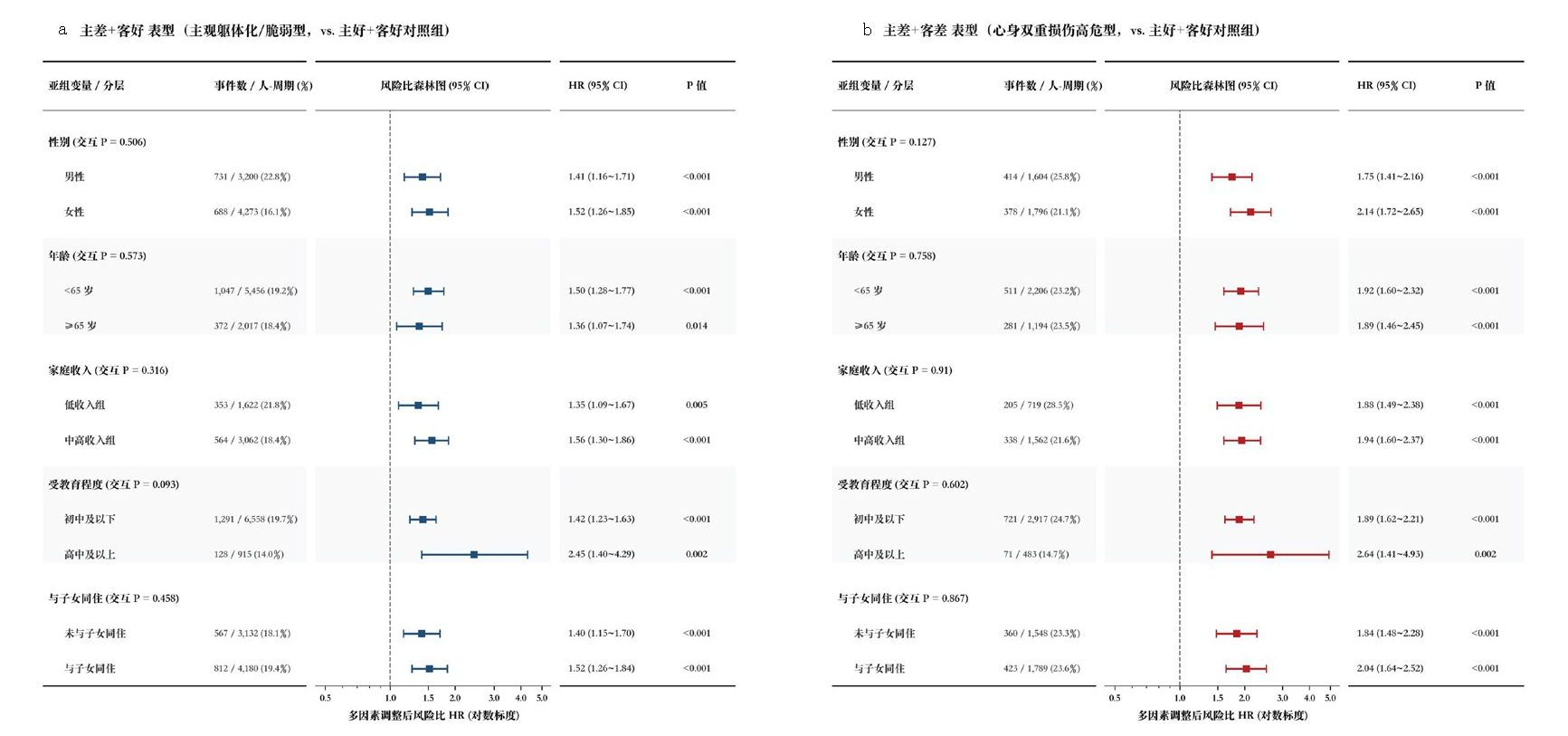
Fig. 2 Forest plots of the risk of incident depression associated with time-updated discrepancies between subjective and objective health phenotypes across clinical subgroups in older adults in the CHARLS cohort a. Forest plots of discrete-time survival model estimates for subgroups within the phenotype of poor self-rated health without comorbidity; b. Forest plots of discrete-time survival model estimates for subgroups within the phenotype of poor self-rated health with comorbidity
| 亚组分类 | 分层水平 | 健康不一致表型 | 人-周期数 | 新发抑郁 (例) | 发病率 (%) | HR(95%CI) | P值 | 交互P值 |
|---|---|---|---|---|---|---|---|---|
| 性别 | 男性 | 自评不良-无共病 | 3 200 | 731 | 22.84 | 1.41(1.16~1.71) | <0.001 | 0.506 |
| 自评良好-伴共病 | 359 | 66 | 18.38 | 1.26(0.87~1.82) | 0.215 | 0.222 | ||
| 自评不良-伴共病 | 1 604 | 414 | 25.81 | 1.75(1.41~2.16) | <0.001 | 0.127 | ||
| 女性 | 自评不良-无共病 | 4 273 | 688 | 16.10 | 1.52(1.26~1.85) | <0.001 | 0.506 | |
| 自评良好-伴共病 | 395 | 54 | 13.67 | 1.68(1.17~2.41) | 0.005 | 0.222 | ||
| 自评不良-伴共病 | 1 796 | 378 | 21.05 | 2.14(1.72~2.65) | <0.001 | 0.127 | ||
| 年龄 | <65岁 | 自评不良-无共病 | 5 456 | 1 047 | 19.19 | 1.50(1.28~1.77) | <0.001 | 0.573 |
| 自评良好-伴共病 | 454 | 78 | 17.18 | 1.52(1.09~2.11) | 0.013 | 0.509 | ||
| 自评不良-伴共病 | 2 206 | 511 | 23.16 | 1.92(1.60~2.32) | <0.001 | 0.758 | ||
| ≥65岁 | 自评不良-无共病 | 2017 | 372 | 18.44 | 1.36(1.07~1.74) | 0.014 | 0.573 | |
| 自评良好-伴共病 | 300 | 42 | 14.00 | 1.32(0.88~1.99) | 0.186 | 0.509 | ||
| 自评不良-伴共病 | 1 194 | 281 | 23.53 | 1.89(1.46~2.45) | <0.001 | 0.758 | ||
| 家庭人均年收入 | 低收入组 | 自评不良-无共病 | 1 622 | 353 | 21.76 | 1.35(1.09~1.67) | 0.005 | 0.316 |
| 自评良好-伴共病 | 148 | 27 | 18.24 | 1.23(0.79~1.90) | 0.354 | 0.404 | ||
| 自评不良-伴共病 | 719 | 205 | 28.51 | 1.88(1.49~2.38) | <0.001 | 0.910 | ||
| 中高收入组 | 自评不良-无共病 | 3062 | 564 | 18.42 | 1.56(1.30~1.86) | <0.001 | 0.316 | |
| 自评良好-伴共病 | 350 | 53 | 15.14 | 1.54(1.12~2.12) | 0.008 | 0.404 | ||
| 自评不良-伴共病 | 1 562 | 338 | 21.64 | 1.94(1.60~2.37) | <0.001 | 0.910 | ||
| 受教育程度 | 初中及以下 | 自评不良-无共病 | 6558 | 1 291 | 19.69 | 1.42(1.23~1.63) | <0.001 | 0.093 |
| 自评良好-伴共病 | 645 | 109 | 16.90 | 1.40(1.07~1.83) | 0.013 | 0.458 | ||
| 自评不良-伴共病 | 2 917 | 721 | 24.72 | 1.89(1.62~2.21) | <0.001 | 0.602 | ||
| 高中及以上 | 自评不良-无共病 | 915 | 128 | 13.99 | 2.45(1.40~4.29) | 0.002 | 0.093 | |
| 自评良好-伴共病 | 109 | 11 | 10.09 | 2.09(0.85~5.18) | 0.109 | 0.458 | ||
| 自评不良-伴共病 | 483 | 71 | 14.70 | 2.64(1.41~4.93) | 0.002 | 0.602 | ||
| 与子女同住情况 | 未同住 | 自评不良-无共病 | 3132 | 567 | 18.10 | 1.40(1.15~1.70) | <0.001 | 0.458 |
| 自评良好-伴共病 | 345 | 56 | 16.23 | 1.40(0.96~2.03) | 0.078 | 0.943 | ||
| 自评不良-伴共病 | 1 548 | 360 | 23.26 | 1.84(1.48~2.28) | <0.001 | 0.867 | ||
| 同住 | 自评不良-无共病 | 4 180 | 812 | 19.43 | 1.52(1.26~1.84) | <0.001 | 0.458 | |
| 自评良好-伴共病 | 396 | 61 | 15.40 | 1.47(1.03~2.11) | 0.034 | 0.943 | ||
| 自评不良-伴共病 | 1 789 | 423 | 23.64 | 2.04(1.64~2.52) | <0.001 | 0.867 |
Tab. 3 Association and interaction analysis of time-updated discrepancies between subjective and objective health phenotypes with risk of incident depression across clinical subgroups in older adults in the CHARLS cohort
| 亚组分类 | 分层水平 | 健康不一致表型 | 人-周期数 | 新发抑郁 (例) | 发病率 (%) | HR(95%CI) | P值 | 交互P值 |
|---|---|---|---|---|---|---|---|---|
| 性别 | 男性 | 自评不良-无共病 | 3 200 | 731 | 22.84 | 1.41(1.16~1.71) | <0.001 | 0.506 |
| 自评良好-伴共病 | 359 | 66 | 18.38 | 1.26(0.87~1.82) | 0.215 | 0.222 | ||
| 自评不良-伴共病 | 1 604 | 414 | 25.81 | 1.75(1.41~2.16) | <0.001 | 0.127 | ||
| 女性 | 自评不良-无共病 | 4 273 | 688 | 16.10 | 1.52(1.26~1.85) | <0.001 | 0.506 | |
| 自评良好-伴共病 | 395 | 54 | 13.67 | 1.68(1.17~2.41) | 0.005 | 0.222 | ||
| 自评不良-伴共病 | 1 796 | 378 | 21.05 | 2.14(1.72~2.65) | <0.001 | 0.127 | ||
| 年龄 | <65岁 | 自评不良-无共病 | 5 456 | 1 047 | 19.19 | 1.50(1.28~1.77) | <0.001 | 0.573 |
| 自评良好-伴共病 | 454 | 78 | 17.18 | 1.52(1.09~2.11) | 0.013 | 0.509 | ||
| 自评不良-伴共病 | 2 206 | 511 | 23.16 | 1.92(1.60~2.32) | <0.001 | 0.758 | ||
| ≥65岁 | 自评不良-无共病 | 2017 | 372 | 18.44 | 1.36(1.07~1.74) | 0.014 | 0.573 | |
| 自评良好-伴共病 | 300 | 42 | 14.00 | 1.32(0.88~1.99) | 0.186 | 0.509 | ||
| 自评不良-伴共病 | 1 194 | 281 | 23.53 | 1.89(1.46~2.45) | <0.001 | 0.758 | ||
| 家庭人均年收入 | 低收入组 | 自评不良-无共病 | 1 622 | 353 | 21.76 | 1.35(1.09~1.67) | 0.005 | 0.316 |
| 自评良好-伴共病 | 148 | 27 | 18.24 | 1.23(0.79~1.90) | 0.354 | 0.404 | ||
| 自评不良-伴共病 | 719 | 205 | 28.51 | 1.88(1.49~2.38) | <0.001 | 0.910 | ||
| 中高收入组 | 自评不良-无共病 | 3062 | 564 | 18.42 | 1.56(1.30~1.86) | <0.001 | 0.316 | |
| 自评良好-伴共病 | 350 | 53 | 15.14 | 1.54(1.12~2.12) | 0.008 | 0.404 | ||
| 自评不良-伴共病 | 1 562 | 338 | 21.64 | 1.94(1.60~2.37) | <0.001 | 0.910 | ||
| 受教育程度 | 初中及以下 | 自评不良-无共病 | 6558 | 1 291 | 19.69 | 1.42(1.23~1.63) | <0.001 | 0.093 |
| 自评良好-伴共病 | 645 | 109 | 16.90 | 1.40(1.07~1.83) | 0.013 | 0.458 | ||
| 自评不良-伴共病 | 2 917 | 721 | 24.72 | 1.89(1.62~2.21) | <0.001 | 0.602 | ||
| 高中及以上 | 自评不良-无共病 | 915 | 128 | 13.99 | 2.45(1.40~4.29) | 0.002 | 0.093 | |
| 自评良好-伴共病 | 109 | 11 | 10.09 | 2.09(0.85~5.18) | 0.109 | 0.458 | ||
| 自评不良-伴共病 | 483 | 71 | 14.70 | 2.64(1.41~4.93) | 0.002 | 0.602 | ||
| 与子女同住情况 | 未同住 | 自评不良-无共病 | 3132 | 567 | 18.10 | 1.40(1.15~1.70) | <0.001 | 0.458 |
| 自评良好-伴共病 | 345 | 56 | 16.23 | 1.40(0.96~2.03) | 0.078 | 0.943 | ||
| 自评不良-伴共病 | 1 548 | 360 | 23.26 | 1.84(1.48~2.28) | <0.001 | 0.867 | ||
| 同住 | 自评不良-无共病 | 4 180 | 812 | 19.43 | 1.52(1.26~1.84) | <0.001 | 0.458 | |
| 自评良好-伴共病 | 396 | 61 | 15.40 | 1.47(1.03~2.11) | 0.034 | 0.943 | ||
| 自评不良-伴共病 | 1 789 | 423 | 23.64 | 2.04(1.64~2.52) | <0.001 | 0.867 |
| 第t波初始健康状态 | 第t+1波: 自评良好-无共病 | 第t+1波: 自评不良-无共病 | 第t+1波: 自评良好-伴共病 | 第t+1波: 自评不良-伴共病 | 第t+1波: 新发抑郁 | 随访总人- 周期数 |
|---|---|---|---|---|---|---|
| 自评良好-无共病 | 2 028(47.9%) | 1 422(33.6%) | 118(2.8%) | 149(3.5%) | 514(12.1%) | 4 231 |
| 自评不良-无共病 | 1 384(18.8%) | 3 887(52.7%) | 95(1.3%) | 593(8.0%) | 1 419(19.2%) | 7 378 |
| 自评良好-伴共病 | 0(0.0%) | 0(0.0%) | 270(35.9%) | 363(48.2%) | 120(15.9%) | 753 |
| 自评不良-伴共病 | 0(0.0%) | 0(0.0%) | 373(11.0%) | 2 233(65.7%) | 792(23.3%) | 3 398 |
Tab. 4 Adjacentwave transition probabilities of subjective and objective health status and transition matrix of incident depression outcomes in the CHARLS cohort from a person-period perspective(N=15 760)
| 第t波初始健康状态 | 第t+1波: 自评良好-无共病 | 第t+1波: 自评不良-无共病 | 第t+1波: 自评良好-伴共病 | 第t+1波: 自评不良-伴共病 | 第t+1波: 新发抑郁 | 随访总人- 周期数 |
|---|---|---|---|---|---|---|
| 自评良好-无共病 | 2 028(47.9%) | 1 422(33.6%) | 118(2.8%) | 149(3.5%) | 514(12.1%) | 4 231 |
| 自评不良-无共病 | 1 384(18.8%) | 3 887(52.7%) | 95(1.3%) | 593(8.0%) | 1 419(19.2%) | 7 378 |
| 自评良好-伴共病 | 0(0.0%) | 0(0.0%) | 270(35.9%) | 363(48.2%) | 120(15.9%) | 753 |
| 自评不良-伴共病 | 0(0.0%) | 0(0.0%) | 373(11.0%) | 2 233(65.7%) | 792(23.3%) | 3 398 |
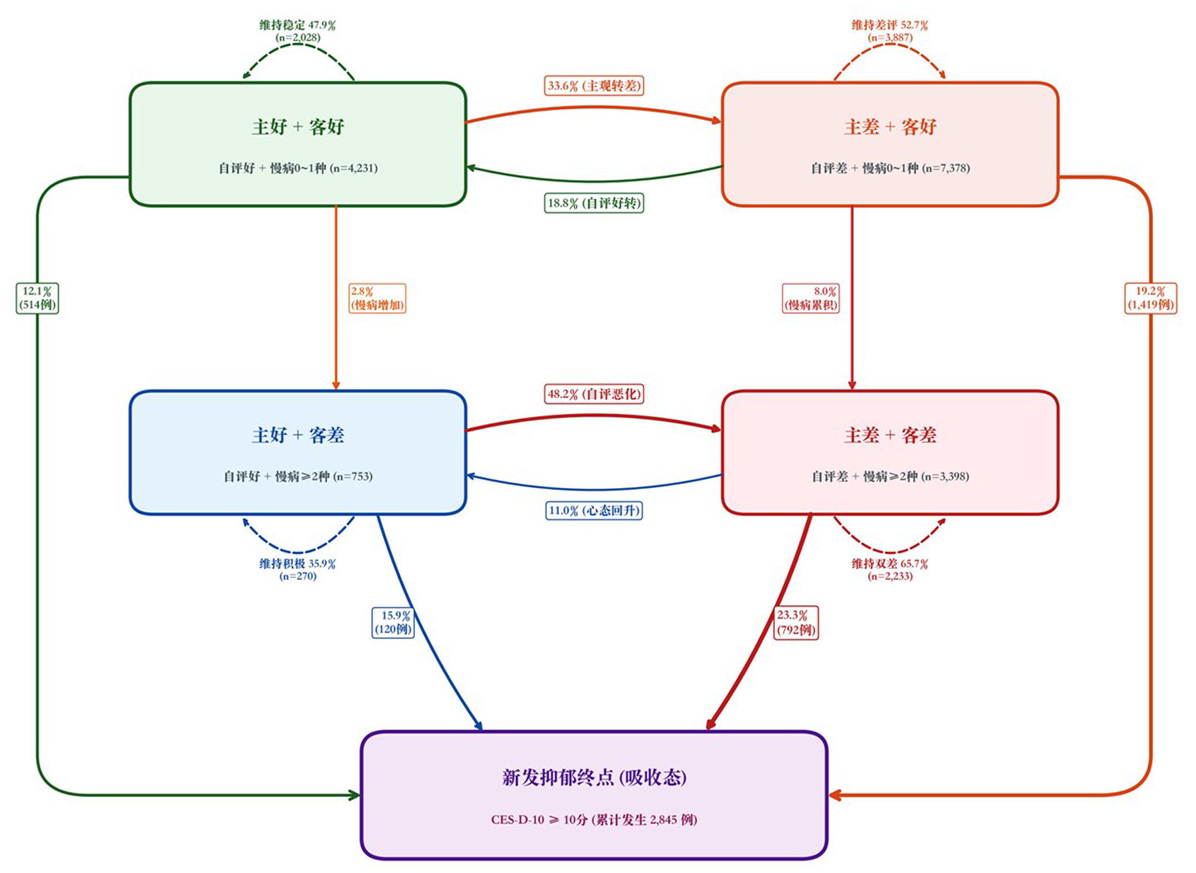
Fig. 3 Multi-state transition diagram of subjective and objective health status in older adults in the CHARLS cohort
| 敏感性检验模型方案 | 人-周期数 | 抑郁事件 | 自评良好- 无共病 | 自评不良-无共病 HR或OR(95%CI) | 自评良好-伴共病 HR或OR(95%CI) | 自评不良-伴共病 HR或OR(95%CI) |
|---|---|---|---|---|---|---|
| 主分析:基准多因素全调整离散生存模型(模型3) | 15 892 | 2 845 | 1.00[参照] | 1.54(1.39~1.71)△ | 1.40(1.14~1.71)# | 2.11(1.88~2.36)△ |
| 敏感性分析1:逆概率加权(IPCW)校正失访与损耗偏倚 | 15 892 | 2 845 | 1.00[参照] | 1.52(1.37~1.69)△ | 1.38(1.12~1.70)# | 2.07(1.84~2.33)△ |
| 敏感性分析2:完全个案分析(排除插补,限制无缺失者) | 13 428 | 2 412 | 1.00[参照] | 1.56(1.40~1.74)△ | 1.39(1.11~1.73)# | 2.13(1.89~2.40)△ |
| 敏感性分析3:排除首个随访波次内事件(滞后排除反向因果) | 9 735 | 2 331 | 1.00[参照] | 1.51(1.34~1.70)△ | 1.37(1.08~1.74)* | 2.08(1.82~2.37)△ |
| 敏感性分析4:提高客观共病切点阈值(重构为累积确诊≥3种慢性病) | 15 892 | 2 845 | 1.00[参照] | 1.53(1.38~1.70)△ | 1.42(1.13~1.79)# | 2.05(1.81~2.32)△ |
| 敏感性分析5:采用Logit连接函数拟合离散时间模型(OR) | 15 892 | 2 845 | 1.00[参照] | 1.58(1.41~1.77)△ | 1.43(1.15~1.77)# | 2.22(1.96~2.52)△ |
Tab. 5 Multiple sensitivity analyses of discrete-time survival models for time-updated discrepancies between subjective and objective health and incident depression in older adults in the CHARLS cohort
| 敏感性检验模型方案 | 人-周期数 | 抑郁事件 | 自评良好- 无共病 | 自评不良-无共病 HR或OR(95%CI) | 自评良好-伴共病 HR或OR(95%CI) | 自评不良-伴共病 HR或OR(95%CI) |
|---|---|---|---|---|---|---|
| 主分析:基准多因素全调整离散生存模型(模型3) | 15 892 | 2 845 | 1.00[参照] | 1.54(1.39~1.71)△ | 1.40(1.14~1.71)# | 2.11(1.88~2.36)△ |
| 敏感性分析1:逆概率加权(IPCW)校正失访与损耗偏倚 | 15 892 | 2 845 | 1.00[参照] | 1.52(1.37~1.69)△ | 1.38(1.12~1.70)# | 2.07(1.84~2.33)△ |
| 敏感性分析2:完全个案分析(排除插补,限制无缺失者) | 13 428 | 2 412 | 1.00[参照] | 1.56(1.40~1.74)△ | 1.39(1.11~1.73)# | 2.13(1.89~2.40)△ |
| 敏感性分析3:排除首个随访波次内事件(滞后排除反向因果) | 9 735 | 2 331 | 1.00[参照] | 1.51(1.34~1.70)△ | 1.37(1.08~1.74)* | 2.08(1.82~2.37)△ |
| 敏感性分析4:提高客观共病切点阈值(重构为累积确诊≥3种慢性病) | 15 892 | 2 845 | 1.00[参照] | 1.53(1.38~1.70)△ | 1.42(1.13~1.79)# | 2.05(1.81~2.32)△ |
| 敏感性分析5:采用Logit连接函数拟合离散时间模型(OR) | 15 892 | 2 845 | 1.00[参照] | 1.58(1.41~1.77)△ | 1.43(1.15~1.77)# | 2.22(1.96~2.52)△ |
| [1] | 黄悦勤, 王向群, 陆林, 等. 中国精神障碍患病率和疾病负担研究[J]. 中华精神科杂志, 2020, 53(5): 348-352. doi: 10.3760/cma.j.cn113661-20200527-00184. |
| [2] | 中国老年保健协会, 北京协和医学院. 中国老年健康研究报告(2020-2021)[M]. 北京: 社会科学文献出版社, 2021: 110-135. |
| [3] |
Jylhä M. What is self-rated health and why does it predict mortality? Towards a unified conceptual model[J]. Soc Sci Med, 2009, 69(3): 307-316. doi: 10.1016/j.socscimed.2009.05.013.
pmid: 19520474 |
| [4] |
Wu S, Wang R, Zhao Y, et al. The relationship between self-rated health and objective health status: A population-based study[J]. BMC Public Health, 2013, 13: 320. doi: 10.1186/1471-2458-13-320.
pmid: 23570559 |
| [5] |
Johnston MC, Crilly M, Black C, et al. Defining and measuring multimorbidity: A systematic review of systematic reviews[J]. Eur J Public Health, 2019, 29(1): 182-189. doi: 10.1093/eurpub/cky098.
pmid: 29878097 |
| [6] |
Pinquart M. Correlates of subjective health in older adults: a meta-analysis[J]. Psychol Aging, 2001, 16(3): 414-426. doi: 10.1037/0882-7974.16.3.414.
pmid: 11554520 |
| [7] |
Zhao Y, Hu Y, Smith JP, et al. Cohort profile: The China Health and Retirement Longitudinal Study (CHARLS)[J]. Int J Epidemiol, 2014, 43(1): 61-68. doi: 10.1093/ije/dys203.
pmid: 23243115 |
| [8] | von Elm E, Altman DG, Egger M, et al. The Strengthening the Reporting of Observational Studies in Epidemiology (STROBE) statement: Guidelines for reporting observational studies[J]. Lancet, 2007, 370(9596): 1453-1457. doi: 10.1016/S0140-6736(07)61602-X. |
| [9] |
Andresen EM, Malmgren JA, Carter WB, et al. Screening for depression in well older adults: Evaluation of a short form of the CES-D (Center for Epidemiologic Studies Depression Scale)[J]. Am J Prev Med, 1994, 10(2): 77-84. doi: 10.1016/S0749-3797(18)30622-6.
pmid: 8037935 |
| [10] |
Chen H, Mui AC. Factorial validity of the Center for Epidemiologic Studies Depression Scale short form in older population in China[J]. Int Psychogeriatr, 2014, 26(1): 49-57. doi: 10.1017/S1041610213001701.
pmid: 24125553 |
| [11] | 中国肥胖问题工作组. 中国成人超重和肥胖症预防与控制指南(节录)[J]. 营养学报, 2004, 26(1):1-4. doi:10.3321/j.issn:0512-7955.2004.01.001. |
| [12] | van Buuren S, Groothuis-Oudshoorn K. Mice: Multivariate imputation by chained equations in R[J]. J Stat Softw, 2011, 45(3): 1-67. doi: 10.18637/jss.v045.i03. |
| [13] |
Prentice RL, Gloeckler LA. Regression analysis of grouped survival data with application to breast cancer data[J]. Biometrics, 1978, 34(1): 57-67. doi: 10.2307/2529588.
pmid: 630037 |
| [14] | McEwen BS. Neurobiological and systemic effects of chronic stress[J]. Chronic Stress (Thousand Oaks), 2017, 1: 1-11. doi: 10.1177/2470547017692328. |
| [15] |
Thayer JF, Sternberg EM. Neural aspects of immunomodulation: Focus on the vagus nerve[J]. Brain Behav Immun, 2010, 24(8): 1223-1230. doi: 10.1016/j.bbi.2010.07.247.
pmid: 20674737 |
| [16] |
Christian LM, Glaser R, Porter K, et al. Poorer self-rated health is associated with elevated inflammatory markers among older adults[J]. Psychoneuroendocrinology, 2011, 36(10): 1495-1504. doi: 10.1016/j.psyneuen.2011.04.003.
pmid: 21601365 |
| [17] |
Miller AH, Raison CL. The role of inflammation in depression: From evolutionary imperative to modern treatment target[J]. Nat Rev Immunol, 2016, 16(1): 22-34. doi: 10.1038/nri.2015.5.
pmid: 26711676 |
| [18] |
Craig AD. How do you feel? Interoception: The sense of the physiological condition of the body[J]. Nat Rev Neurosci, 2002, 3(8): 655-666. doi: 10.1038/nrn894.
pmid: 12154366 |
| [19] | Barsky AJ, Wyshak G. Hypochondriasis and somatosensory amplification[J]. Br J Psychiatry, 1990, 157(3): 404-409. doi: 10.1192/bjp.157.3.404. |
| [20] |
Rief W, Broadbent E. Explaining medically unexplained symptoms-models and mechanisms[J]. Clin Psychol Rev, 2007, 27(7): 821-841. doi: 10.1016/j.cpr.2007.07.005.
pmid: 17716793 |
| [21] |
Albert PR. Why is depression more prevalent in women?[J]. J Psychiatry Neurosci, 2015, 40(4): 219-221. doi: 10.1503/jpn.150205.
pmid: 26107348 |
| [22] |
Pinquart M, Sörensen S. Spouses, adult children, and children-in-law as caregivers of older adults: A meta-analytic comparison[J]. Psychol Aging, 2011, 26(1): 1-14. doi: 10.1037/a0021863.
pmid: 21417538 |
| [23] |
Lachman ME, Weaver SL. The sense of control as a moderator of social class differences in health and well-being[J]. J Pers Soc Psychol, 1998, 74(3): 763-773. doi: 10.1037/0022-3514.74.3.763.
pmid: 9523418 |
| [24] | Silverstein M, Cong Z, Li S. Intergenerational transfers and living arrangements of older people in rural China: Consequences for psychological well-being[J]. J Gerontol B Psychol Sci Soc Sci, 2006, 61(5): S256-S266. doi: 10.1093/geronb/61.5.s256. |
| [25] | Lazarus RS, Folkman S. Stress, appraisal, and coping[M]. New York: Springer Publishing Company, 1984: 117-140. |
| [26] |
Southwick SM, Charney DS. The science of resilience: Implications for the prevention and treatment of depression[J]. Science, 2012, 338(6103): 79-82. doi: 10.1126/science.1222942.
pmid: 23042887 |
| [27] | Steptoe A, Wardle J, Marmot M. Positive affect and health-related neuroendocrine, cardiovascular, and inflammatory processes[J]. Proc Natl Acad Sci U S A, 2005, 102(18): 6508-6512. doi: 10.1073/pnas.0409174102. |
| [28] | Bowling A. Just one question: If one question works, why ask several?[J]. J Epidemiol Community Health, 2005, 59(5): 342-345. doi: 10.1136/jech.2004.021204. |
| [29] | Cuijpers P, Quero S, Dowrick C, et al. Psychological treatment of depression in primary care: Recent developments[J]. Curr Psychiatry Rep, 2019, 21(12): 129. doi: 10.1007/s11920-019-1117-x. |
| [30] | 中华医学会心身医学分会躯体症状及相关障碍学组. 躯体症状障碍多学科诊疗专家共识[J]. 中华精神科杂志, 2024, 57(3): 140-151. doi: 10.3760/cma.j.cn113661-20240115-00018. |
| [1] | Wang Xiaohan, Wang Dongze, Han Bing. Association of inflammatory cell ratios with depressive symptoms and short-term treatment response [J]. Clinical Focus, 2026, 41(10): 891-900. |
| [2] | Hu Ping, Han Bing, Wang Yuping. Diagnosis and management of antidepressant-induced SIADH in a patient with Parkinson's disease and comorbid depression: A case report and insights from integrated psychiatric and neurological care [J]. Clinical Focus, 2026, 41(10): 933-937. |
| [3] | . [J]. Clinical Focus, 2026, 41(5): 457-461. |
| [4] | . [J]. Clinical Focus, 2026, 41(3): 285-288. |
| [5] | Lu Yuansi, Lv Jianjun, Guan Jibin, Cao Longbin. Correlation of serum FGF1 expression with glucose and lipid metabolism in bipolar disorder [J]. Clinical Focus, 2025, 40(7): 619-623. |
| [6] | Lu Xiangxiu, Wang Haiming, Zhang Yijie, Qiu Erxian. Effect of cognitive behavioral therapy on cognitive function in patients with first-episode depressive disorder [J]. Clinical Focus, 2024, 39(4): 320-324. |
| [7] | Yuan Fengying, Ma Xiaoling, Qu Junmin. Effect of agomelatine combined with poker-based entertainment therapy on cognitive function in patients with first-episode major depressive disorder [J]. Clinical Focus, 2024, 39(2): 130-133. |
| [8] | Duan Dengai, Deng Yan, Zhang Zhixiong, Gu Zhanglin. Effect of dialectical behavior therapy combined with sertraline on adolescent depression disorder with non-suicidal self-injury [J]. Clinical Focus, 2023, 38(4): 319-323. |
| [9] | . [J]. Clinical Focus, 2023, 38(1): 75-78. |
| [10] | . [J]. Clinical Focus, 2022, 37(10): 957-960. |
| [11] | Huang Yonglan;Zhang Hua;Chen Zhenhua;Yang Can;Zhu Zhixian. Application of drugs in treatment of 224 bipolar disorder patients [J]. Clinical Focus, 2015, 30(8): 935-937. |
| [12] | ZHAO Yuan-yuan;ZHAO Xiao-chuan;TAN Li;WANG Jin-cheng;JIN Gui-xing. Case-control study on executive function impairment in unipolar and bipolar depressive disorders [J]. Clinical Focus, 2014, 29(7): 769-770774. |
| [13] | ZHAO Peng;YANG Hai-long;SHEN Di-wen;ZHANG Yu-zhe;CAO Qiu-yun. Analysis of new clients from psychiatric clinic in general hospital [J]. CLINICAL FOCUS, 2013, 28(10): 1081-1.08211e+007. |
| [14] | . [J]. CLINICAL FOCUS, 2013, 28(8): 920-922. |
| [15] | HU Rui;WANG Zhi-feng;YOU Dao-feng;LI You-dong;WANG Ran;WANG Lan;WANG Xue-yi. Curative effect observations of paroxetine combined with hyerbaric oxygen in patients of depression with sleep disorders [J]. CLINICAL FOCUS, 2013, 28(6): 630-632. |
| Viewed | ||||||
|
Full text |
|
|||||
|
Abstract |
|
|||||