Clinical Focus ›› 2026, Vol. 41 ›› Issue (9): 812-817.doi: 10.3969/j.issn.1004-583X.2026.09.005
Previous Articles Next Articles
Risk factors and development and validation of a prediction model for vision impairment in middle-aged and older adults: A CHARLS database-based study
Mei Baihao, Li Ying, Yang Xingyu, Gao Zhaoyu( )
School of Nursing ,Mudanjiang Medical University Mudanjiang 157000, China
-
Received:2026-05-20Online:2026-09-20Published:2026-09-17 -
Contact:Gao Zhaoyu E-mail:gzy721031@163.com

CLC Number:
Cite this article
Mei Baihao, Li Ying, Yang Xingyu, Gao Zhaoyu. Risk factors and development and validation of a prediction model for vision impairment in middle-aged and older adults: A CHARLS database-based study[J]. Clinical Focus, 2026, 41(9): 812-817.
share this article
Add to citation manager EndNote|Ris|BibTeX
URL: https://www.lchc.cn/EN/10.3969/j.issn.1004-583X.2026.09.005
| 特征 | 总体(n=19 430) | VI组(n=5 026) | 非VI组(n=14 404) | P值 |
|---|---|---|---|---|
| 性别 | ||||
| 女 男 | 10 262(52.8) 9 168(47.2) | 2 297(45.7) 2 729(54.3) | 7 965(55.3) 6 439(44.7) | <0.001 |
| 年龄 | ||||
| 45~55 | 5 368(27.6) | 1 105(22.0) | 4 263(29.6) | |
| 55~65 | 6 564(33.8) | 1 910(38.0) | 4 654(32.3) | <0.001 |
| ≥65 | 7 498(38.6) | 2 011(40.0) | 5 487(38.1) | |
| 居住地(农村) | ||||
| 否 是 | 7 729(39.8) 11 701(60.2) | 2 647(52.7) 2 379(47.3) | 5 082(35.3) 9 322(64.7) | <0.001 |
| 高血压 | ||||
| 否 是 | 11 973(61.6) 7 441(38.3) | 2 999(59.7) 2 015(40.1) | 8 974(62.3) 5 426(37.7) | <0.001 |
| 糖尿病 | ||||
| 否 是 | 16 924(87.1) 2 488(12.8) | 4 264(84.8) 750(14.9) | 12 660(87.9) 1 738(12.1) | <0.001 |
| 听力状况 | ||||
| 极好 | 2 691(13.8) | 629(12.5) | 2 062(14.3) | |
| 很好 | 9 144(47.1) | 1 787(35.6) | 7 357(51.1) | |
| 一般 | 4 424(22.8) | 1 569(31.2) | 2 855(19.8) | <0.001 |
| 不好 | 2 766(14.2) | 817(16.3) | 1 949(13.5) | |
| 很不好 | 398(2.0) | 224(4.5) | 174(1.2) | |
| 教育水平 | ||||
| 文盲 | 7 703(39.6) | 1 246(24.8) | 6 457(44.8) | |
| 小学 | 5 648(29.1) | 1 462(29.1) | 4 186(29.1) | <0.001 |
| 初中 | 3 897(20.1) | 1 320(26.3) | 2 577(17.9) | |
| 高中及以上 | 2 182(11.2) | 998(19.9) | 1 184(8.2) | |
| 慢性病 | ||||
| 否 是 | 4 038(20.8) 15 385(79.2) | 919(18.3) 4 105(81.7) | 3 119(21.7) 11 280(78.3) | <0.001 |
| 记忆疾病 | ||||
| 否 是 | 18 632(95.9) 779(4.0) | 4 814(95.8) 199(4.0) | 13 818(95.9) 580(4.0) | 0.999 |
| 是否饮酒 | ||||
| 否 是 | 12 871(66.2) 6 544(33.7) | 2 969(59.1) 2 044(40.7) | 9 902(68.7) 4 500(31.2) | <0.001 |
| 是否吸烟 | ||||
| 否 是 | 11 255(57.9) 8 160(42.0) | 2 630(52.3) 2 383(47.4) | 8 625(59.9) 5 777(40.1) | <0.001 |
| 地区 | ||||
| 东部 | 11 224(57.8) | 3 012(59.9) | 8 212(57.0) | |
| 中部 | 5 903(30.4) | 1 418(28.2) | 4 485(31.1) | <0.001 |
| 西部 | 1 484(7.6) | 300(6.0) | 1 184(8.2) | |
| 缺失 | 819(4.2) | 296(5.9) | 523(3.6) |
Tab. 1 Baseline characteristics of the sample (n, %)
| 特征 | 总体(n=19 430) | VI组(n=5 026) | 非VI组(n=14 404) | P值 |
|---|---|---|---|---|
| 性别 | ||||
| 女 男 | 10 262(52.8) 9 168(47.2) | 2 297(45.7) 2 729(54.3) | 7 965(55.3) 6 439(44.7) | <0.001 |
| 年龄 | ||||
| 45~55 | 5 368(27.6) | 1 105(22.0) | 4 263(29.6) | |
| 55~65 | 6 564(33.8) | 1 910(38.0) | 4 654(32.3) | <0.001 |
| ≥65 | 7 498(38.6) | 2 011(40.0) | 5 487(38.1) | |
| 居住地(农村) | ||||
| 否 是 | 7 729(39.8) 11 701(60.2) | 2 647(52.7) 2 379(47.3) | 5 082(35.3) 9 322(64.7) | <0.001 |
| 高血压 | ||||
| 否 是 | 11 973(61.6) 7 441(38.3) | 2 999(59.7) 2 015(40.1) | 8 974(62.3) 5 426(37.7) | <0.001 |
| 糖尿病 | ||||
| 否 是 | 16 924(87.1) 2 488(12.8) | 4 264(84.8) 750(14.9) | 12 660(87.9) 1 738(12.1) | <0.001 |
| 听力状况 | ||||
| 极好 | 2 691(13.8) | 629(12.5) | 2 062(14.3) | |
| 很好 | 9 144(47.1) | 1 787(35.6) | 7 357(51.1) | |
| 一般 | 4 424(22.8) | 1 569(31.2) | 2 855(19.8) | <0.001 |
| 不好 | 2 766(14.2) | 817(16.3) | 1 949(13.5) | |
| 很不好 | 398(2.0) | 224(4.5) | 174(1.2) | |
| 教育水平 | ||||
| 文盲 | 7 703(39.6) | 1 246(24.8) | 6 457(44.8) | |
| 小学 | 5 648(29.1) | 1 462(29.1) | 4 186(29.1) | <0.001 |
| 初中 | 3 897(20.1) | 1 320(26.3) | 2 577(17.9) | |
| 高中及以上 | 2 182(11.2) | 998(19.9) | 1 184(8.2) | |
| 慢性病 | ||||
| 否 是 | 4 038(20.8) 15 385(79.2) | 919(18.3) 4 105(81.7) | 3 119(21.7) 11 280(78.3) | <0.001 |
| 记忆疾病 | ||||
| 否 是 | 18 632(95.9) 779(4.0) | 4 814(95.8) 199(4.0) | 13 818(95.9) 580(4.0) | 0.999 |
| 是否饮酒 | ||||
| 否 是 | 12 871(66.2) 6 544(33.7) | 2 969(59.1) 2 044(40.7) | 9 902(68.7) 4 500(31.2) | <0.001 |
| 是否吸烟 | ||||
| 否 是 | 11 255(57.9) 8 160(42.0) | 2 630(52.3) 2 383(47.4) | 8 625(59.9) 5 777(40.1) | <0.001 |
| 地区 | ||||
| 东部 | 11 224(57.8) | 3 012(59.9) | 8 212(57.0) | |
| 中部 | 5 903(30.4) | 1 418(28.2) | 4 485(31.1) | <0.001 |
| 西部 | 1 484(7.6) | 300(6.0) | 1 184(8.2) | |
| 缺失 | 819(4.2) | 296(5.9) | 523(3.6) |
| 模型名称 | AUC | Accuracy | Precision | Recall(TPR) | F1-Score |
|---|---|---|---|---|---|
| GB | 0.778 | 0.675 | 0.429 | 0.777 | 0.553 |
| LGBM | 0.779 | 0.685 | 0.436 | 0.741 | 0.549 |
| XGB | 0.771 | 0.758 | 0.569 | 0.264 | 0.361 |
| RF | 0.748 | 0.706 | 0.448 | 0.582 | 0.506 |
| CB | 0.773 | 0.716 | 0.466 | 0.667 | 0.549 |
Tab. 2 Comparison of predictive performance among five machine learning models for VI
| 模型名称 | AUC | Accuracy | Precision | Recall(TPR) | F1-Score |
|---|---|---|---|---|---|
| GB | 0.778 | 0.675 | 0.429 | 0.777 | 0.553 |
| LGBM | 0.779 | 0.685 | 0.436 | 0.741 | 0.549 |
| XGB | 0.771 | 0.758 | 0.569 | 0.264 | 0.361 |
| RF | 0.748 | 0.706 | 0.448 | 0.582 | 0.506 |
| CB | 0.773 | 0.716 | 0.466 | 0.667 | 0.549 |
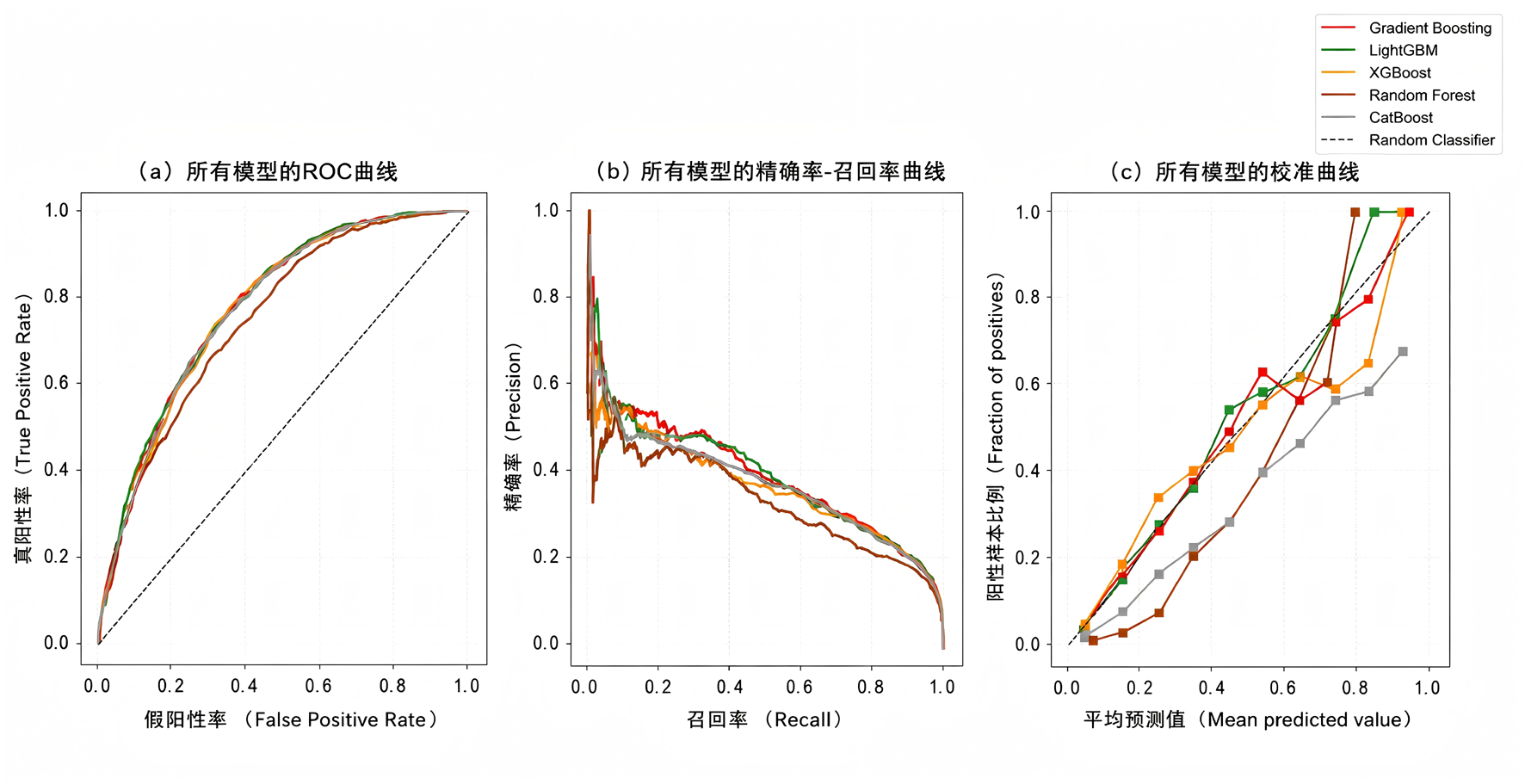
Fig. 1 ROC curves, precision-recall curves, and calibration curves for machine learning models

Fig. 2 SHAP explanation plot
| [1] | World health organization. World report on vision[R]. Geneva: World Health Organization, 2019. |
| [2] | 魏粤晖, 简伟研. 中国老年人社会经济地位与视力障碍的相关性[J]. 北京大学学报(医学版), 2025, 57(6):1136-1144.doi:10.19723/j.issn.1671-167X.2025.06.018. |
| [3] | Cao X, Chen H, Zhou J. Neuropsychological and psychiatric outcomes among community-dwelling young Chinese older adults affected by falls in the past year with and without vision impairment[J]. Qual Life Res, 2024, 33(11): 3057-3067. doi: 10.1007/s11136-024-03751-8. |
| [4] |
Burton MJ, Ramke J, Marques AP, et al. The Lancet Global Health Commission on Global Eye Health: Vision beyond 2020[J]. Lancet Glob Health, 2021, 9(4): e489-e551. doi: 10.1016/S2214-109X(20)30488-5.
pmid: 33607016 |
| [5] | Kyriazos T, Poga M. Application of machine learning models in social sciences: Managing nonlinear relationships[J]. Encycl, 2024, 4(4): 1790-1805. doi: 10.3390/encyclopedia4040118. |
| [6] | 成洪壮, 宁欣如, 郭楚云, 等. 深度学习在视网膜疾病研究中的现状与发展[J]. 眼科新进展, 2025, 45(9):738-746.doi:10.13389/j.cnki.rao.2025.0127. |
| [7] |
Zhao Y, Hu Y, Smith JP, et al. Cohort profile: the China Health and Retirement Longitudinal Study (CHARLS)[J]. Int J Epidemiol, 2014, 43(1): 61-68. doi: 10.1093/ije/dys203.
pmid: 23243115 |
| [8] | Shang X, Zhu Z, Wang W, et al. Associations of vision impairment and eye diseases with memory decline over 4 years in China and the United States[J]. Am J Ophthalmol, 2021, 228: 16-26. doi: 10.1016/j.ajo.2021.03.021. |
| [9] | Zhao Y, Wang A. Development and validation of a risk prediction model for visual impairment in older adults[J]. Int J Nurs Sci, 2023, 10(3): 383-390. doi: 10.1016/j.ijnss.2023.06.010. |
| [10] |
Xiong K, Mao H, Zhang Q, et al. Associations between vision impairment and multimorbidity among older Chinese adults: Results from the China Health and Retirement Longitudinal Study[J]. BMC Geriatrics, 2023, 23(1): 688. doi: 10.1186/s12877-023-04393-0.
pmid: 37875816 |
| [11] | Thornton J, Edwards R, Mitchell P, et al. Smoking and age-related macular degeneration: A review of association[J]. Eye, 2005, 19(9): 935-944. doi: 10.1038/sj.eye.6701978. |
| [12] | Shang X, Wu G, Wang W, et al. Associations of vision impairment and eye diseases with frailty in community-dwelling older adults: A nationwide longitudinal study in China[J]. Br J Ophthalmol, 2024, 108(2): 310-316. doi:10.1136/bjo-2022-322048. |
| [13] | Zheng DD, Lee DJ, Rundek T, et al. Visual impairment and cognitive function in aging adults: Sex and age differences in mediating effect of social isolation and depression[J]. Am J Ophthalmol, 2025, 274: 196-208. doi: 10.1016/j.ajo.2025.02.043. |
| [14] | Nastasi J. The social participation of older adults living with a visual impairment[J]. Phys Occup Ther Geriatr 2019, 37(4): 282-297. doi: 10.1080/02703181.2019.1648625. |
| [15] | Fu Z, Chen C T, Cagnone G, et al. Dyslipidemia in retinal metabolic disorders[J]. EMBO Mol Med, 2019, 11(10): e10473. doi:10.15252/emmm.201910473. |
| [16] | Beretta L, Santaniello A. Nearest neighbor imputation algorithms: A critical evaluation[J]. BMC Med Inform Decis Mak, 2016, 16(Suppl 3): 74. doi:10.1186/s12911-016-0318-z. |
| [17] | Ling Y, Upadhyaya P, Chen L, et al. Emulate randomized clinical trials using heterogeneous treatment effect estimation for personalized treatments: Methodology review and benchmark[J]. J Biomed Inform, 2023, 137: 104256. doi: 10.1016/j.jbi.2022.104256. |
| [18] | Chen X, Liang C, Huang D, et al. Symbolic discovery of optimization algorithms[C]//Advances in Neural Information Processing Systems 36. Red Hook: Curran Associates, Inc, 2023: 49205-49233. |
| [19] | Snoek J, Larochelle H, Adams RP. Practical Bayesian optimization of machine learning algorithms[C]// Advances in Neural Information Processing Systems 25. Red Hook: Curran Associates, Inc, 2012: 2951-2959. |
| [20] | Gao X, Alam S, Shi P, et al. Interpretable machine learning models for hospital readmission prediction: A two-step extracted regression tree approach[J]. BMC Med Inform Decis Mak, 2023, 23(1): 104. doi:10.1186/s12911-023-02193-5. |
| [21] |
Chen J, Yang C, Zheng W, et al. Global, regional, and national epidemiology of visual impairment in working-age individuals, 1990-2019[J]. JAMA Ophthalmol, 2024, 142(1): 25-32. doi:10.1001/jamaophthalmol.2023.5617.
pmid: 38060235 |
| [22] |
Zou M, Guo D, Chen A, et al. Prevalence of visual impairment among older Chinese population: A systematic review and meta-analysis[J]. J Glob Health, 2021, 11: 08004. doi:10.7189/jogh.11.08004.
pmid: 33981412 |
| Viewed | ||||||
|
Full text |
|
|||||
|
Abstract |
|
|||||