
临床荟萃 ›› 2025, Vol. 40 ›› Issue (11): 999-1005.doi: 10.3969/j.issn.1004-583X.2025.11.005
阮鹏, 张能涵, 张春艳, 韩拓, 王聪霞( )
)
收稿日期:2025-09-12
出版日期:2025-11-20
发布日期:2025-12-02
通讯作者:
王聪霞
E-mail:wcx622@163.com
基金资助:
Ruan Peng, Tayyaba Khan, Zhang Nenghan, Zhang Chunyan, Han Tuo, Wang Congxia()
Received:2025-09-12
Online:2025-11-20
Published:2025-12-02
Contact:
Wang Congxia
E-mail:wcx622@163.com
摘要:
目的 探究外源性胰岛素自身免疫综合征(exogenous insulin autoimmune syndrome, EIAS)与糖尿病患者肾脏损害之间的关联性。方法 连续收集2023年6月-2024年3月我院内分泌科收治的具有胰岛素自身抗体(insulin autoantibody, IAA)检测结果的糖尿病患者,根据IAA结果分为对照组与EIAS组,比较2组间临床特征与尿白蛋白肌酐比值(albumin-to-creatinine ratio, ACR);根据ACR 30 mg/g为界值进行分组,比较2组临床特征;采用单因素与多因素logistic回归分析EIAS与ACR升高的关联性。结果 共纳入115例具有IAA检测结果的糖尿病患者,其中EIAS 36例(31.3%)。与对照组相比,EIAS组平均年龄更大、糖尿病病程更长、每日胰岛素用量更高,门冬胰岛素和预混人重组胰岛素制剂使用频率更高(均P<0.05)。EIAS组空腹血糖和糖化血红蛋白水平更低,空腹与餐后2 h胰岛素水平更高,胰岛素抵抗指数升高(均P<0.05)。单因素logistic回归分析显示,EIAS与ACR升高显著相关(OR=2.70, 95%CI: 1.20~6.60, P=0.016)。而在校正年龄、糖尿病病程、胰岛素剂量、肾小球滤过率、空腹血糖、空腹胰岛素及糖化血红蛋白后,关联显著性消失(OR=2.89, 95%CI: 0.95~8.79, P=0.062)。结论 糖尿病合并EIAS患者更易出现血糖波动不稳,胰岛素抵抗与肾脏损害更为严重,临床医师应重视EIAS的筛查与管理。
中图分类号:
阮鹏, 张能涵, 张春艳, 韩拓, 王聪霞. 外源性胰岛素自身免疫综合征与糖尿病肾病关联性分析[J]. 临床荟萃, 2025, 40(11): 999-1005.
Ruan Peng, Tayyaba Khan, Zhang Nenghan, Zhang Chunyan, Han Tuo, Wang Congxia. Association between exogenous insulin autoimmune syndrome and diabetic kidney disease[J]. Clinical Focus, 2025, 40(11): 999-1005.
| 变量 | 总体( | 对照组( | EIAS组( | ||
|---|---|---|---|---|---|
| 年龄(岁) | 51.3±17.6 | 47.1±16.3 | 60.8±17.0 | 17.004 | <0.01 |
| 性别[例(%)] | |||||
| 男性 女性 | 66(57.4) 49(42.6) | 49(62.0) 30(38.0) | 17(47.2) 19(52.8) | 2.216 | 0.137 |
| BMI(kg/m2) | 22.9±3.3 | 22.6±3.2 | 23.5±3.5 | 2.133 | 0.147 |
| 糖尿病类型[例(%)] | |||||
| T1DM | 11(9.6) | 8(10.1) | 3(8.3) | ||
| T2DM | 92(80.0) | 60(75.9) | 32(88.9) | 0.157 | |
| LADA | 12(10.4) | 11(13.9) | 1(2.8) | ||
| 病程(年) | 10.0(2.0, 16.0) | 6.0(1.0, 14.0) | 12.5(7.8, 20.0) | 7.876 | 0.005 |
| 胰岛素剂量(IU) | 27.0(10.0, 42.0) | 20.0(0.0, 38.0) | 36.5(25.5, 49.2) | 11.414 | <0.01 |
| 吸烟史[例(%)] | 43(37.4) | 33(41.8) | 10(27.8) | 2.069 | 0.150 |
| 饮酒史[例(%)] | 20(17.4) | 17(21.5) | 3(8.3) | 2.993 | 0.084 |
| 血小板计数(×109/L) | 222.6±63.6 | 222.8±63.5 | 222.2±64.6 | 0.002 | 0.962 |
| 中性粒细胞计数(×109/L) | 4.0±1.5 | 3.9±1.6 | 4.3±1.3 | 1.216 | 0.272 |
| 单核细胞计数(×109/L) | 0.4±0.1 | 0.4±0.1 | 0.4±0.1 | 0.001 | 0.971 |
| 淋巴细胞计数(×109/L) | 1.7±0.7 | 1.7±0.7 | 1.6±0.7 | 0.451 | 0.503 |
| 谷丙转氨酶(IU/L) | 18.5(13.2, 27.8) | 17.0(13.0, 27.5) | 20.0(15.0, 27.5) | 0.474 | 0.491 |
| 谷草转氨酶(IU/L) | 21.9±12.3 | 21.8±13.8 | 22.1±8.2 | 0.022 | 0.883 |
| 白蛋白(g/L) | 44.6±3.7 | 44.7±3.3 | 44.2±4.5 | 0.486 | 0.487 |
| 血尿酸(μmol/L) | 293.5±101.3 | 287.9±110.0 | 305.6±79.1 | 0.687 | 0.409 |
| 尿素氮(mmol/L) | 5.5±2.1 | 5.5±2.1 | 5.6±2.1 | 0.107 | 0.744 |
| 血肌酐(mmol/L) | 66.0±27.6 | 63.1±28.7 | 72.6±23.9 | 2.951 | 0.089 |
| 肾小球滤过率[ml/(min·1.73 m2)] | 99.6±25.5 | 105.0±25.1 | 87.4±22.2 | 11.983 | <0.01 |
| 总胆固醇(mmol/L) | 4.6±1.6 | 4.8±1.7 | 4.3±1.3 | 1.960 | 0.164 |
| 甘油三酯(mmol/L) | 1.4(1.0, 2.1) | 1.4(1.0, 2.4) | 1.4(0.9, 1.7) | 0.946 | 0.331 |
| 低密度脂蛋白胆固醇(mmol/L) | 1.3±0.3 | 1.3±0.3 | 1.3±0.3 | 0.029 | 0.865 |
| 高密度脂蛋白胆固醇(mmol/L) | 2.7±1.0 | 2.8±1.0 | 2.5±1.0 | 1.275 | 0.261 |
| 空腹血糖(mmol/L) | 11.5±5.3 | 12.4±5.9 | 9.6±3.0 | 7.616 | 0.007 |
| 空腹胰岛素(mU/L) | 4.3(2.1, 14.7) | 2.9(1.3, 6.2) | 13.1(5.4, 35.0) | 22.303 | <0.01 |
| 空腹C肽(ng/ml) | 0.9(0.6, 1.6) | 0.8(0.6, 1.5) | 1.1(0.7, 1.8) | 3.463 | 0.063 |
| 餐后2 h血糖(mmol/L) | 15.1±4.5 | 15.0±4.2 | 15.4±5.2 | 0.109 | 0.742 |
| 餐后2 h胰岛(mU/L) | 10.5(4.5, 20.4) | 8.2(3.6, 14.7) | 19.5(10.8, 41.8) | 14.863 | <0.01 |
| 餐后2 h C肽(ng/ml) | 1.8(1.2, 3.0) | 1.8(0.9, 2.9) | 2.1(1.5, 3.5) | 2.546 | 0.111 |
| 糖化血红蛋白(%) | 9.4±2.3 | 9.9±2.5 | 8.3±1.6 | 13.022 | <0.01 |
| HOMA-IR | 2.3(0.9, 6.1) | 1.8(0.7, 3.6) | 6.1(2.3, 14.2) | 17.133 | <0.01 |
| ACR(mg/g) | 17.1(7.1, 83.5) | 14.8(6.6, 53.9) | 51.8(8.1, 114.6) | 4.034 | 0.045 |
| ACR分级[例(%)] | |||||
| <30 mg/g | 67(58.3) | 52(65.8) | 15(41.7) | ||
| [30, 300) mg/g | 35(30.4) | 20(25.3) | 15(41.7) | 0.051 | |
| ≥300 mg/g | 13(11.3) | 7(8.9) | 6(16.7) |
表1 EIAS组与对照组临床特征比较
Tab.1 Comparison of clinical characteristics between the EIAS group and the control group
| 变量 | 总体( | 对照组( | EIAS组( | ||
|---|---|---|---|---|---|
| 年龄(岁) | 51.3±17.6 | 47.1±16.3 | 60.8±17.0 | 17.004 | <0.01 |
| 性别[例(%)] | |||||
| 男性 女性 | 66(57.4) 49(42.6) | 49(62.0) 30(38.0) | 17(47.2) 19(52.8) | 2.216 | 0.137 |
| BMI(kg/m2) | 22.9±3.3 | 22.6±3.2 | 23.5±3.5 | 2.133 | 0.147 |
| 糖尿病类型[例(%)] | |||||
| T1DM | 11(9.6) | 8(10.1) | 3(8.3) | ||
| T2DM | 92(80.0) | 60(75.9) | 32(88.9) | 0.157 | |
| LADA | 12(10.4) | 11(13.9) | 1(2.8) | ||
| 病程(年) | 10.0(2.0, 16.0) | 6.0(1.0, 14.0) | 12.5(7.8, 20.0) | 7.876 | 0.005 |
| 胰岛素剂量(IU) | 27.0(10.0, 42.0) | 20.0(0.0, 38.0) | 36.5(25.5, 49.2) | 11.414 | <0.01 |
| 吸烟史[例(%)] | 43(37.4) | 33(41.8) | 10(27.8) | 2.069 | 0.150 |
| 饮酒史[例(%)] | 20(17.4) | 17(21.5) | 3(8.3) | 2.993 | 0.084 |
| 血小板计数(×109/L) | 222.6±63.6 | 222.8±63.5 | 222.2±64.6 | 0.002 | 0.962 |
| 中性粒细胞计数(×109/L) | 4.0±1.5 | 3.9±1.6 | 4.3±1.3 | 1.216 | 0.272 |
| 单核细胞计数(×109/L) | 0.4±0.1 | 0.4±0.1 | 0.4±0.1 | 0.001 | 0.971 |
| 淋巴细胞计数(×109/L) | 1.7±0.7 | 1.7±0.7 | 1.6±0.7 | 0.451 | 0.503 |
| 谷丙转氨酶(IU/L) | 18.5(13.2, 27.8) | 17.0(13.0, 27.5) | 20.0(15.0, 27.5) | 0.474 | 0.491 |
| 谷草转氨酶(IU/L) | 21.9±12.3 | 21.8±13.8 | 22.1±8.2 | 0.022 | 0.883 |
| 白蛋白(g/L) | 44.6±3.7 | 44.7±3.3 | 44.2±4.5 | 0.486 | 0.487 |
| 血尿酸(μmol/L) | 293.5±101.3 | 287.9±110.0 | 305.6±79.1 | 0.687 | 0.409 |
| 尿素氮(mmol/L) | 5.5±2.1 | 5.5±2.1 | 5.6±2.1 | 0.107 | 0.744 |
| 血肌酐(mmol/L) | 66.0±27.6 | 63.1±28.7 | 72.6±23.9 | 2.951 | 0.089 |
| 肾小球滤过率[ml/(min·1.73 m2)] | 99.6±25.5 | 105.0±25.1 | 87.4±22.2 | 11.983 | <0.01 |
| 总胆固醇(mmol/L) | 4.6±1.6 | 4.8±1.7 | 4.3±1.3 | 1.960 | 0.164 |
| 甘油三酯(mmol/L) | 1.4(1.0, 2.1) | 1.4(1.0, 2.4) | 1.4(0.9, 1.7) | 0.946 | 0.331 |
| 低密度脂蛋白胆固醇(mmol/L) | 1.3±0.3 | 1.3±0.3 | 1.3±0.3 | 0.029 | 0.865 |
| 高密度脂蛋白胆固醇(mmol/L) | 2.7±1.0 | 2.8±1.0 | 2.5±1.0 | 1.275 | 0.261 |
| 空腹血糖(mmol/L) | 11.5±5.3 | 12.4±5.9 | 9.6±3.0 | 7.616 | 0.007 |
| 空腹胰岛素(mU/L) | 4.3(2.1, 14.7) | 2.9(1.3, 6.2) | 13.1(5.4, 35.0) | 22.303 | <0.01 |
| 空腹C肽(ng/ml) | 0.9(0.6, 1.6) | 0.8(0.6, 1.5) | 1.1(0.7, 1.8) | 3.463 | 0.063 |
| 餐后2 h血糖(mmol/L) | 15.1±4.5 | 15.0±4.2 | 15.4±5.2 | 0.109 | 0.742 |
| 餐后2 h胰岛(mU/L) | 10.5(4.5, 20.4) | 8.2(3.6, 14.7) | 19.5(10.8, 41.8) | 14.863 | <0.01 |
| 餐后2 h C肽(ng/ml) | 1.8(1.2, 3.0) | 1.8(0.9, 2.9) | 2.1(1.5, 3.5) | 2.546 | 0.111 |
| 糖化血红蛋白(%) | 9.4±2.3 | 9.9±2.5 | 8.3±1.6 | 13.022 | <0.01 |
| HOMA-IR | 2.3(0.9, 6.1) | 1.8(0.7, 3.6) | 6.1(2.3, 14.2) | 17.133 | <0.01 |
| ACR(mg/g) | 17.1(7.1, 83.5) | 14.8(6.6, 53.9) | 51.8(8.1, 114.6) | 4.034 | 0.045 |
| ACR分级[例(%)] | |||||
| <30 mg/g | 67(58.3) | 52(65.8) | 15(41.7) | ||
| [30, 300) mg/g | 35(30.4) | 20(25.3) | 15(41.7) | 0.051 | |
| ≥300 mg/g | 13(11.3) | 7(8.9) | 6(16.7) |
| 降糖药物 | 总体( | 对照组( | EIAS组( | χ2值 | |
|---|---|---|---|---|---|
| 门冬胰岛素 | 57(49.6) | 34(43) | 23(63.9) | 4.301 | 0.038 |
| 甘精胰岛素 | 46(40.0) | 28(35.4) | 18(50.0) | 2.184 | 0.139 |
| 赖脯胰岛素 | 8(7.0) | 6(7.6) | 2(5.6) | - | 0.999 |
| 地特胰岛素 | 13(11.3) | 7(8.9) | 6(16.7) | - | 0.223 |
| 德古胰岛素 | 40(34.8) | 31(39.2) | 9(25.0) | 2.211 | 0.137 |
| 预混人胰岛素 | 19(16.5) | 9(11.4) | 10(27.8) | 4.814 | 0.028 |
| 二甲双胍 | 59(51.3) | 43(54.4) | 16(44.4) | 0.987 | 0.320 |
| α糖苷酶抑制剂 | 31(27.0) | 21(26.6) | 10(27.8) | 0.018 | 0.893 |
| 钠-葡萄糖共转运蛋白2抑制剂 | 16(13.9) | 10(12.7) | 6(16.7) | 0.332 | 0.565 |
| 二肽基肽酶4抑制剂 | 13(11.3) | 9(11.4) | 4(11.1) | - | 1.000 |
| 磺脲类 | 5(4.3) | 3(3.8) | 2(5.6) | - | 0.648 |
| 噻唑烷二酮类 | 5(4.3) | 5(6.3) | 0(0.0) | - | 0.323 |
| 胰高血糖素样肽1受体激动剂 | 8(7.0) | 5(6.3) | 3(8.3) | - | 0.704 |
表2 EIAS与对照组降糖药物使用情况[例(%)]
Tab.2 Use of hypoglycemic drugs in the EIAS and control groups(n, %)
| 降糖药物 | 总体( | 对照组( | EIAS组( | χ2值 | |
|---|---|---|---|---|---|
| 门冬胰岛素 | 57(49.6) | 34(43) | 23(63.9) | 4.301 | 0.038 |
| 甘精胰岛素 | 46(40.0) | 28(35.4) | 18(50.0) | 2.184 | 0.139 |
| 赖脯胰岛素 | 8(7.0) | 6(7.6) | 2(5.6) | - | 0.999 |
| 地特胰岛素 | 13(11.3) | 7(8.9) | 6(16.7) | - | 0.223 |
| 德古胰岛素 | 40(34.8) | 31(39.2) | 9(25.0) | 2.211 | 0.137 |
| 预混人胰岛素 | 19(16.5) | 9(11.4) | 10(27.8) | 4.814 | 0.028 |
| 二甲双胍 | 59(51.3) | 43(54.4) | 16(44.4) | 0.987 | 0.320 |
| α糖苷酶抑制剂 | 31(27.0) | 21(26.6) | 10(27.8) | 0.018 | 0.893 |
| 钠-葡萄糖共转运蛋白2抑制剂 | 16(13.9) | 10(12.7) | 6(16.7) | 0.332 | 0.565 |
| 二肽基肽酶4抑制剂 | 13(11.3) | 9(11.4) | 4(11.1) | - | 1.000 |
| 磺脲类 | 5(4.3) | 3(3.8) | 2(5.6) | - | 0.648 |
| 噻唑烷二酮类 | 5(4.3) | 5(6.3) | 0(0.0) | - | 0.323 |
| 胰高血糖素样肽1受体激动剂 | 8(7.0) | 5(6.3) | 3(8.3) | - | 0.704 |
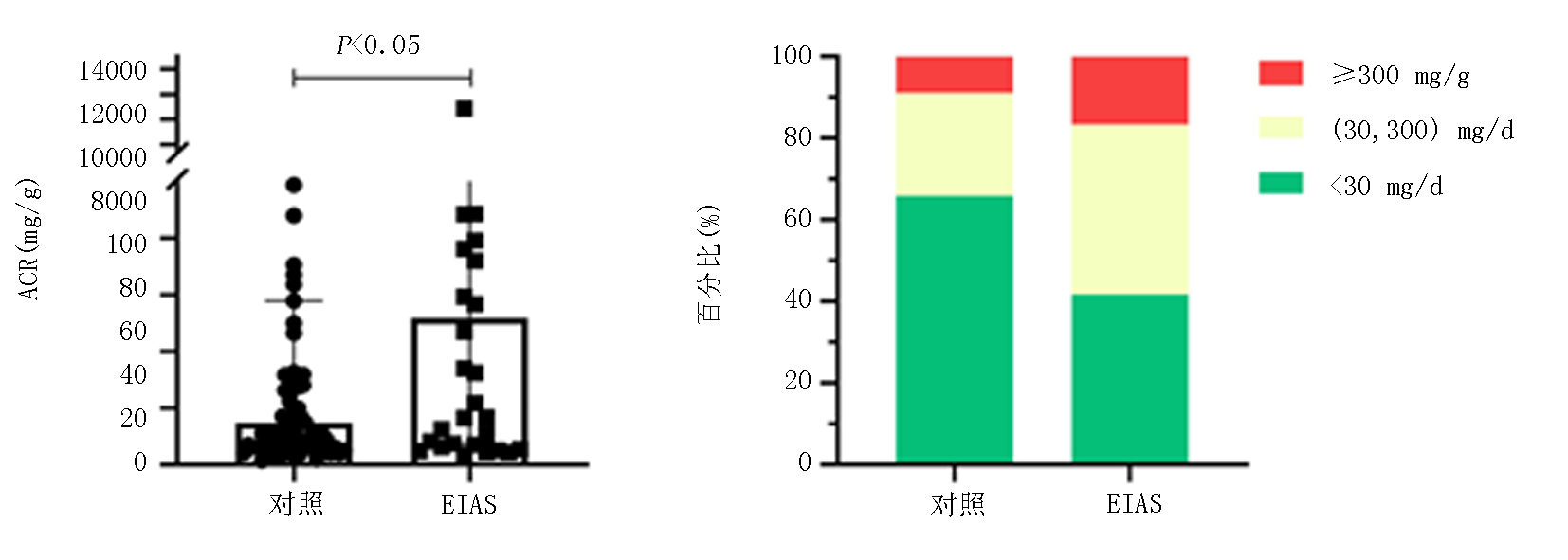
图1 EIAS与对照组ACR水平与分级比较
Fig.1 Comparison of ACR levels and grades between the EIAS group and the control group
| 变量 | 总体( | ACR<30 mg/g( | ACR≥30 mg/g( | ||
|---|---|---|---|---|---|
| 年龄(岁) | 51.3±17.6 | 46.6±16.2 | 57.9±17.6 | 12.530 | <0.01 |
| 性别[例(%)] | |||||
| 男性 女性 | 66(57.4) 49(42.6) | 37(55.2) 30(44.8) | 29(60.4) 19(39.6) | 0.308 | 0.579 |
| BMI(kg/m2) | 22.9±3.3 | 22.7±3.0 | 23.2±3.7 | 0.579 | 0.448 |
| 糖尿病类型[例(%)] | |||||
| T1DM | 11(9.6) | 7(10.4) | 4(8.3) | ||
| T2DM | 92(80.0) | 52(77.6) | 40(83.3) | 0.785 | |
| LADA | 12(10.4) | 8(11.9) | 4(8.3) | ||
| 病程(年) | 10.0(2.0, 16.0) | 7.0(1.0, 12.5) | 10.5(5.0, 20.0) | 7.025 | 0.008 |
| 胰岛素剂量(IU) | 27.0(10.0, 42.0) | 26.0(0.0, 40.5) | 30.0(14.8, 46.2) | 1.543 | 0.214 |
| 吸烟史[例(%)] | 43(37.4) | 23(34.3) | 20(41.7) | 0.643 | 0.423 |
| 饮酒史[例(%)] | 20(17.4) | 12(17.9) | 8(16.7) | 0.030 | 0.862 |
| 血小板计数(×109/L) | 222.6±63.6 | 224.3±68.2 | 220.1±57.0 | 0.122 | 0.728 |
| 中性粒细胞计数(×109/L) | 4.0±1.5 | 3.9±1.6 | 4.2±1.3 | 1.234 | 0.269 |
| 单核细胞计数(×109/L) | 0.4±0.1 | 0.4±0.1 | 0.4±0.1 | 3.659 | 0.058 |
| 淋巴细胞计数(×109/L) | 1.7±0.7 | 1.7±0.6 | 1.8±0.8 | 0.834 | 0.363 |
| 谷丙转氨酶(IU/L) | 18.5(13.2, 27.8) | 19.0(13.0, 26.5) | 17.0(14.0, 28.0) | 0.010 | 1.000 |
| 谷草转氨酶(IU/L) | 21.9±12.3 | 20.2±7.7 | 24.3±16.7 | 3.055 | 0.083 |
| 白蛋白(g/L) | 44.6±3.7 | 45.1±3.1 | 43.9±4.3 | 2.982 | 0.087 |
| 血尿酸(μmol/L) | 293.5±101.3 | 280.7±96.4 | 311.2±106.3 | 2.337 | 0.129 |
| 尿素氮(mmol/L) | 5.5±2.1 | 5.0±1.6 | 6.2±2.5 | 9.870 | 0.002 |
| 血肌酐(mmol/L) | 66.0±27.6 | 60.9±17.0 | 73.3±36.9 | 5.847 | 0.017 |
| 肾小球滤过率[ml/(min·1.73 m2)] | 99.6±25.5 | 105.4±23.0 | 91.6±26.9 | 8.073 | 0.005 |
| 总胆固醇(mmol/L) | 4.6±1.6 | 4.3±1.1 | 5.0±2.0 | 5.989 | 0.016 |
| 甘油三酯(mmol/L) | 1.4(1.0, 2.1) | 1.4(0.9, 1.9) | 1.5(1.1, 2.5) | 1.196 | 0.274 |
| 低密度脂蛋白胆固醇(mmol/L) | 1.3±0.3 | 1.2±0.3 | 1.3±0.3 | 0.511 | 0.476 |
| 高密度脂蛋白胆固醇(mmol/L) | 2.7±1.0 | 2.6±0.9 | 2.9±1.1 | 2.612 | 0.109 |
| 空腹血糖(mmol/L) | 11.5±5.3 | 11.6±5.5 | 11.5±5.2 | 0.006 | 0.938 |
| 空腹胰岛素(mU/L) | 4.3(2.1, 14.7) | 3.2(2.0, 8.4) | 5.6(2.6, 31.9) | 4.781 | 0.029 |
| 空腹C肽(ng/ml) | 0.9(0.6, 1.6) | 0.8(0.6, 1.5) | 1.0(0.6, 1.7) | 0.235 | 0.628 |
| 餐后2 h血糖(mmol/L) | 15.1±4.5 | 15.6±5.1 | 14.4±3.3 | 1.731 | 0.191 |
| 餐后2 h胰岛(mU/L) | 10.5(4.5, 20.4) | 11.1(6.0, 20.1) | 8.7(2.8, 21.2) | 0.258 | 0.612 |
| 餐后2 h C肽(ng/ml) | 1.8(1.2, 3.0) | 2.0(1.3, 3.0) | 1.6(1.0, 3.2) | 0.932 | 0.334 |
| 糖化血红蛋白(%) | 9.4±2.3 | 9.2±2.2 | 9.7±2.5 | 1.125 | 0.291 |
| HOMA-IR | 2.3(0.9, 6.1) | 1.9(0.8, 4.2) | 3.3(1.0, 12.6) | 4.632 | 0.031 |
| ACR(mg/g) | 17.1(7.1, 83.5) | 7.7(5.1, 13.1) | 100.5(58.9, 444.1) | 83.173 | <0.01 |
| EIAS[例(%)] | 36(31.3) | 15(22.4) | 21(43.8) | 5.934 | 0.015 |
表3 不同ACR分级组间临床特征比较
Tab.3 Comparison of clinical characteristics between different ACR subgroups
| 变量 | 总体( | ACR<30 mg/g( | ACR≥30 mg/g( | ||
|---|---|---|---|---|---|
| 年龄(岁) | 51.3±17.6 | 46.6±16.2 | 57.9±17.6 | 12.530 | <0.01 |
| 性别[例(%)] | |||||
| 男性 女性 | 66(57.4) 49(42.6) | 37(55.2) 30(44.8) | 29(60.4) 19(39.6) | 0.308 | 0.579 |
| BMI(kg/m2) | 22.9±3.3 | 22.7±3.0 | 23.2±3.7 | 0.579 | 0.448 |
| 糖尿病类型[例(%)] | |||||
| T1DM | 11(9.6) | 7(10.4) | 4(8.3) | ||
| T2DM | 92(80.0) | 52(77.6) | 40(83.3) | 0.785 | |
| LADA | 12(10.4) | 8(11.9) | 4(8.3) | ||
| 病程(年) | 10.0(2.0, 16.0) | 7.0(1.0, 12.5) | 10.5(5.0, 20.0) | 7.025 | 0.008 |
| 胰岛素剂量(IU) | 27.0(10.0, 42.0) | 26.0(0.0, 40.5) | 30.0(14.8, 46.2) | 1.543 | 0.214 |
| 吸烟史[例(%)] | 43(37.4) | 23(34.3) | 20(41.7) | 0.643 | 0.423 |
| 饮酒史[例(%)] | 20(17.4) | 12(17.9) | 8(16.7) | 0.030 | 0.862 |
| 血小板计数(×109/L) | 222.6±63.6 | 224.3±68.2 | 220.1±57.0 | 0.122 | 0.728 |
| 中性粒细胞计数(×109/L) | 4.0±1.5 | 3.9±1.6 | 4.2±1.3 | 1.234 | 0.269 |
| 单核细胞计数(×109/L) | 0.4±0.1 | 0.4±0.1 | 0.4±0.1 | 3.659 | 0.058 |
| 淋巴细胞计数(×109/L) | 1.7±0.7 | 1.7±0.6 | 1.8±0.8 | 0.834 | 0.363 |
| 谷丙转氨酶(IU/L) | 18.5(13.2, 27.8) | 19.0(13.0, 26.5) | 17.0(14.0, 28.0) | 0.010 | 1.000 |
| 谷草转氨酶(IU/L) | 21.9±12.3 | 20.2±7.7 | 24.3±16.7 | 3.055 | 0.083 |
| 白蛋白(g/L) | 44.6±3.7 | 45.1±3.1 | 43.9±4.3 | 2.982 | 0.087 |
| 血尿酸(μmol/L) | 293.5±101.3 | 280.7±96.4 | 311.2±106.3 | 2.337 | 0.129 |
| 尿素氮(mmol/L) | 5.5±2.1 | 5.0±1.6 | 6.2±2.5 | 9.870 | 0.002 |
| 血肌酐(mmol/L) | 66.0±27.6 | 60.9±17.0 | 73.3±36.9 | 5.847 | 0.017 |
| 肾小球滤过率[ml/(min·1.73 m2)] | 99.6±25.5 | 105.4±23.0 | 91.6±26.9 | 8.073 | 0.005 |
| 总胆固醇(mmol/L) | 4.6±1.6 | 4.3±1.1 | 5.0±2.0 | 5.989 | 0.016 |
| 甘油三酯(mmol/L) | 1.4(1.0, 2.1) | 1.4(0.9, 1.9) | 1.5(1.1, 2.5) | 1.196 | 0.274 |
| 低密度脂蛋白胆固醇(mmol/L) | 1.3±0.3 | 1.2±0.3 | 1.3±0.3 | 0.511 | 0.476 |
| 高密度脂蛋白胆固醇(mmol/L) | 2.7±1.0 | 2.6±0.9 | 2.9±1.1 | 2.612 | 0.109 |
| 空腹血糖(mmol/L) | 11.5±5.3 | 11.6±5.5 | 11.5±5.2 | 0.006 | 0.938 |
| 空腹胰岛素(mU/L) | 4.3(2.1, 14.7) | 3.2(2.0, 8.4) | 5.6(2.6, 31.9) | 4.781 | 0.029 |
| 空腹C肽(ng/ml) | 0.9(0.6, 1.6) | 0.8(0.6, 1.5) | 1.0(0.6, 1.7) | 0.235 | 0.628 |
| 餐后2 h血糖(mmol/L) | 15.1±4.5 | 15.6±5.1 | 14.4±3.3 | 1.731 | 0.191 |
| 餐后2 h胰岛(mU/L) | 10.5(4.5, 20.4) | 11.1(6.0, 20.1) | 8.7(2.8, 21.2) | 0.258 | 0.612 |
| 餐后2 h C肽(ng/ml) | 1.8(1.2, 3.0) | 2.0(1.3, 3.0) | 1.6(1.0, 3.2) | 0.932 | 0.334 |
| 糖化血红蛋白(%) | 9.4±2.3 | 9.2±2.2 | 9.7±2.5 | 1.125 | 0.291 |
| HOMA-IR | 2.3(0.9, 6.1) | 1.9(0.8, 4.2) | 3.3(1.0, 12.6) | 4.632 | 0.031 |
| ACR(mg/g) | 17.1(7.1, 83.5) | 7.7(5.1, 13.1) | 100.5(58.9, 444.1) | 83.173 | <0.01 |
| EIAS[例(%)] | 36(31.3) | 15(22.4) | 21(43.8) | 5.934 | 0.015 |
| 变量 | 单因素回归 | 多因素回归 | |||
|---|---|---|---|---|---|
| 年龄 | 1.04(1.02~1.07) | 0.001 | 1.04(0.99~1.09) | 0.100 | |
| DM病程 | 1.07(1.02~1.12) | 0.005 | 1.06(0.98~1.15) | 0.171 | |
| 胰岛素剂量 | 1.01(0.99~1.03) | 0.253 | 1.00(0.98~1.02) | 0.968 | |
| 肾小球滤过率 | 0.98(0.96~0.99) | 0.008 | 0.98(0.96~1.01) | 0.179 | |
| 空腹血糖 | 1.00(0.93~1.07) | 0.937 | 1.04(0.92~1.16) | 0.549 | |
| 空腹胰岛素 | 1.01(1.00~1.03) | 0.095 | 1.00(0.99~1.01) | 0.923 | |
| 糖化血红蛋白 | 1.09(0.93~1.28) | 0.289 | 1.46(1.10~1.93) | 0.008 | |
| EIAS | 2.70(1.20~6.06) | 0.016 | 2.89(0.95~8.79) | 0.062 | |
表4 ACR升高的单因素与多因素logistic回归分析
Tab.4 Univariate and multivariate logistic regression of ACR elevation
| 变量 | 单因素回归 | 多因素回归 | |||
|---|---|---|---|---|---|
| 年龄 | 1.04(1.02~1.07) | 0.001 | 1.04(0.99~1.09) | 0.100 | |
| DM病程 | 1.07(1.02~1.12) | 0.005 | 1.06(0.98~1.15) | 0.171 | |
| 胰岛素剂量 | 1.01(0.99~1.03) | 0.253 | 1.00(0.98~1.02) | 0.968 | |
| 肾小球滤过率 | 0.98(0.96~0.99) | 0.008 | 0.98(0.96~1.01) | 0.179 | |
| 空腹血糖 | 1.00(0.93~1.07) | 0.937 | 1.04(0.92~1.16) | 0.549 | |
| 空腹胰岛素 | 1.01(1.00~1.03) | 0.095 | 1.00(0.99~1.01) | 0.923 | |
| 糖化血红蛋白 | 1.09(0.93~1.28) | 0.289 | 1.46(1.10~1.93) | 0.008 | |
| EIAS | 2.70(1.20~6.06) | 0.016 | 2.89(0.95~8.79) | 0.062 | |
| [1] | Cappellani D, Macchia E, Falorni A, et al. Insulin autoimmune syndrome(hirata disease): A comprehensive review fifty years after its first description[J]. Diabetes Metab Syndr Obes, 2020, 13:963-978. doi:10.2147/dmso.S219438. |
| [2] |
陈敏, 庄晓明, 窦京涛, 等. 胰岛素自身免疫综合征的临床特征比较分析[J]. 首都医科大学学报, 2012, 33(3):409-413.
doi: 10.3969/j.issn.1006-7795.2012.03.026 |
| [3] |
Uchigata Y, Omori Y, Nieda M, et al. HLA-DR4 genotype and insulin-processing in insulin autoimmune syndrome[J]. Lancet, 1992, 340(8833):1467. doi:10.1016/0140-6736(92)92654-x.
pmid: 1360579 |
| [4] | Jain N, Savani M, Agarwal M, et al. Methimazole-induced insulin autoimmune syndrome[J]. Ther Adv Endocrinol Metab, 2016, 7(4):178-181. doi:10.1177/2042018816658396. |
| [5] | 刘莉, 张木勋, 邵诗颖. 胰岛素自身免疫综合征1例诊治报告及文献复习[J]. 华中科技大学学报(医学版), 2018, 47(3):361-364. |
| [6] |
Shen Y, Song X, Ren Y. Insulin autoimmune syndrome induced by exogenous insulin injection: A four-case series[J]. BMC Endocr Disord, 2019, 19(1):148. doi:10.1186/s12902-019-0482-0.
pmid: 31883520 |
| [7] | 史晓伟, 王晓霞, 张定华, 等. 外源性胰岛素自身免疫综合征患者临床特征五例报道[J]. 中国糖尿病杂志, 2021, 29(11):850-854. |
| [8] |
Li Z, Yi D, Zheng L, et al. Analysis of the clinical characteristics of insulin autoimmune syndrome induced by exogenous insulin in diabetic patients[J]. Diabetol Metab Syndr, 2021, 13(1):38. doi:10.1186/s13098-021-00658-z.
pmid: 33827670 |
| [9] | Committee ADAPP. 2. Classification and diagnosis of diabetes: Standards of medical care in diabetes-2022[J]. Diabetes Care, 2022, 45(Suppl 1):S17-s38. doi:10.2337/dc22-S002. |
| [10] |
Buzzetti R, Tuomi T, Mauricio D, et al. Management of latent autoimmune diabetes in adults: A consensus statement from an international expert panel[J]. Diabetes, 2020, 69(10):2037-2047. doi:10.2337/dbi20-0017.
pmid: 32847960 |
| [11] | Tahapary DL, Pratisthita LB, Fitri NA, et al. Challenges in the diagnosis of insulin resistance: Focusing on the role of HOMA-IR and tryglyceride/glucose index[J]. Diabetes Metab Syndr, 2022, 16(8):102581. doi:10.1016/j.dsx.2022.102581. |
| [12] | Wu HY, Peng YS, Chiang CK, et al. Diagnostic performance of random urine samples using albumin concentration vs ratio of albumin to creatinine for microalbuminuria screening in patients with diabetes mellitus: A systematic review and meta-analysis[J]. JAMA Intern Med, 2014, 174(7):1108-1115. doi:10.1001/jamainternmed.2014.1363. |
| [13] |
Censi S, Mian C, Betterle C. Insulin autoimmune syndrome: From diagnosis to clinical management[J]. Ann Transl Med, 2018, 6(17):335. doi:10.21037/atm.2018.07.32.
pmid: 30306074 |
| [14] | Liu Y, Ping F, Yu J, et al. Hypoglycemia caused by exogenous insulin antibody syndrome: A large single-center case series from China[J]. J Clin Endocrinol Metab, 2023, 108(3):713-717. doi:10.1210/clinem/dgac578. |
| [15] | 杨彩彩, 谷伟军, 吕朝晖, 等. 19例胰岛素自身免疫综合征的临床特点分析并文献复习[J]. 解放军医学院学报, 2020, 41(6):583-587. |
| [16] | Yamada Y, Kitayama K, Oyachi M, et al. Nationwide survey of endogenous hyperinsulinemic hypoglycemia in Japan(2017-2018): Congenital hyperinsulinism, insulinoma, non-insulinoma pancreatogenous hypoglycemia syndrome and insulin autoimmune syndrome(Hirata's disease)[J]. J Diabetes Investig, 2020, 11(3):554-563. doi:10.1111/jdi.13180. |
| [17] | Woo CY, Jeong JY, Jang JE, et al. Clinical features and causes of endogenous hyperinsulinemic hypoglycemia in Korea[J]. Diabetes Metab J, 2015, 39(2):126-131. doi:10.4093/dmj.2015.39.2.126. |
| [18] | 伊丽努尔·阿德尔江, 高静. 糖尿病患者胰岛素/C肽比值与胰岛素抗体的相关性研究[J]. 新疆医学, 2023, 53(8):907-911. |
| [19] |
Yuan T, Li J, Li M, et al. Insulin autoimmune syndrome diagnosis and therapy in a single chinese center[J]. Clin Ther, 2019, 41(5):920-928. doi:10.1016/j.clinthera.2019.03.009.
pmid: 30992145 |
| [20] |
Marzinotto I, Pittman DL, Williams AJK, et al. Islet autoantibody standardization program: Interlaboratory comparison of insulin autoantibody assay performance in 2018 and 2020 workshops[J]. Diabetologia, 2023, 66(5):897-912. doi:10.1007/s00125-023-05877-9.
pmid: 36759347 |
| [21] | 陈煦阳, 顾卫琼. 胰岛素自身抗体临床检测应用局限及对策研究进展[J]. 诊断学理论与实践, 2022, 21(1):95-98. doi:10.16150/j.1671-2870.2022.01.018. |
| [22] | 蒋雪松, 李佳. 外源性胰岛素自身免疫综合征合并线粒体糖尿病1例并文献复习[J]. 解放军医学院学报, 2024:1-5. |
| [23] |
Li R, Mao J, Yu K, et al. Medical nutrition therapy is effective in the management of hypoglycemia caused by insulin antibodies: A case report and literature review[J]. J Am Coll Nutr, 2016, 35(1):86-90. doi:10.1080/07315724.2014.976673.
pmid: 26273793 |
| [24] | Boro H, Gupta U, Singh C, et al. Continuous glucose monitoring and rituximab treatment in insulin autoimmune syndrome[J]. Diabetes Metab Syndr, 2021, 15(6):102294. doi:10.1016/j.dsx.2021.102294. |
| [25] | Monteiro SS, Santos TS, Dores J. Novel management of insulin autoimmune syndrome with methylprednisolone and flash glucose monitoring[J]. Ann Endocrinol (Paris), 2023, 84(1):83-85. doi:10.1016/j.ando.2022.10.001. |
| [1] | 刘胜华. 胰岛素抵抗代谢评分对原发性高血压患者并发主动脉弓钙化的预测价值[J]. 临床荟萃, 2025, 40(7): 589-594. |
| [2] | 吕莎莎, 宋金兰, 石健. m.3243A>G突变相关线粒体糖尿病1例并文献复习[J]. 临床荟萃, 2024, 39(2): 160-163. |
| [3] | 李佳文, 刘艳兰, 李瑶霜, 邱慧娜, 李芳, 毋帆, 林辰莹, 林静娜. 2型糖尿病患者TyG指数及其衍生指数与糖尿病肾病风险的相关性[J]. 临床荟萃, 2024, 39(10): 901-908. |
| [4] | 江黎晨, 章秋, 胡红琳. Apelin在多囊卵巢综合征中的研究进展[J]. 临床荟萃, 2023, 38(3): 285-288. |
| [5] | 韩拓, 王丽霞, 王怡雯, 李盈, 巩红, 张春艳, 张岩, 李永勤, 王聪霞. 健康人群中膳食营养素摄入与血糖及胰岛素抵抗相关性分析[J]. 临床荟萃, 2023, 38(2): 126-131. |
| [6] | 任玉梅, 章秋, 胡红琳. 多囊卵巢综合征患者血清S100A4水平变化及其对多囊卵巢综合征的影响[J]. 临床荟萃, 2023, 38(12): 1078-1085. |
| [7] | 张上仕, 朱红艳, 李楠, 陈鹰熙. 冠心病合并2型糖尿病患者冠状动脉病变与胰岛素抵抗的相关性分析[J]. 临床荟萃, 2023, 38(1): 46-49. |
| [8] | 高士欣, 宋冰, 施克新. 血清脂蛋白α、胱抑素-C和尿酸检测对早期糖尿病肾病的诊断价值[J]. 临床荟萃, 2022, 37(3): 248-252. |
| [9] | 齐琪, 江黎晨, 孙蓉, 胡红琳, 章秋. 妊娠中晚期孕妇血清Gremlin1水平变化及其对妊娠期糖尿病的影响[J]. 临床荟萃, 2022, 37(3): 257-261. |
| [10] | 徐海凤,赵猛. 2型糖尿病患者甲状腺结节的危险因素分析[J]. 临床荟萃, 2020, 35(3): 242-244. |
| [11] | 吕雪, 方琨, 郝文卿, 韩玉鑫, 杨乃龙. 不同人群持续性高胰岛素血症的相关危害及其应对策略[J]. 临床荟萃, 2020, 35(12): 1120-1125. |
| [12] | 杨毕,童宗武,卢永新. 慢性肾脏病患者胰岛素抵抗的研究进展[J]. 临床荟萃, 2018, 33(9): 821-824. |
| [13] | 谷晓岚1,张德龙2,牛敏1,高政南1,付红军1,卢林娜1. 甲状腺功能正常的非糖尿病人群甲状腺激素水平与胰岛素抵抗的关系[J]. 临床荟萃, 2018, 33(2): 111-114. |
| [14] | 高燕1, 李林倩2, 王倩2,张思2,张海松1. 肝细胞因子在糖尿病肾病发病中的作用[J]. 临床荟萃, 2018, 33(10): 859-862. |
| [15] | 魏新亮,魏思忱,田树英,孔郁,王卫卫,姜红玉. 肝硬化患者血清网膜素、脂联素的表达及其相关性分析[J]. 临床荟萃, 2016, 31(12): 1313-1317. |
| 阅读次数 | ||||||
|
全文 |
|
|||||
|
摘要 |
|
|||||
