临床荟萃 ›› 2026, Vol. 41 ›› Issue (7): 590-595.doi: 10.3969/j.issn.1004-583X.2026.07.002

• 论著 • 上一篇    下一篇

心电图参数联合血清NT-proBNP、25-OH-VitD3水平预测慢性心力衰竭患者主要心血管不良事件的价值

李慧丹(), 睢国鑫, 赵娟, 杨涛   

  1. 新乡市第一人民医院 心血管内科, 河南 新乡 453000
  • 收稿日期:2026-04-24 出版日期:2026-07-20 发布日期:2026-07-17
  • 通讯作者: 李慧丹,Email: lihuidan584126@126.com

Value of electrocardiographic parameters combined with serum NT-proBNP and 25-OH-VitD3 levels in predicting major adverse cardiovascular events in patients with chronic heart failure

Li Huidan(), Sui Guoxin, Zhao Juan, Yang Tao   

  1. Department of Cardiology, Xinxiang First People's Hospital, Xinxiang 453000, China
  • Received:2026-04-24 Online:2026-07-20 Published:2026-07-17
  • Contact: Li Huidan,Email: lihuidan584126@126.com

摘要:

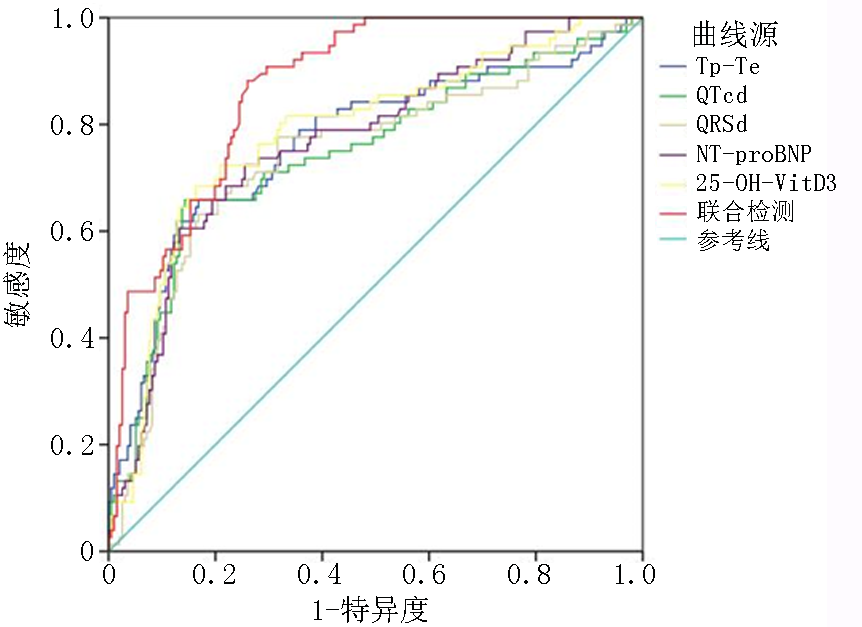
目的 研究心电图参数联合血清N末端脑钠肽前体(NT-proBNP)、25-羟维生素D3(25-OH-VitD3)水平预测慢性心力衰竭(CHF)患者主要心血管不良事件(MACE)的价值。方法 回顾性队列研究,收集2022年11月-2024年11月新乡市第一人民医院心血管内科收治的272例CHF患者的病例资料,根据随访12个月内是否发生MACE分为MACE组(n=76)及无MACE组(n=196),比较两组基线资料、入院当天心电图参数[T波峰末间期(Tp-Te)、校正Q-T间期离散度(QTcd)及QRS波时程(QRSd)]、血清NT-proBNP、25-OH-VitD3水平,通过构建多因素logistic回归模型分析上述指标预测发生MACE的价值。结果 MACE组年龄及心功能分级为Ⅲ~Ⅳ级占比、Tp-Te、QTcd、QRSd、血清NT-proBNP均高于无MACE组(P<0.05),25-OH-VitD3低于无MACE组(P<0.05)。多因素logistic回归分析结果显示:高Tp-Te、高QTcd、高QRSd、高水平NT-proBNP、低水平25-OH-VitD3是CHF患者随访12个月内发生MACE的独立危险因素(P<0.05)。Tp-Te、QTcd、QRSd、血清NT-proBNP、25-OH-VitD3水平联合预测发生MACE的效能最高,预测敏感度为88.16%,特异度为73.98%。结论 CHF患者心电图参数Tp-Te、QTcd、QRSd、血清NT-proBNP、25-OH-VitD3水平均可作为预测其发生MACE的有效指标,且五指标构建的logistic回归模型联合预测效能更高。

关键词: 心力衰竭, 心电图参数, 主要心血管不良事件, N末端脑钠肽前体, 25-羟维生素D3

Abstract:

Objective To investigate the value of electrocardiographic parameters combined with serum N-terminal pro-brain natriuretic peptide (NT-proBNP) and 25-hydroxyvitamin D3 (25-OH-VitD3) levels in predicting major adverse cardiovascular events (MACE) in patients with chronic heart failure (CHF). Methods This retrospective cohort study included the medical records of 272 patients with CHF admitted to the Department of Cardiology, Xinxiang First People’s Hospital, from November 2022 to November 2024. According to whether MACE occurred within 12 months of follow-up, patients were divided into a MACE group (n=76) and a non-MACE group (n=196). Baseline characteristics, electrocardiographic parameters on the day of admission (T wave peak-to-end interval [Tp-Te], corrected QT dispersion [QTcd], and QRS duration [QRSd]), and serum NT-proBNP and 25-OH-VitD3 levels were compared between the two groups. A multivariable logistic regression model was constructed to analyze the predictive value of these indicators for MACE occurrence. Results Compared with the non-MACE group, the MACE group had higher age, a higher proportion of patients with cardiac function grade Ⅲ-Ⅳ, and higher Tp-Te, QTcd, QRSd, and serum NT-proBNP levels (P<0.05), as well as lower 25-OH-VitD3 levels (P<0.05). Multivariable logistic regression analysis showed that higher Tp-Te, higher QTcd, higher QRSd, higher NT-proBNP levels, and lower 25-OH-VitD3 levels were independent risk factors for MACE within 12 months in patients with CHF (P<0.05). The combined prediction model using Tp-Te, QTcd, QRSd, serum NT-proBNP, and 25-OH-VitD3 achieved the highest predictive performance for MACE, with a sensitivity of 88.16% and a specificity of 73.98%. Conclusion Electrocardiographic parameters Tp-Te, QTcd, and QRSd, along with serum NT-proBNP and 25-OH-VitD3 levels, can serve as effective indicators for predicting MACE in patients with CHF. The logistic regression model constructed from these five indicators provides superior combined predictive performance.

Key words: heart failure, electrocardiogram parameters, major cardiovascular adverse events, N-terminal pro-brain natriuretic peptide, 25-hydroxyvitamin D3

中图分类号: