临床荟萃 ›› 2026, Vol. 41 ›› Issue (4): 312-317.doi: 10.3969/j.issn.1004-583X.2026.04.004

• 论著 • 上一篇    下一篇

终末期维持性血液透析患者营养不良-炎症复合综合征发生情况及其危险因素

姜少利1(), 闫国胜2, 李丽丽3   

  1. 1.黄河科技学院附属医院 肾内科/血液净化室,河南 郑州 450000
    2.河南省人民医院 血液净化中心,河南 郑州 450000
    3.郑州市第六人民医院 血液净化室,河南 郑州 450000
  • 收稿日期:2026-03-05 出版日期:2026-04-20 发布日期:2026-04-24
  • 通讯作者: 姜少利,Email: jsl165042@126.com

Incidence and risk factors of malnutrition-inflammation complex syndrome in patients receiving maintenance hemodialysis at the end stage of renal disease

Jiang Shaoli1(), Yan Guosheng2, Li Lili3   

  1. 1. Department of Nephrology (Blood Purification Room),Huanghe ST College Affiliated Hospital, Zhengzhou 450000,China
    2. Blood Purification Center,Henan Provincial People's Hospital, Zhengzhou 450000,China
    3. Blood Purification Room,the Sixth People's Hospital of Zhengzhou, Zhengzhou 450000,China
  • Received:2026-03-05 Online:2026-04-20 Published:2026-04-24
  • Contact: Jiang Shaoli,Email: jsl165042@126.com

摘要:

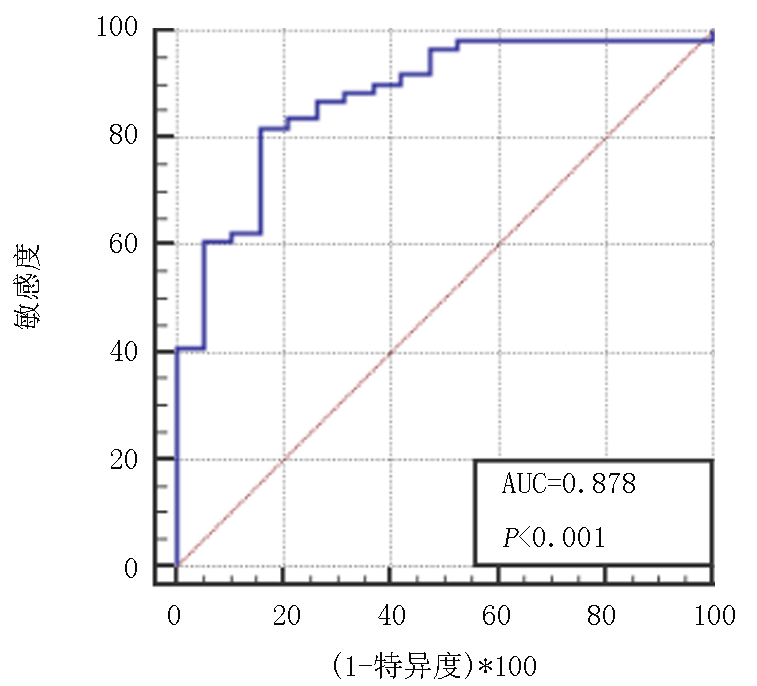
目的 探讨终末期维持性血液透析(maintenance hemodialysis,MHD)患者营养不良-炎症复合综合征(malnutrition-inflammation complex syndrome,MICS)发生情况,并分析其相关危险因素,为临床防治MICS提供理论依据。方法 回顾性分析2022年7月-2025年7月于黄河科技学院附属医院与河南省人民医院接受终末期MHD治疗的108例患者的临床资料,根据MICS发生情况将其分为MICS组和非MICS组。收集两组一般资料、透析资料、实验室检查指标等相关数据,采用单因素分析比较两组差异,多因素logistic回归模型筛选并发症独立危险因素。结果 共接受终末期MHD治疗的患者108例,MICS组74例(68.5%),非MICS组34例(31.5%)。两组一般资料比较,MICS组年龄、合并糖尿病例数高于非MICS组(P<0.05);两组透析相关指标比较,MICS组透析龄高于非MICS组(P<0.05);两组实验室指标比较,MICS组白蛋白(albumin,Alb)、血红蛋白均低于非MICS组(P<0.05),超敏C反应蛋白(high-sensitivity C-reactive protein,hs-CRP)、白细胞介素-6均高于非MICS组(P<0.05)。以终末期MHD治疗后是否发生MICS为因变量(未发生=0,发生=1),将单因素分析差异具有统计学意义的项目作为自变量进行赋值纳入模型,经多因素logistic回归分析发现,年龄≥65岁、透析龄≥3年、Alb<35 g/L、hs-CRP≥10 mg/L均为影响终末期MHD发生MICS的独立危险因素(P<0.05)。依据多因素logistic回归输出结果,建立终末期MHD发生MICS的预测模型,Y=0.659×年龄+0.435×透析龄+0.578×Alb+0.701×hs-CRP-6.583,ROC曲线分析结果显示,该模型预测终末期MHD发生MICS的曲线下面积为0.878,特异度为86.50%,敏感度为75.69%。结论 终末期MHD患者MICS发生率较高,达68.52%。高龄、长期透析、低血清Alb及高炎症指标是其发生的独立危险因素,据此构建的预测模型具有较高的预测效能。

关键词: 肾功能衰竭, 慢性, 终末期肾病, 维持性血液透析, 营养不良-炎症复合综合征, 危险因素

Abstract:

Objective To investigate the incidence of malnutrition-inflammation complex syndrome (MICS) in patients with end-stage renal disease receiving maintenance hemodialysis (MHD) and to analyze its associated risk factors, thereby providing a theoretical basis for the clinical prevention and treatment of MICS. Methods A retrospective analysis was performed on the clinical data of 108 patients who received end-stage MHD at Huanghe S&T College Affiliated Hospital and Henan Provincial People's Hospital from July 2022 to July 2025. According to the occurrence of MICS, the patients were divided into a MICS group and a non-MICS group. General data, dialysis-related data, and laboratory indicators were collected from both groups. Differences between the two groups were compared by univariate analysis, and independent risk factors were identified using a multivariate logistic regression model. Results Among the 108 patients receiving end-stage MHD, 74 were in the MICS group (68.5%) and 34 in the non-MICS group (31.5%). In terms of baseline characteristics, the MICS group was older and had a higher prevalence of diabetes mellitus than the non-MICS group (P<0.05). Regarding dialysis-related indicators, dialysis vintage was longer in the MICS group than in the non-MICS group (P<0.05). For laboratory indicators, the MICS group had lower albumin (Alb) and hemoglobin levels, but higher high-sensitivity C-reactive protein (hs-CRP) and interleukin-6 levels than the non-MICS group (P<0.05). With the occurrence of MICS after end-stage MHD as the dependent variable (no=0, yes=1), variables with statistically significant differences in univariate analysis were assigned and included as independent variables in the model. Multivariate logistic regression showed that age ≥65 years, dialysis vintage ≥3 years, Alb <35 g/L, and hs-CRP ≥10 mg/L were independent risk factors for MICS in patients receiving end-stage MHD (P<0.05). Based on the multivariate logistic regression output, a prediction model for MICS in end-stage MHD was established: Y=0.659×age+0.435×dialysis vintage+0.578×Alb+0.701×hs-CRP-6.583. Receiver operating characteristic (ROC) curve analysis showed that the area under the curve (AUC) of this model for predicting MICS in end-stage MHD was 0.878, with a specificity of 86.50% and a sensitivity of 75.69%. Conclusion The incidence of MICS in patients receiving end-stage MHD is high, reaching 68.52%. Advanced age, prolonged dialysis duration, low serum Alb, and elevated inflammatory markers are independent risk factors. The prediction model constructed on this basis demonstrates good predictive performance.

Key words: kidney failure, chronic, end-stage renal disease, maintenance hemodialysis, malnutrition-inflammation complex syndrome, risk factors

中图分类号: