
临床荟萃 ›› 2026, Vol. 41 ›› Issue (9): 773-786.doi: 10.3969/j.issn.1004-583X.2026.09.001
• 循证研究 • 下一篇
李永婧, 苏怀义, 王鑫源, 张金龙, 宋淑华( )
收稿日期:2026-01-22
出版日期:2026-09-20
发布日期:2026-09-17
通讯作者:
宋淑华
E-mail:1057955454@qq.com
基金资助:
Li Yongjing, Su Huaiyi, Wang Xinyuan, Zhang Jinlong, Song Shuhua()
Received:2026-01-22
Online:2026-09-20
Published:2026-09-17
Contact:
Song Shuhua
E-mail:1057955454@qq.com
摘要:
目的 通过传统meta与网状meta分析对不同运动改善青少年抑制、认知灵活性及工作记忆疗效进行对比。方法 全面检索CNKI、万方、维普、百度学术、Web of science、PubMed、Science Direct数据库,检索时限为从建库至2025-12-01。利用Review Manager 5.4、Stata 18软件进行传统meta、网状meta分析。结果 共纳入15项随机对照试验,包含17 289名青少年,有氧运动、抗阻运动、认知体能游戏、高强度间歇训练及多模式运动5项。亚组分析显示,20 min/次低剂量运动较对照组在改善青少年抑制功能方面差异有统计学意义[SMD=0.29,95%CI=(0.01,0.58)];45 min/次中等剂量较对照组在改善青少年认知灵活性方面差异有统计学意义[SMD=1.15,95%CI=(0.14,2.15)];4次/周的干预频率[SMD=1.52,95%CI=(0.56,2.48)]、共10~12周[SMD=0.66,95%CI=(0.04,1.29)]较对照组在改善青少年工作记忆方面差异有统计学意义。网状meta分析显示:①运动类型对青少年抑制功能改善效果排名:认知体能游戏(SUCRA=98.7%)>抗阻运动(SUCRA=77.8%)>有氧运动(SUCRA=51.9%)>多模式运动(SUCRA=34.0%)>无干预(SUCRA=30.1%)>高强度间歇训练(SUCRA=7.5%),且认知体能游戏较有氧运动[SMD=2.96,95%CI=(0.74,5.19)]、多模式运动[SMD=3.47,95%CI=(1.63,5.32)]、无干预[SMD=3.56,95%CI=(1.70,5.41)]、高强度间歇训练[SMD=4.38,95%CI=(2.06,6.71)]差异有统计学意义;②运动类型对青少年认知灵活性改善效果排名:有氧运动(SUCRA=83.5%)>认知体能游戏(SUCRA=59.3%)>多模式运动(SUCRA=44.9%)>高强度间歇训练(SUCRA=21.1%);③运动类型对青少年工作记忆改善效果排名:有氧运动(SUCRA=71.1%)>高强度间歇训练(SUCRA=61.1%)>多模式运动(SUCRA=57.3%)>抗阻运动(SUCRA=21.5%)。结论 认知体能游戏在改善抑制功能方面表现出优势,有氧运动在提升青少年认知灵活性及工作记忆方面效果排于首位。干预剂量方面,20 min/次的低剂量对青少年抑制功能改善呈现正向效应趋势,45 min/次的中等剂量对青少年认知灵活性干预效果显著,且每周4次、为期10~12周的中长期干预能显著提升青少年工作记忆。
中图分类号:
李永婧, 苏怀义, 王鑫源, 张金龙, 宋淑华. 不同运动类型改善青少年抑制、认知灵活性及工作记忆疗效的网状meta分析[J]. 临床荟萃, 2026, 41(9): 773-786.
Li Yongjing, Su Huaiyi, Wang Xinyuan, Zhang Jinlong, Song Shuhua. Network meta-analysis of the effects of different exercise types on inhibition, cognitive flexibility, and working memory in adolescents[J]. Clinical Focus, 2026, 41(9): 773-786.
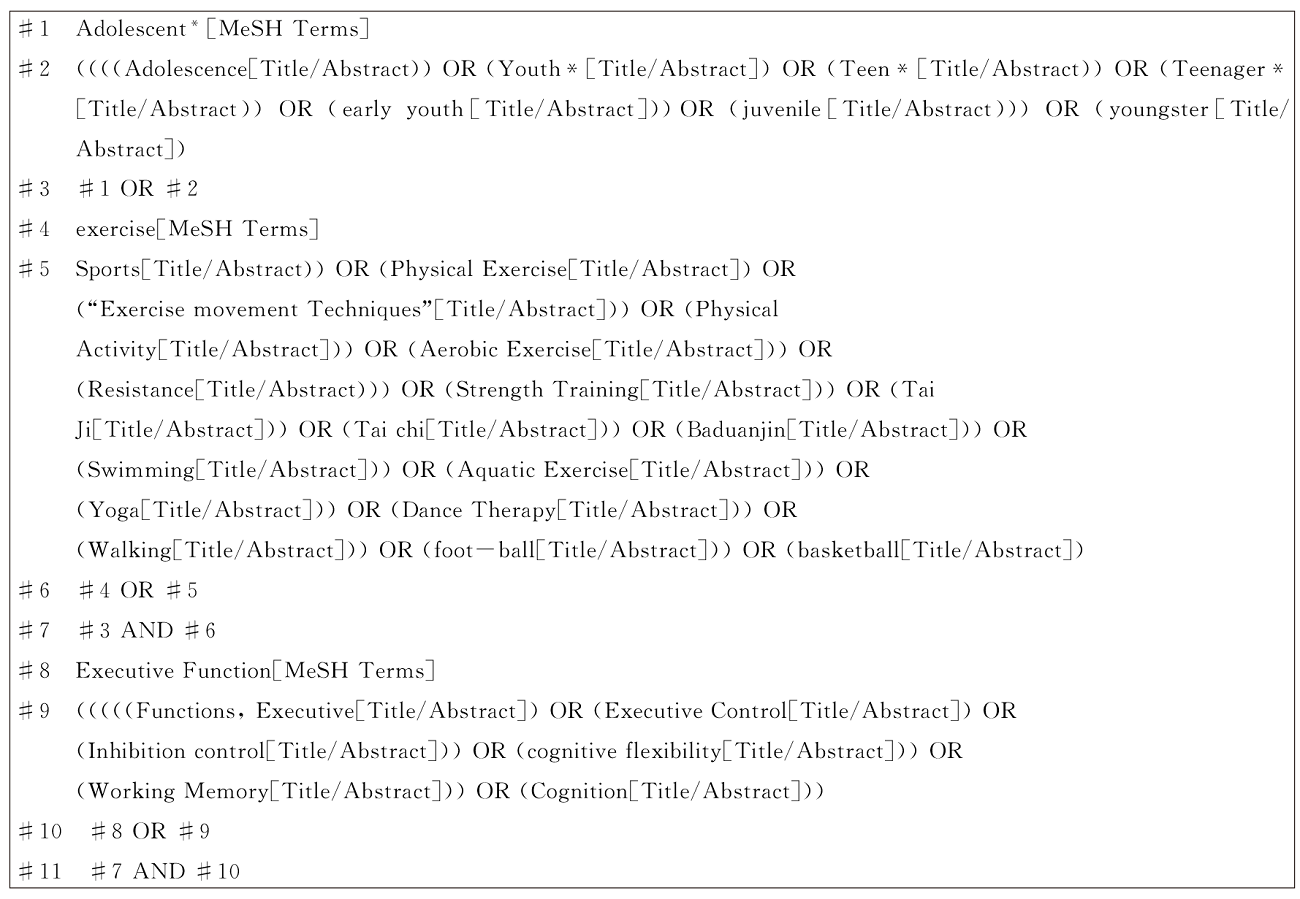
图1 PubMed检索策略
Fig.1 PubMed search strategy
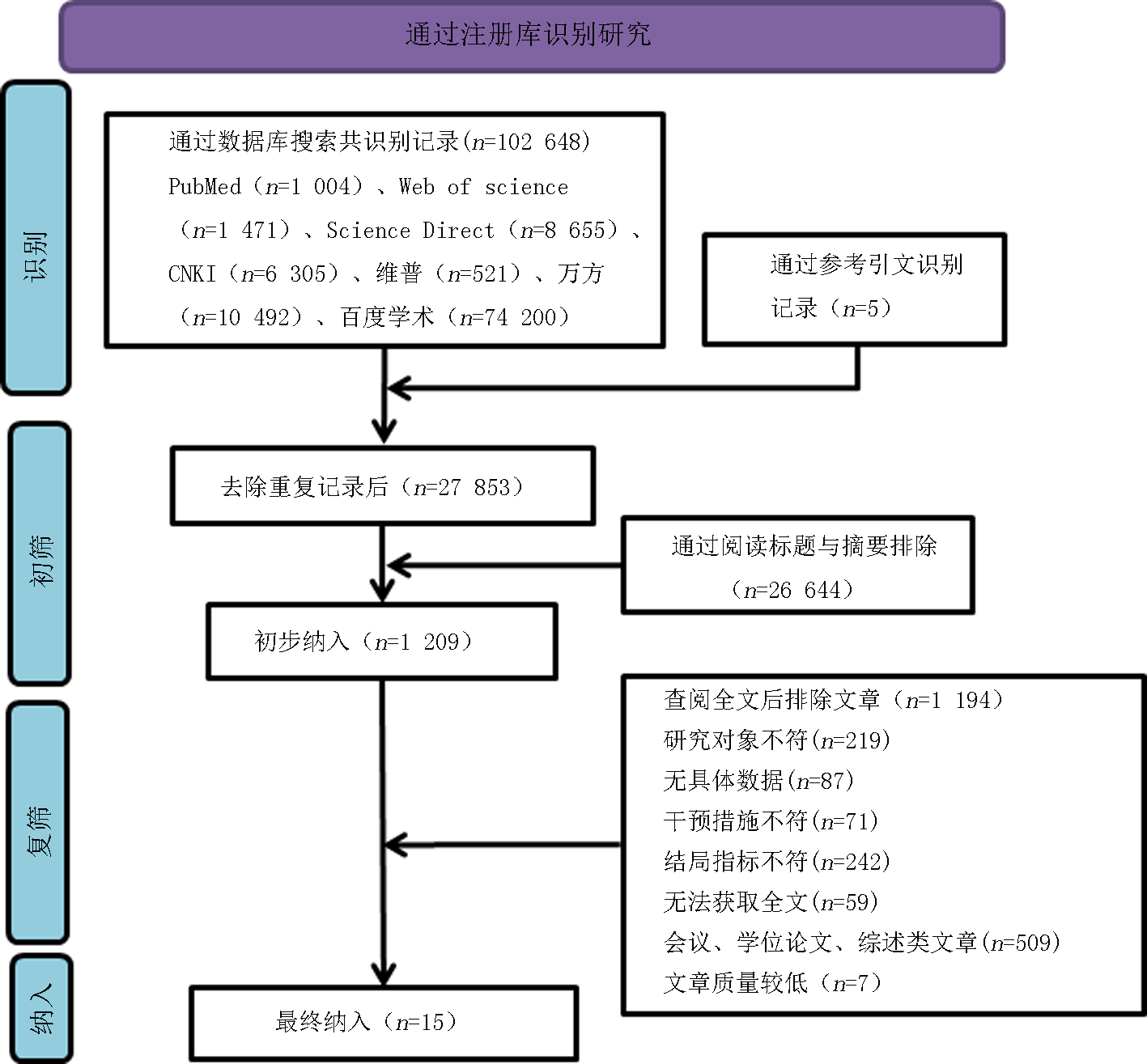
图2 文献筛选流程图
Fig.2 Flowchart of literature screening
| 研究者 | 国家 | 样本量 (T/C) | 平均年龄 (T/C) | 干预措施 (T/C) | 干预方案 | 结局指标 |
|---|---|---|---|---|---|---|
| Benzing等[ | 瑞士 | 42(21/21) | T1:14.52±1.03 T2:14.61±1.22 C:14.38±1.02 | ②/③/① | 15min/次,-,- | D-KEFS |
| Tavakoil等[ | 伊朗 | 60(30/30) | 12.13±0.28/12.83±0.61 | ④/① | 45 min/次,3次/周,8周 | Simon任务 |
| Sjöwall等[ | 瑞典 | 167(108/59) | - | ②/① | 20 min/次,-,- | D-KEFS/Stroop色词测验/WISC |
| Silva等[ | 巴西 | 20(10/10) | 12±2/12±1 | ②/① | -,2次/周,8周 | TMT |
| Jeon等[ | 美国 | 40(10/10/10/10) | T1:15.06±0.73 T2:15.47±0.78 T3:15.15±0.33 C:15.05±0.41 | ②/① | -,4次/周,12周 | WISC |
| Kolovelonis等[ | 希腊 | 102(36/34/32) | - | ③/⑤/① | 45 min/次,-,- | DFT |
| 李琳等[ | 中国 | 58(18/21/19) | T1:18.44±0.51 T2:18.43±0.51 C:18.58±0.51 | ②/④/① | 50 min/次,3次/周,8周 | Stroop色词测验/N-back任务 |
| 张凯等[ | 中国 | 32(17/15) | - | ⑤/① | 45 min/次,2次/周,10周 | Flanker任务 |
| 张立敏等[ | 中国 | 66(33/33) | - | ⑤/① | 45 min/次,-,12周 | Flanker任务/shifting task/N-back任务 |
| Rutkauskaite等[ | 立陶宛 | 63(31/32) | 13.7±0.8/13.9±0.8 | ⑤/① | 60 min/次,3次/周,4周 | Stroop色词测验/VDST |
| Hillman等[ | 美国 | 221(109/112) | - | ⑤/① | 70 min/次,5次/周,20周 | CSST |
| Ludyga等[ | 瑞士 | 35(19/16) | 12.5±0.7/12.4±0.7 | ⑤/① | 20 min/次,5次/周,8周 | Stroop色词测验 |
| Subramanian等[ | 英国 | 350(172/175) | - | ⑤/① | 120 min/次,6次/周,24周 | RFFT |
| Williams等[ | 英国 | 16(8/8) | 11.8±0.2/11.6±0.4 | ⑥/① | 60 min/次,3次/周,2周 | Stroop色词测验、Sternberg paradigm |
| Wassenaar等[ | 英国 | 16 017(7 860/8 157) | 12.5±0.30/12.5±0.29 | ⑥/① | 60 min/次,2次/周,40周 | Flanker任务/CSST/2-Back任务 |
表1 纳入研究特征
Tab.1 Characteristics of the included studies
| 研究者 | 国家 | 样本量 (T/C) | 平均年龄 (T/C) | 干预措施 (T/C) | 干预方案 | 结局指标 |
|---|---|---|---|---|---|---|
| Benzing等[ | 瑞士 | 42(21/21) | T1:14.52±1.03 T2:14.61±1.22 C:14.38±1.02 | ②/③/① | 15min/次,-,- | D-KEFS |
| Tavakoil等[ | 伊朗 | 60(30/30) | 12.13±0.28/12.83±0.61 | ④/① | 45 min/次,3次/周,8周 | Simon任务 |
| Sjöwall等[ | 瑞典 | 167(108/59) | - | ②/① | 20 min/次,-,- | D-KEFS/Stroop色词测验/WISC |
| Silva等[ | 巴西 | 20(10/10) | 12±2/12±1 | ②/① | -,2次/周,8周 | TMT |
| Jeon等[ | 美国 | 40(10/10/10/10) | T1:15.06±0.73 T2:15.47±0.78 T3:15.15±0.33 C:15.05±0.41 | ②/① | -,4次/周,12周 | WISC |
| Kolovelonis等[ | 希腊 | 102(36/34/32) | - | ③/⑤/① | 45 min/次,-,- | DFT |
| 李琳等[ | 中国 | 58(18/21/19) | T1:18.44±0.51 T2:18.43±0.51 C:18.58±0.51 | ②/④/① | 50 min/次,3次/周,8周 | Stroop色词测验/N-back任务 |
| 张凯等[ | 中国 | 32(17/15) | - | ⑤/① | 45 min/次,2次/周,10周 | Flanker任务 |
| 张立敏等[ | 中国 | 66(33/33) | - | ⑤/① | 45 min/次,-,12周 | Flanker任务/shifting task/N-back任务 |
| Rutkauskaite等[ | 立陶宛 | 63(31/32) | 13.7±0.8/13.9±0.8 | ⑤/① | 60 min/次,3次/周,4周 | Stroop色词测验/VDST |
| Hillman等[ | 美国 | 221(109/112) | - | ⑤/① | 70 min/次,5次/周,20周 | CSST |
| Ludyga等[ | 瑞士 | 35(19/16) | 12.5±0.7/12.4±0.7 | ⑤/① | 20 min/次,5次/周,8周 | Stroop色词测验 |
| Subramanian等[ | 英国 | 350(172/175) | - | ⑤/① | 120 min/次,6次/周,24周 | RFFT |
| Williams等[ | 英国 | 16(8/8) | 11.8±0.2/11.6±0.4 | ⑥/① | 60 min/次,3次/周,2周 | Stroop色词测验、Sternberg paradigm |
| Wassenaar等[ | 英国 | 16 017(7 860/8 157) | 12.5±0.30/12.5±0.29 | ⑥/① | 60 min/次,2次/周,40周 | Flanker任务/CSST/2-Back任务 |
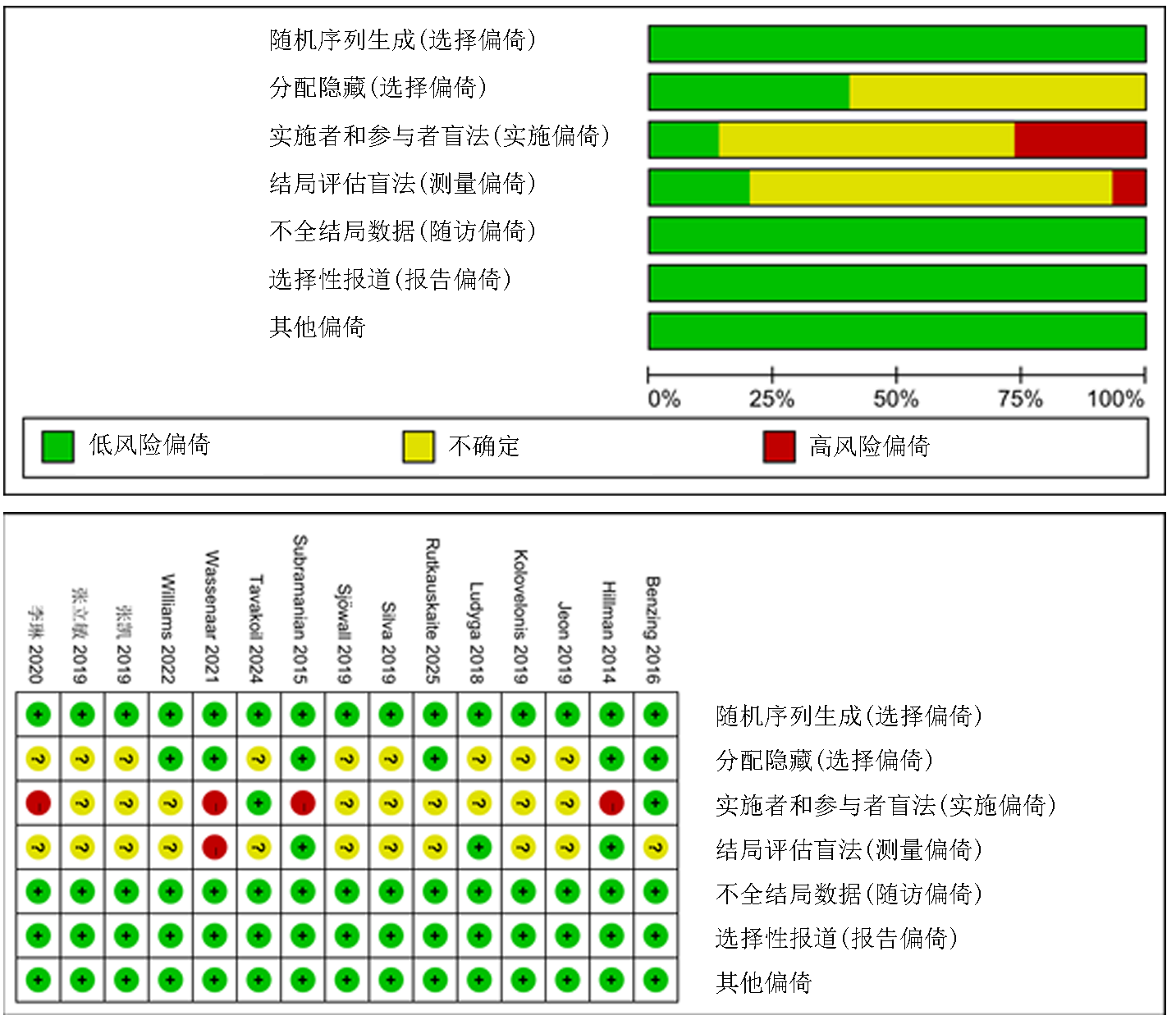
图3 纳入研究风险偏倚图
Fig.3 Risk of bias plot for the included studies
| 结局指标 | 纳入研究数(个) | 异质性检验结果 | 效应模型 | meta分析结果 | ||
|---|---|---|---|---|---|---|
| I2值(%) | P值 | SMD(95%CI) | P值 | |||
| 抑制 | 10 | 85.55 | <0.01 | 随机 | 0.36[0.04, 0.65] | <0.05 |
| 认知灵活性 | 8 | 98.47 | <0.01 | 随机 | 0.77[0.03, 1.51] | <0.05 |
| 工作记忆 | 9 | 95.37 | <0.01 | 随机 | 0.66[0.03, 0.70] | <0.05 |
表2 传统meta分析汇总表
Tab.2 Summary table of the traditional meta-analysis
| 结局指标 | 纳入研究数(个) | 异质性检验结果 | 效应模型 | meta分析结果 | ||
|---|---|---|---|---|---|---|
| I2值(%) | P值 | SMD(95%CI) | P值 | |||
| 抑制 | 10 | 85.55 | <0.01 | 随机 | 0.36[0.04, 0.65] | <0.05 |
| 认知灵活性 | 8 | 98.47 | <0.01 | 随机 | 0.77[0.03, 1.51] | <0.05 |
| 工作记忆 | 9 | 95.37 | <0.01 | 随机 | 0.66[0.03, 0.70] | <0.05 |
| 结局指标 | 亚组 | 纳入研究数 (个) | 异质性检验结果 | meta分析结果 | ||||
|---|---|---|---|---|---|---|---|---|
| I2值(%) | P值 | SMD(95%CI) | P值 | |||||
| 抑制 | 结局指标 | D-KEFS | 1 | - | - | 0.32[0.00, 0.64] | >0.05 | |
| Simon任务 | 1 | - | - | 1.62[1.04, 2.20] | <0.01 | |||
| DFT | 1 | - | - | 0.90[0.40, 1.39] | <0.01 | |||
| Stroop色词测验 | 4 | 0.00 | >0.05 | 0.17[-0.15, 0.48] | >0.05 | |||
| Flanker任务 | 3 | 60.69 | >0.05 | 0.09[-0.27, 0.45] | >0.05 | |||
| 干预措施 | 有氧运动 | 1 | - | - | 0.32[0.00, 0.64] | >0.05 | ||
| 认知体能游戏 | 2 | 71.27 | >0.05 | 1.24[0.53, 1.95] | <0.01 | |||
| 多模式运动 | 4 | 0.00 | >0.05 | 0.28[0.01, 0.56] | <0.05 | |||
| 抗阻运动 | 1 | - | - | 0.00[-0.63, 0.63] | >0.05 | |||
| 高强度间歇训练 | 2 | 0.00 | >0.05 | -0.04[-0.07, -0.01] | <0.05 | |||
| 剂量 | 20 min/次 | 2 | 0.00 | 0.05 | 0.29[0.01, 0.58] | 0.05 | ||
| 45~50 min/次 | 5 | 83.23 | <0.01 | 0.59[-0.03, 1.21] | >0.05 | |||
| 60 min/次 | 3 | 32.24 | >0.05 | 0.03[-0.23, 0.29] | >0.05 | |||
| 频率 | 2次/周 | 2 | 0.00 | >0.05 | -0.04[-0.07, -0.01] | <0.05 | ||
| 3次/周 | 4 | 84.18 | <0.01 | 0.49[-0.30, 1.28] | >0.05 | |||
| 5次/周 | 1 | - | - | 0.16[-0.49, 0.81] | >0.05 | |||
| 周期 | 2~4周 | 2 | 0.00 | >0.05 | 0.25[-0.19, 0.68] | >0.05 | ||
| 8周 | 3 | 87.71 | <0.01 | 0.60[-0.42, 1.62] | >0.05 | |||
| 10~12周 | 2 | 59.09 | >0.05 | 0.22[-0.43, 0.87] | >0.05 | |||
| 40周 | 1 | - | - | -0.04[-0.07, -0.01] | <0.05 | |||
| 认知灵活性 | 干预措施 | 有氧运动 | 2 | 95.99 | <0.01 | 1.96[-1.84, 5.75] | >0.05 | |
| 认知体能游戏 | 2 | 82.65 | <0.05 | 1.17[0.19, 2.16] | <0.05 | |||
| 多模式运动 | 3 | 0.00 | >0.05 | 0.20[0.04, 0.35] | <0.05 | |||
| 高强度间歇训练 | 1 | - | - | -0.01[-0.04, 0.03] | >0.05 | |||
| 剂量 | 15~20 min/次 | 2 | 62.21 | >0.05 | 0.31[-0.23, 0.86] | >0.05 | ||
| 45 min/次 | 2 | 86.58 | <0.05 | 1.15[0.14, 2.15] | <0.05 | |||
| 60~70 min/次 | 2 | 0.00 | >0.05 | -0.00[-0.03, 0.03] | >0.05 | |||
| 120 min/次 | 1 | - | - | 0.16[-0.05, 0.37] | >0.05 | |||
| 频率 | 2次/周 | 2 | 96.34 | <0.01 | 1.91[-1.98, 5.8] | >0.05 | ||
| 5~6次/周 | 2 | 0.00 | >0.05 | 0.15[-0.02, 0.31] | >0.05 | |||
| 工作记忆 | 结局指标 | N-back任务 | 5 | 96.65 | <0.01 | 0.78[-0.29, 1.84] | >0.05 | |
| WISC | 2 | 87.67 | <0.01 | 0.71[-0.73, 2.14] | >0.05 | |||
| VDST | 1 | - | - | 0.26[-0.23, 0.75] | >0.05 | |||
| Sternberg paradigm | 1 | - | - | 0.50[-0.44, 1.44] | >0.05 | |||
| 干预措施 | 有氧运动 | 2 | 87.67 | <0.01 | 0.71[-0.73, 2.14] | >0.05 | ||
| 多模式运动 | 3 | 0.00 | >0.05 | 0.36[0.05, 0.66] | <0.05 | |||
| 抗阻运动 | 2 | 96.81 | <0.01 | 1.62[-1.10, 4.33] | >0.05 | |||
| 高强度间歇训练 | 2 | 11.80 | >0.05 | 0.02[-0.22, 0.26] | >0.05 | |||
| 剂量 | 20 min/次 | 1 | - | - | 0.05[-0.27, 0.36] | >0.05 | ||
| 45~50min/次 | 4 | 94.26 | <0.01 | 0.99[-0.31, 2.29] | >0.05 | |||
| 60 min/次 | 3 | 26.73 | >0.05 | 0.07[-0.17, 0.30] | >0.05 | |||
| 频率 | 2次/周 | 2 | 0.00 | >0.05 | -0.01[-0.04, 0.02] | >0.05 | ||
| 3次/周 | 4 | 93.49 | <0.01 | 1.00[-0.32, 2.31] | >0.05 | |||
| 4次/周 | 1 | - | - | 1.52[0.56, 2.48] | <0.01 | |||
| 周期 | 2~4周 | 2 | 0.00 | >0.05 | 0.31[-0.12, 0.75] | >0.05 | ||
| 8周 | 2 | 96.81 | <0.01 | 1.62[-1.10, 4.33] | >0.05 | |||
| 10~12周 | 3 | 60.16 | >0.05 | 0.66[0.04, 1.29] | <0.05 | |||
| 40周 | 1 | - | - | -0.01[-0.04, 0.02] | >0.05 | |||
表3 各结局指标亚组分析汇总表
Tab.3 Summary table of subgroup analyses for each outcome measure
| 结局指标 | 亚组 | 纳入研究数 (个) | 异质性检验结果 | meta分析结果 | ||||
|---|---|---|---|---|---|---|---|---|
| I2值(%) | P值 | SMD(95%CI) | P值 | |||||
| 抑制 | 结局指标 | D-KEFS | 1 | - | - | 0.32[0.00, 0.64] | >0.05 | |
| Simon任务 | 1 | - | - | 1.62[1.04, 2.20] | <0.01 | |||
| DFT | 1 | - | - | 0.90[0.40, 1.39] | <0.01 | |||
| Stroop色词测验 | 4 | 0.00 | >0.05 | 0.17[-0.15, 0.48] | >0.05 | |||
| Flanker任务 | 3 | 60.69 | >0.05 | 0.09[-0.27, 0.45] | >0.05 | |||
| 干预措施 | 有氧运动 | 1 | - | - | 0.32[0.00, 0.64] | >0.05 | ||
| 认知体能游戏 | 2 | 71.27 | >0.05 | 1.24[0.53, 1.95] | <0.01 | |||
| 多模式运动 | 4 | 0.00 | >0.05 | 0.28[0.01, 0.56] | <0.05 | |||
| 抗阻运动 | 1 | - | - | 0.00[-0.63, 0.63] | >0.05 | |||
| 高强度间歇训练 | 2 | 0.00 | >0.05 | -0.04[-0.07, -0.01] | <0.05 | |||
| 剂量 | 20 min/次 | 2 | 0.00 | 0.05 | 0.29[0.01, 0.58] | 0.05 | ||
| 45~50 min/次 | 5 | 83.23 | <0.01 | 0.59[-0.03, 1.21] | >0.05 | |||
| 60 min/次 | 3 | 32.24 | >0.05 | 0.03[-0.23, 0.29] | >0.05 | |||
| 频率 | 2次/周 | 2 | 0.00 | >0.05 | -0.04[-0.07, -0.01] | <0.05 | ||
| 3次/周 | 4 | 84.18 | <0.01 | 0.49[-0.30, 1.28] | >0.05 | |||
| 5次/周 | 1 | - | - | 0.16[-0.49, 0.81] | >0.05 | |||
| 周期 | 2~4周 | 2 | 0.00 | >0.05 | 0.25[-0.19, 0.68] | >0.05 | ||
| 8周 | 3 | 87.71 | <0.01 | 0.60[-0.42, 1.62] | >0.05 | |||
| 10~12周 | 2 | 59.09 | >0.05 | 0.22[-0.43, 0.87] | >0.05 | |||
| 40周 | 1 | - | - | -0.04[-0.07, -0.01] | <0.05 | |||
| 认知灵活性 | 干预措施 | 有氧运动 | 2 | 95.99 | <0.01 | 1.96[-1.84, 5.75] | >0.05 | |
| 认知体能游戏 | 2 | 82.65 | <0.05 | 1.17[0.19, 2.16] | <0.05 | |||
| 多模式运动 | 3 | 0.00 | >0.05 | 0.20[0.04, 0.35] | <0.05 | |||
| 高强度间歇训练 | 1 | - | - | -0.01[-0.04, 0.03] | >0.05 | |||
| 剂量 | 15~20 min/次 | 2 | 62.21 | >0.05 | 0.31[-0.23, 0.86] | >0.05 | ||
| 45 min/次 | 2 | 86.58 | <0.05 | 1.15[0.14, 2.15] | <0.05 | |||
| 60~70 min/次 | 2 | 0.00 | >0.05 | -0.00[-0.03, 0.03] | >0.05 | |||
| 120 min/次 | 1 | - | - | 0.16[-0.05, 0.37] | >0.05 | |||
| 频率 | 2次/周 | 2 | 96.34 | <0.01 | 1.91[-1.98, 5.8] | >0.05 | ||
| 5~6次/周 | 2 | 0.00 | >0.05 | 0.15[-0.02, 0.31] | >0.05 | |||
| 工作记忆 | 结局指标 | N-back任务 | 5 | 96.65 | <0.01 | 0.78[-0.29, 1.84] | >0.05 | |
| WISC | 2 | 87.67 | <0.01 | 0.71[-0.73, 2.14] | >0.05 | |||
| VDST | 1 | - | - | 0.26[-0.23, 0.75] | >0.05 | |||
| Sternberg paradigm | 1 | - | - | 0.50[-0.44, 1.44] | >0.05 | |||
| 干预措施 | 有氧运动 | 2 | 87.67 | <0.01 | 0.71[-0.73, 2.14] | >0.05 | ||
| 多模式运动 | 3 | 0.00 | >0.05 | 0.36[0.05, 0.66] | <0.05 | |||
| 抗阻运动 | 2 | 96.81 | <0.01 | 1.62[-1.10, 4.33] | >0.05 | |||
| 高强度间歇训练 | 2 | 11.80 | >0.05 | 0.02[-0.22, 0.26] | >0.05 | |||
| 剂量 | 20 min/次 | 1 | - | - | 0.05[-0.27, 0.36] | >0.05 | ||
| 45~50min/次 | 4 | 94.26 | <0.01 | 0.99[-0.31, 2.29] | >0.05 | |||
| 60 min/次 | 3 | 26.73 | >0.05 | 0.07[-0.17, 0.30] | >0.05 | |||
| 频率 | 2次/周 | 2 | 0.00 | >0.05 | -0.01[-0.04, 0.02] | >0.05 | ||
| 3次/周 | 4 | 93.49 | <0.01 | 1.00[-0.32, 2.31] | >0.05 | |||
| 4次/周 | 1 | - | - | 1.52[0.56, 2.48] | <0.01 | |||
| 周期 | 2~4周 | 2 | 0.00 | >0.05 | 0.31[-0.12, 0.75] | >0.05 | ||
| 8周 | 2 | 96.81 | <0.01 | 1.62[-1.10, 4.33] | >0.05 | |||
| 10~12周 | 3 | 60.16 | >0.05 | 0.66[0.04, 1.29] | <0.05 | |||
| 40周 | 1 | - | - | -0.01[-0.04, 0.02] | >0.05 | |||
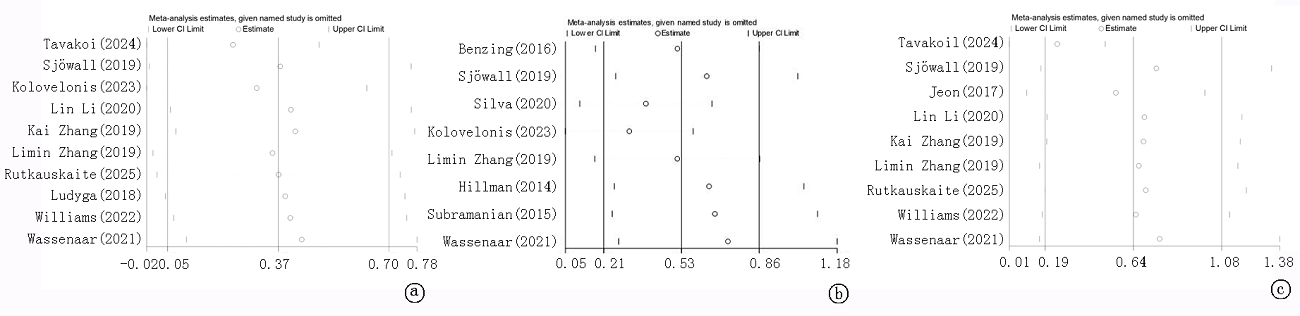
图4 敏感性分析 a:抑制;b:认知灵活性;c:工作记忆
Fig.4 Sensitivity analysis a. Inhibition; b. Cognitive flexibility; c. Working memory
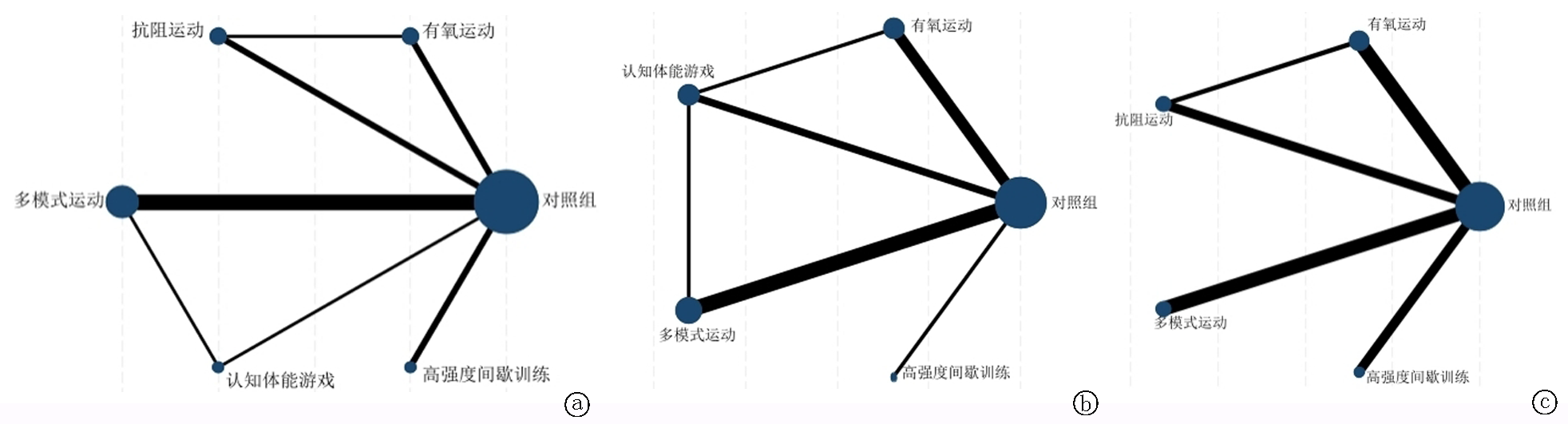
图5 网络证据图 a:抑制;b:认知灵活性;c:工作记忆
Fig.5 Network evidence plot a. Inhibition; b. Cognitive flexibility; c. Working memory

图6 不同运动类型对青少年抑制、认知灵活性及工作记忆干预效果的累计概率排序图 a:抑制;b:认知灵活性;c:工作记忆
Fig.6 Cumulative probability ranking plot of the intervention effects of different exercise types on adolescent inhibition, cognitive flexibility, and working memory a. Inhibition; b. Cognitive flexibility; c. Working memory

图7 不同运动类型对青少年抑制、认知灵活性及工作记忆干预效果的两两比较结果 a:抑制;b:认知灵活性;c:工作记忆
Fig.7 Pairwise comparison results of the intervention effects of different exercise types on adolescent inhibition, cognitive flexibility, and working memory a. Inhibition; b. Cognitive flexibility; c. Working memory
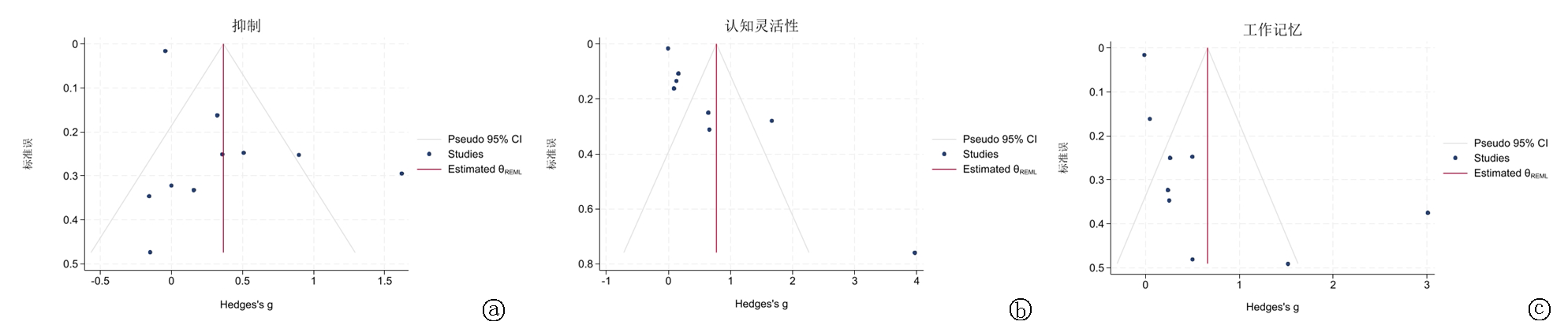
图8 漏斗图 a:抑制;b:认知灵活性;c:工作记忆
Fig.8 Funnel plot a. Inhibition; b. Cognitive flexibility; c. Working memory
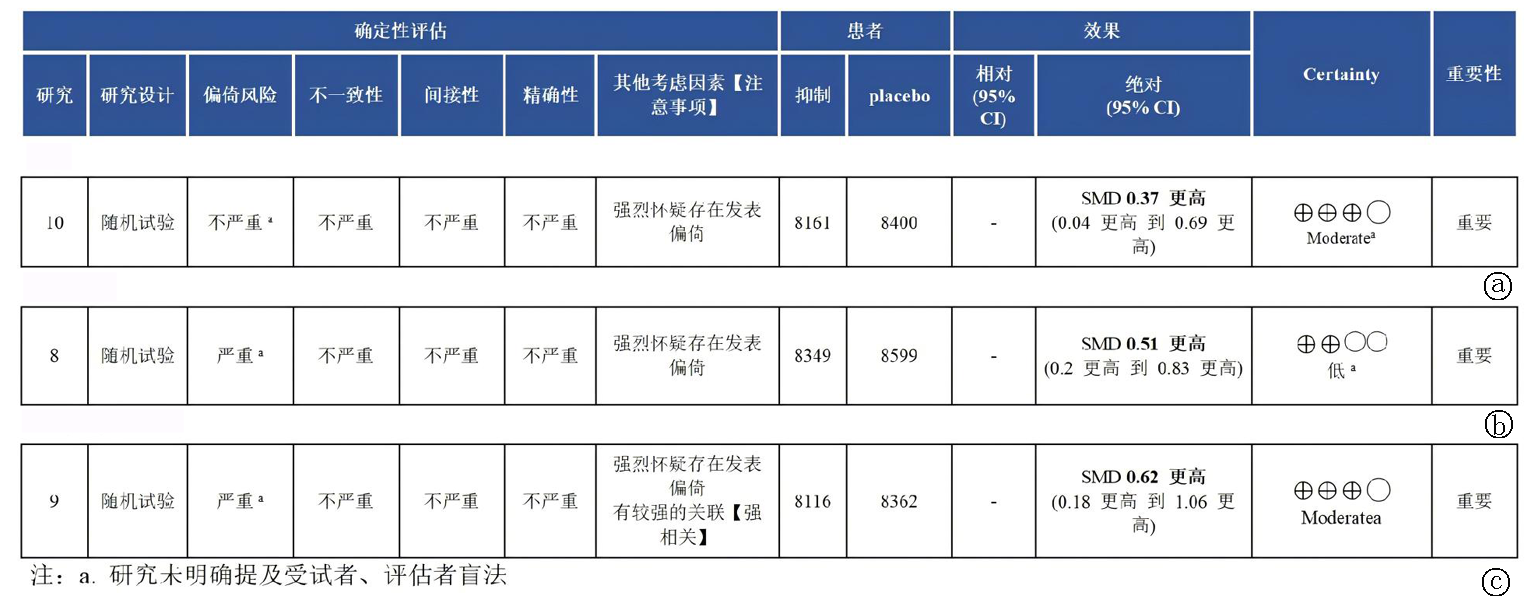
图9 GRADE证据质量评价图 a:抑制;b:认知灵活性;c:工作记忆
Fig.9 GRADE evidence quality assessment plot a. Inhibition; b. Cognitive flexibility; c. Working memory
| [1] |
Arnett JJ. Adolescent storm and stress, reconsidered[J]. Am Psychol, 1999, 54(5): 317-326. doi:10.1037/0003-066X.54.5.317.
pmid: 10354802 |
| [2] | Pan XF, Wang L, Pan A. Epidemiology and determinants of obesity in China[J]. Lancet Diabetes Endocrinol, 2021, 9(6): 373-392. doi: 10.1016/S2213-8587(21)00045-0. |
| [3] | 王兵. 全球及中国的肥胖症流行病学现状及趋势[J]. 中国普外基础与临床杂志, 2025, 32(6): 661-668. doi: 10.7507/1007-9424.202505133. |
| [4] | Chen K, Shen Z, Gu W, et al. Prevalence of obesity and associated complications in China: A cross-sectional, real-world study in 15.8 million adults[J]. Diabetes Obes Metab, 2023, 25(11): 3390-3399. doi: 10.1111/dom.15238. |
| [5] | 吴婷, 张文武, 杜亚松. 青少年抑郁障碍的研究与诊疗现状[J]. 现代实用医学, 2022, 34(4): 421-424. doi:10.3969/j.issn.1671-0800.2022.04.001. |
| [6] | 冯月, 王芳. 2015-2024年我国儿童青少年抑郁症状患病率的Meta分析[J]. 中国当代儿科杂志, 2025, 27(5): 529-539. doi:10.7499/j.issn.1008-8830.2409109. |
| [7] | 张诗婷, 黄霞, 刘春莹, 等. 1990-2021年中国10-24岁青少年焦虑症疾病负担及变化趋势分析[J]. 现代预防医学, 2025, 52(6): 1063-1068. doi: 10.20043/j.cnki.MPM.202410362. |
| [8] |
Padilla MM, Fernández-Serrano MJ, Verdejo García A, et al. Negative social evaluation impairs executive functions in adolescents with excess weight: Associations with autonomic responses[J]. Ann Behav Med, 2019, 53(4): 383-391. doi: 10.1093/abm/kay051.
pmid: 29939202 |
| [9] | Vilgis V, Silk TJ, Vance A. Executive function and attention in children and adolescents with depressive disorders: A systematic review[J]. Eur Child Adolesc Psychiatry, 2015, 24(4): 365-384. doi: 10.1007/s00787-015-0675-7. |
| [10] |
Han G, Helm J, Iucha C, et al. Are executive functioning deficits concurrently and predictively associated with depressive and anxiety symptoms in adolescents?[J]. J Clin Child Adolesc Psychol, 2016, 45(1): 44-58. doi: 10.1080/15374416.2015.1041592.
pmid: 26042358 |
| [11] |
Mamrot P, Han'c T. The association of the executive functions with overweight and obesity indicators in children and adolescents: A literature review[J]. Neurosci Biobehav Rev, 2019, 107: 59-68. doi: 10.1016/j.neubiorev.2019.08.021.
pmid: 31470031 |
| [12] |
Diamond A. Executive functions[J]. Annu Rev Psychol, 2013, 64: 135-168. doi: 10.1146/annurev-psych-113011-143750.
pmid: 23020641 |
| [13] | Miyake A, Friedman NP, Emerson MJ, et al. The unity and diversity of executive functions and their contributions to complex “frontal lobe” tasks: A latent variable analysis[J]. Cogn Psychol, 2000, 41(1): 49-100. doi: 10.1006/cogp.1999.0734. |
| [14] |
Cowan N. Working memory underpins cognitive development, learning, and education[J]. Educ Psychol Rev, 2014, 26(2): 197-223. doi: 10.1007/s10648-013-9246-y.
pmid: 25346585 |
| [15] |
Hofmann W, Schmeichel BJ, Baddeley AD. Executive functions and self-regulation[J]. Trends Cogn Sci, 2012, 16(3): 174-180. doi: 10.1016/j.tics.2012.01.006.
pmid: 22336729 |
| [16] |
Diamond A. Close interrelation of motor development and cognitive development and of the cerebellum and prefrontal cortex[J]. Child Dev, 2000, 71(1): 44-56. doi: 10.1111/1467-8624.00117.
pmid: 10836557 |
| [17] |
Hillman CH, Erickson KI, Kramer AF. Be smart, exercise your heart: Exercise effects on brain and cognition[J]. Nat Rev Neurosci, 2008, 9(1): 58-65. doi: 10.1038/nrn2298.
pmid: 18094706 |
| [18] | Kolb B, Whishaw IQ. Brain plasticity and behavior[J]. Annu Rev Psychol, 1998, 49(1): 43-64. doi: 10.1146/annurev.psych.49.1.43. |
| [19] |
Harrison BJ, Shaw M, Yücel M, et al. Functional connectivity during Stroop task performance[J]. Neuroimage, 2005, 24(1): 181-191. doi: 10.1016/j.neuroimage.2004.08.033.
pmid: 15588609 |
| [20] |
Vaynman SS, Ying Z, Yin D, et al. Exercise differentially regulates synaptic proteins associated to the function of BDNF[J]. Brain Res, 2006, 1070(1): 124-130. doi: 10.1016/j.brainres.2005.11.062.
pmid: 16413508 |
| [21] | Kujach S, Olek RA, Byun K, et al. Acute sprint interval exercise increases both cognitive functions and peripheral neurotrophic factors in humans: The possible involvement of lactate[J]. Front Neurosci, 2020, 13: 1455. doi: 10.3389/fnins.2019.01455. |
| [22] | Henckens MJ, Van Wingen GA, Joëls M, et al. Time-dependent effects of cortisol on selective attention and emotional interference: A functional MRI study[J]. Front Integr Neurosci, 2012, 6: 66. doi: 10.3389/fnint.2012.00066. |
| [23] | Verburgh L, Königs M, Scherder EJ, et al. Physical exercise and executive functions in preadolescent children, adolescents and young adults: A meta-analysis[J]. Br J Sports Med, 2014, 48(12): 973-979. doi: 10.1136/bjsports-2012-091441. |
| [24] | Xue Y, Yang Y, Huang T. Effects of chronic exercise interventions on executive function among children and adolescents: A systematic review with meta-analysis[J]. Br J Sports Med, 2019, 53(22): 1397-1404. doi: 10.1136/bjsports-2018-099825. |
| [25] | Liu S, Yu Q, Li Z, et al. Effects of acute and chronic exercises on executive function in children and adolescents: A systemic review and meta-analysis[J]. Front Psychol, 2020, 11: 554915. doi: 10.3389/fpsyg.2020.554915. |
| [26] |
Park S, Etnier JL. Beneficial effects of acute exercise on executive function in adolescents[J]. J Phys Act Health, 2019, 16(6): 423-429. doi: 10.1123/jpah.2018-0219.
pmid: 31010372 |
| [27] | Hu S, Shi P, Zhang Z, et al. Effects of open-skill exercise on executive functions in children and adolescents: A systematic review and meta-analysis[J]. Front Hum Neurosci, 2025, 18: 1495371. doi: 10.3389/fnhum.2024.1495371. |
| [28] | Reyes-Amigo T, Bezerra A, Gomez-Mazorra M, et al. Effects of high-intensity interval training on executive functions in children and adolescents: A systematic review and meta-analysis[J]. Physical Activity Review, 2022, 10(2): 77-87. doi: 10.16926/par.2022.10.23. |
| [29] | Wang H, Cheng G, Li MM. The effectiveness and sustained effects of exercise therapy to improve executive function in children and adolescents with autism: A systematic review and meta-analysis[J]. Eur J Pediatr, 2025, 184(5): 286. doi: 10.1007/s00431-025-06115-7. |
| [30] | Song Y, Fan B, Wang C, et al. Meta-analysis of the effects of physical activity on executive function in children and adolescents with attention deficit hyperactivity disorder[J]. PLoS One, 2023, 18(8): e0289732. doi: 10.1371/journal.pone.0289732. |
| [31] | Benzing V, Heinks T, Eggenberger N, et al. Acute cognitively engaging exergame-based physical activity enhances executive functions in adolescents[J]. PLos One, 2016, 11(12): e0167501. doi: 10.1371/journal.pone.0167501. |
| [32] | Tavakoli MHM, Shojaei M, Molanorouzl K. Effects of physical activity on sleep quality, inhibitory control, working memory and cognitive flexibility among adolescent students[J]. Revista Iberoamericana de Psicología del Ejercicio y el Deporte, 2024, 19(4): 398-401. |
| [33] | Sjöwall D, Thorell LB, Mandic M, et al. No effects of a long-term physical activity intervention on executive functioning among adolescents[J]. SAGE Open Med, 2019, 7: 2050312119880734. doi: 10.1177/2050312119880734. |
| [34] |
Silva LAD, Doyenart R, Henrique Salvan P, et al. Swimming training improves mental health parameters, cognition and motor coordination in children with attention deficit hyperactivity disorder[J]. Int J Environ Health Res, 2020, 30(5): 584-592. doi: 10.1080/09603123.2019.1612041.
pmid: 31081373 |
| [35] | Jeon YK, Ha CH. The effect of exercise intensity on brain derived neurotrophic factor and memory in adolescents[J]. Environ Health Prev Med, 2017, 22(1): 27. doi: 10.1186/s12199-017-0643-6. |
| [36] | Kolovelonis A, Goudas M. The effects of cognitively challenging physical activity games versus health-related fitness activities on students’ executive functions and situational interest in physical education: A group-randomized controlled trial[J]. Eur J Investig Health Psychol Educ, 2023, 13(5): 796-809. doi: 10.3390/ejihpe13050060. |
| [37] | 李琳, 崔洁, 项琪, 等. 8周不同类型的运动对女大学生执行功能的影响[J]. 中国运动医学杂志, 2020, 39(10): 810-816. doi: 10.16038/j.1000-6710.2020.10.010. |
| [38] | 张凯, 魏源. 五体球运动对高中生执行功能的影响[J]. 湖北体育科技, 2019, 38(6): 514-518. |
| [39] | 张立敏, 喻青, 查圣祥. 中等强度足球锻炼对小学生执行功能的影响[J]. 体育成人教育学刊, 2019, 35(3): 74-79. doi: 10.16419/j.cnki.42-1684/g8.20190524.010. |
| [40] | Rutkauskaite R, Gruodyte-Raciene R, Pliuskute G, et al. The influence of short-term dance-oriented exergaming on cognitive skills and psychological well-being of adolescents[J]. Educ Sci, 2025, 15(4): 508. doi: 10.3390/educsci15040508. |
| [41] | Hillman CH, Pontifex MB, Castelli DM, et al. Effects of the FITKids randomized controlled trial on executive control and brain function[J]. Pediatrics, 2014, 134(4): e1063-e1071. doi: 10.1542/peds.2013-3219. |
| [42] | Ludyga S, Gerber M, Herrmann C, et al. Chronic effects of exercise implemented during school-break time on neurophysiological indices of inhibitory control in adolescents[J]. Trends Neurosci Educ, 2018, 10: 1-7. doi: 10.1016/j.tine.2017.11.001. |
| [43] | Subramanian SK, Sharma VK, Arunachalam V, et al. Effect of structured and unstructured physical activity training on cognitive functions in adolescents-a randomized control trial[J]. J Clin Diagn Res, 2015, 9(11): CC04. doi: 10.7860/JCDR/2015/14881.6818. |
| [44] | Williams RA, Dring KJ, Morris JG, et al. Effect of two-weeks of school-based sprint training on physical fitness, risk factors for cardiometabolic diseases and cognitive function in adolescent girls: A randomized controlled pilot trial[J]. Front Sports Act Living, 2022, 4: 884051. doi: 10.3389/fspor.2022.884051. |
| [45] |
Wassenaar TM, Wheatley CM, Beale N, et al. The effect of a one-year vigorous physical activity intervention on fitness, cognitive performance and mental health in young adolescents: The fit to study cluster randomised controlled trial[J]. Int J Behav Nutr Phys Act, 2021, 18(1): 47. doi: 10.1186/s12966-021-01113-y.
pmid: 33789683 |
| [46] |
Best JR. Exergaming immediately enhances children's executive function[J]. Dev Psychol, 2012, 48(5): 1501. doi: 10.1037/a0026648.
pmid: 22148945 |
| [47] |
Anderson-Hanley C, Arciero PJ, Brickman AM, et al. Exergaming and older adult cognition: A cluster randomized clinical trial[J]. Am J Prev Med, 2012, 42(2): 109-119. doi: 10.1016/j.amepre.2011.10.016.
pmid: 22261206 |
| [48] |
Karr JE, Areshenkoff CN, Rast P, et al. An empirical comparison of the therapeutic benefits of physical exercise and cognitive training on the executive functions of older adults: A meta-analysis of controlled trials[J]. Neuropsychology, 2014, 28(6): 829. doi: 10.1037/neu0000101.
pmid: 24933486 |
| [49] |
Toril P, Reales JM, Ballesteros S. Video game training enhances cognition of older adults: A meta-analytic study[J]. Psychol Aging, 2014, 29(3): 706. doi:10.1037/a0037507.
pmid: 25244488 |
| [50] |
Swinburn BA, Sacks G, Hall KD, et al. The global obesity pandemic: Shaped by global drivers and local environments[J]. lancet, 2011, 378(9793): 804-814. doi: 10.1016/S0140-6736(11)60813-1.
pmid: 21872749 |
| [51] | Navon D, Gopher D. On the economy of the human-processing system[J]. Psychol Rev, 1979, 86(3): 214. doi:10.1037/0033-295X.86.3.214. |
| [52] |
Navon D, Miller J. Role of outcome conflict in dual-task interference[J]. J Exp Psychol Human, 1987, 13(3): 435. doi: 10.1037/0096-1523.13.3.435.
pmid: 2958592 |
| [53] |
Harlow HF. The formation of learning sets[J]. Psychol Rev, 1949, 56(1): 51. doi: 10.1037/h0062474.
pmid: 18124807 |
| [54] |
Schott N, Klotzbier TJ. Profiles of cognitive-motor interference during walking in children: Does the motor or the cognitive task matter?[J]. Front Psychol, 2018, 9: 947. doi: 10.3389/fpsyg.2018.00947.
pmid: 29951020 |
| [55] |
Lcour M, Bernard-Demanze L, Dumitrescu M. Posture control, aging, and attention resources: Models and posture-analysis methods[J]. Neurophysiol Clin, 2008, 38(6): 411-421. doi: 10.1016/j.neucli.2008.09.005.
pmid: 19026961 |
| [56] |
Ludyga S, Gerber M, Brand S, et al. Acute effects of moderate aerobic exercise on specific aspects of executive function in different age and fitness groups: A meta-analysis[J]. Psychophysiology, 2016, 53(11): 1611-1626. doi: 10.1111/psyp.12736.
pmid: 27556572 |
| [57] | Zang W, Zhu J, Xiao N, et al. Effects of aerobic exercise on children's executive function and academic performance: A systematic review and meta-analysis[J]. Heliyon, 2024, 10(7): e28633. doi: 10.1016/j.heliyon.2024.e28633. |
| [58] |
Guiney H, Machado L. Benefits of regular aerobic exercise for executive functioning in healthy populations[J]. Psychon Bull Rev, 2013, 20(1): 73-86. doi: 10.3758/s13423-012-0345-4.
pmid: 23229442 |
| [59] | Chang YK, Chu C H, Wang CC, et al. Dose-response relation between exercise duration and cognition[J]. Med Sci Sports Exerc, 2015, 47(1): 159-165. doi: 10.1249/MSS.0000000000000383. |
| [60] | Sibley BA, Etnier JL, Le Masurier GC. Effects of an acute bout of exercise on cognitive aspects of Stroop performance[J]. J Sport Exercise Psy, 2006, 28(3): 285-299. doi: 10.1123/jsep.28.3.285. |
| [61] | Hillmasibley BA, Etnier JL, Le Masurier GC. Effects of an acute bout of exercise on cognitive aspects of Stroop performance[J]. J Sport Exercise Psy, 2006, 28(3): 285-299. doi: https://doi.org/10.1123/jsep.28.3.285. |
| [62] | Joyce J, Graydon J, McMorris T, et al. The time course effect of moderate intensity exercise on response execution and response inhibition[J]. Brain Cogn, 2009, 71(1): 14-19. doi: 10.1016/j.bandc.2009.03.004. |
| [63] | Moriarty T, Bourbeau K, Bellovary B, et al. Exercise intensity influences prefrontal cortex oxygenation during cognitive testing[J]. Behav Sci, 2019, 9(8): 83. doi: 10.3390/bs9080083. |
| [1] | 周域, 邓丽平, 胡俊, 寿玥莺, 吴勐, 高洁婷, 李韦. 不同剂量SGLT-2抑制剂致2型糖尿病患者尿路感染风险的网状meta分析[J]. 临床荟萃, 2026, 41(8): 677-684. |
| [2] | 马丽云, 任喜艳, 闫春良. 免疫检查点抑制剂相关危重型心肌炎合并肌炎1例并文献复习[J]. 临床荟萃, 2026, 41(8): 725-730. |
| [3] | 张仕昌, 金贞爱. 青少年特发性脊柱侧弯影响因素的研究进展[J]. 临床荟萃, 2026, 41(8): 742-746. |
| [4] | 刘东斐, 姜昱成, 王占峰. 运动对中国睡眠障碍青少年睡眠质量干预效果的meta分析[J]. 临床荟萃, 2026, 41(5): 389-398. |
| [5] | 林涛, 吴玮君. 中高海拔地区帕金森病非运动症状的临床特征谱及其与肠道菌群-肠-脑轴关联机制[J]. 临床荟萃, 2026, 41(4): 301-306. |
| [6] | 王小丫, 刘晓娟, 刘军艳, 李宇轩, 李元霞. 延安市青少年心理健康状况及相关因素[J]. 临床荟萃, 2026, 41(3): 241-248. |
| [7] | 曹泽贤, 刘宇鑫, 沈士朋, 赵松, 高一平, 刘茂东. 慢性粒细胞性白血病合并膜增生性肾小球肾炎1例并文献复习[J]. 临床荟萃, 2026, 41(3): 259-263. |
| [8] | 刘三娇, 任桦, 郭伊凡. 类风湿关节炎患者恐动症研究的范围综述[J]. 临床荟萃, 2026, 41(1): 44-50. |
| [9] | 任喜艳, 马丽云, 任冠军, 薛旗山, 闫春良, 景淑贤. 抗生素诱发获得性凝血因子Ⅴ抑制物1例并文献复习[J]. 临床荟萃, 2026, 41(1): 60-63. |
| [10] | 唐漆, 秦臻. 铁死亡相关通路及其在癫痫中的研究进展[J]. 临床荟萃, 2026, 41(1): 91-95. |
| [11] | 叶倩, 刘申香. H1抗组胺药与接受免疫检查点抑制剂治疗的肿瘤患者预后关系的meta分析[J]. 临床荟萃, 2025, 40(8): 684-688. |
| [12] | 刘洋, 梁燕敏. 新型降脂药物的最新研究进展[J]. 临床荟萃, 2025, 40(8): 736-741. |
| [13] | 孙楠, 杨凯琦, 唐亚赛, 谢小华, 吕佩源, 董艳红. 帕金森病认知障碍的治疗新进展[J]. 临床荟萃, 2025, 40(8): 748-752. |
| [14] | 徐胜, 杨青青, 张敏. 基于功能性近红外光谱技术, 观察脑机接口训练系统对亚急性期脑卒中后上肢功能障碍患者功能连接网络的影响[J]. 临床荟萃, 2025, 40(5): 428-433. |
| [15] | 王东霞, 张东, 宋世飞, 杨艺敏. 肝移植术后并发可逆性后部白质脑病综合征1例并文献复习[J]. 临床荟萃, 2025, 40(5): 454-457. |
| 阅读次数 | ||||||
|
全文 |
|
|||||
|
摘要 |
|
|||||
