Clinical Focus ›› 2026, Vol. 41 ›› Issue (5): 406-410.doi: 10.3969/j.issn.1004-583X.2026.05.003
Previous Articles Next Articles
Distribution of uropathogens in patients with malignant tumors and the application of combined blood glucose and urinalysis testing
Shi Shaoxin1, Chen Xueting2, Zhuang Yihui3, Guo Lin3, Lu Renquan3, Xu Xiaofeng3( )
)
- 1
Department of Clinical Laboratory ,Fudan University Shanghai Cancer Center Xiamen Hospital
2Department of Blood Transfusion ,Xiamen Medical College Affiliated Haicang Hospital
3Department of Clinical Laboratory Department of Oncology ,Shanghai Medical College of Fudan University , Shanghai 200032, China
-
Received:2026-04-08Online:2026-05-20Published:2026-05-26 -
Contact:Xu Xiaofeng,Email:709007178@qq.com

CLC Number:
Cite this article
Shi Shaoxin, Chen Xueting, Zhuang Yihui, Guo Lin, Lu Renquan, Xu Xiaofeng. Distribution of uropathogens in patients with malignant tumors and the application of combined blood glucose and urinalysis testing[J]. Clinical Focus, 2026, 41(5): 406-410.
share this article
Add to citation manager EndNote|Ris|BibTeX
URL: https://www.lchc.cn/EN/10.3969/j.issn.1004-583X.2026.05.003
| 细菌名称 | 菌株数(株) | 百分比(%) |
|---|---|---|
| 大肠埃希菌 | 142 | 53.58 |
| 粪肠球菌 | 39 | 14.72 |
| 屎肠球菌 | 13 | 4.91 |
| 奇异变形杆菌 | 12 | 4.53 |
| 肺炎克雷伯菌 | 10 | 3.77 |
| 阴沟肠杆菌阴沟亚种 | 7 | 2.64 |
| 无乳链球菌 | 5 | 1.89 |
| 不动杆菌属 | 4 | 1.51 |
| 铜绿假单胞菌 | 4 | 1.51 |
| 普通变形杆菌 | 4 | 1.51 |
| 其他 | 25 | 9.43 |
| 总计 | 265 | 100.00 |
Tab.1 Distribution of pathogens in patients with malignant tumors complicated by UTI
| 细菌名称 | 菌株数(株) | 百分比(%) |
|---|---|---|
| 大肠埃希菌 | 142 | 53.58 |
| 粪肠球菌 | 39 | 14.72 |
| 屎肠球菌 | 13 | 4.91 |
| 奇异变形杆菌 | 12 | 4.53 |
| 肺炎克雷伯菌 | 10 | 3.77 |
| 阴沟肠杆菌阴沟亚种 | 7 | 2.64 |
| 无乳链球菌 | 5 | 1.89 |
| 不动杆菌属 | 4 | 1.51 |
| 铜绿假单胞菌 | 4 | 1.51 |
| 普通变形杆菌 | 4 | 1.51 |
| 其他 | 25 | 9.43 |
| 总计 | 265 | 100.00 |
| 组别 | 例数 | NIT(阴性/阳性) | LEU(阴性/阳性) | 尿糖(阴性/阳性) | UWBC(个/μL) | 血糖(mmol/L) |
|---|---|---|---|---|---|---|
| 阳性组 | 264 | 185/79 | 92/172 | 225/39 | 129.70(17.83,780.50) | 5.88(5.12,7.45) |
| 对照组 | 273 | 266/7 | 179/94 | 261/12 | 12.90(2.80,58.40) | 5.29(4.91,5.78) |
| χ2/Z值 | 75.293 | 50.473 | 16.815 | 9.350 | 6.223 | |
| P值 | <0.001 | <0.01 | <0.01 | <0.01 | <0.01 |
Tab.2 Comparison of urinalysis indices and blood glucose test results between the positive group and the control group
| 组别 | 例数 | NIT(阴性/阳性) | LEU(阴性/阳性) | 尿糖(阴性/阳性) | UWBC(个/μL) | 血糖(mmol/L) |
|---|---|---|---|---|---|---|
| 阳性组 | 264 | 185/79 | 92/172 | 225/39 | 129.70(17.83,780.50) | 5.88(5.12,7.45) |
| 对照组 | 273 | 266/7 | 179/94 | 261/12 | 12.90(2.80,58.40) | 5.29(4.91,5.78) |
| χ2/Z值 | 75.293 | 50.473 | 16.815 | 9.350 | 6.223 | |
| P值 | <0.001 | <0.01 | <0.01 | <0.01 | <0.01 |
| 项目 | AUC | 敏感度(%) | 特异度(%) | 标准误 | 95%CI |
|---|---|---|---|---|---|
| NIT | 0.637 | 29.92 | 97.44 | 0.024 | 0.590~0.684 |
| LEU | 0.700 | 53.41 | 83.88 | 0.023 | 0.656~0.745 |
| UWBC | 0.733 | 67.05 | 73.26 | 0.022 | 0.691~0.775 |
| 血糖 | 0.655 | 48.48 | 81.32 | 0.024 | 0.609~0.702 |
| 联合检测 | 0.805 | 75.00 | 77.29 | 0.019 | 0.767~0.842 |
Tab.3 Comparison of NIT, LEU, UWBC, and blood glucose in the diagnosis of UTI in patients with malignant tumors
| 项目 | AUC | 敏感度(%) | 特异度(%) | 标准误 | 95%CI |
|---|---|---|---|---|---|
| NIT | 0.637 | 29.92 | 97.44 | 0.024 | 0.590~0.684 |
| LEU | 0.700 | 53.41 | 83.88 | 0.023 | 0.656~0.745 |
| UWBC | 0.733 | 67.05 | 73.26 | 0.022 | 0.691~0.775 |
| 血糖 | 0.655 | 48.48 | 81.32 | 0.024 | 0.609~0.702 |
| 联合检测 | 0.805 | 75.00 | 77.29 | 0.019 | 0.767~0.842 |
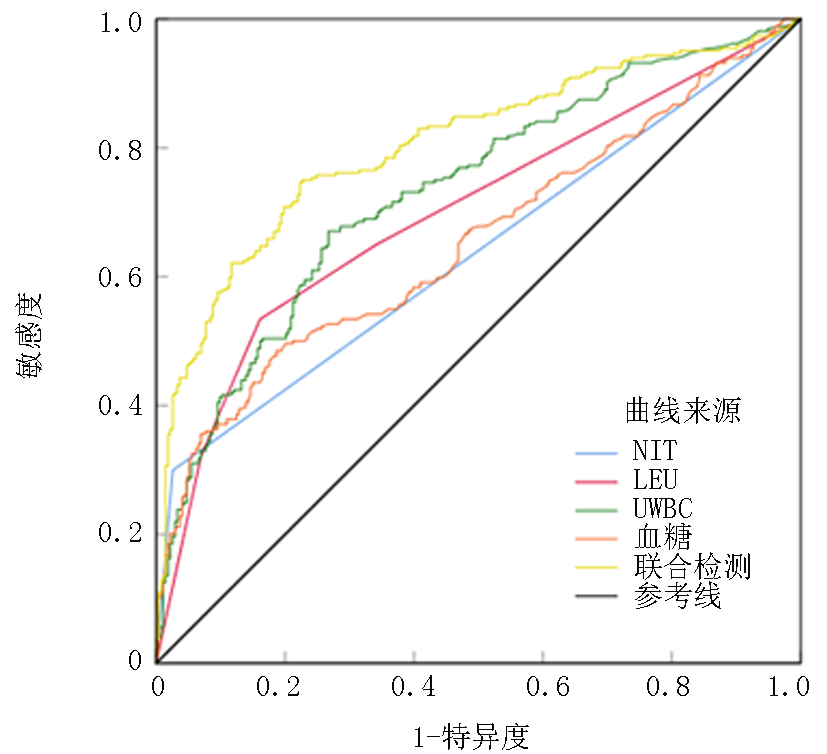
Fig.1 ROC curves of NIT, LEU, UWBC, and blood glucose for the diagnosis of UTI in patients with malignant tumors
| [1] |
|
| [2] |
pmid: 40560443 |
| [3] |
pmid: 36879210 |
| [4] |
|
| [5] |
|
| [6] |
pmid: 38666412 |
| [7] |
|
| [8] |
中国抗癌协会肿瘤内分泌专业委员会, 重庆市中西医结合学会肿瘤内分泌分会, 周琦, 等. 肿瘤相关性高血糖管理指南(2021年版)[J]. 中国癌症杂志, 2021, 31(7): 651-688.doi:10.19401/j.cnki.1007-3639.2021.07.013.
|
| [9] |
|
| [10] |
中华医学会检验医学分会分子生物学组, 广东省医师协会检验医师分会, 广东省医学会检验医学分会委员会, 广东省医学检验临床医学研究中心. 尿路感染临床检验路径专家共识(2025版)[J]. 中华检验医学杂志, 2026, 49(4): 406-417.doi:10.3760/cma.j.cn114452-20250822-00475.
|
| [11] |
|
| [12] |
|
| [13] |
|
| [14] |
郑翠玲, 韩晓红, 冯莎娜, 等. 尿沉渣分析仪对肿瘤患者尿路感染的筛查价值[J]. 中华肿瘤杂志, 2016, 38(1): 35-39.doi:10.3760/cma.j.issn.0253-3766.2016.01.007.
|
| [15] |
|
| [16] |
田翠萍, 王文渊, 郭芳芳. 尿常规检测在尿路感染诊断中的应用价值[J]. 中国实用医刊, 2021, 48(9): 75-77.doi:10.3760/cma.j.cn115689-20210128-00463.
|
| [17] |
pmid: 36921761 |
| [18] |
|
| [19] |
pmid: 40497539 |
| [20] |
章文, 陈继中, 潘晓龙, 等. 慢性肾功能不全患者尿路感染病原菌及危险因素分析[J]. 国际泌尿系统杂志, 2022, 42(5): 905-909.doi:10.3760/cma.j.cn431460-20201225-00242.
|
| [21] |
杜颖, 冯景, 杨传信, 等. 尿常规及尿液定量分析参数在早期尿路感染经验性用药中的应用[J]. 检验医学, 2020, 35(10): 1046-1048.doi:10.3969/j.issn.1673-8640.2020.10.019.
|
| [22] |
|
| [23] |
|
| [24] |
pmid: 40323595 |
| [25] |
|
| [26] |
|
| [1] | Wang Tianhui, Lyu Hui, Feng Lifei, Chen Yajie. Relationship between serum FABP5, SII, and VEGF levels and prognosis in patients with liver cancer [J]. Clinical Focus, 2026, 41(5): 399-405. |
| [2] | Liu Xiaoli, Yang Shuang, Yin Li, Hu Yan, Zheng Yumeng, Duan Lihong. Artificial intelligence-assisted assessment of BI-RADS category 4 breast nodules by physicians of different seniority [J]. Clinical Focus, 2026, 41(5): 411-416. |
| [3] | Tang Siying, Jia Junping, Tang Yuting, Zheng Yuqin, Kong Yue. Dietary inflammatory index and lung cancer risk: A meta-analysis [J]. Clinical Focus, 2026, 41(3): 197-204. |
| [4] | Wei Tingting, Pan Zhengyan, Feng Xianyan, Long Yaxiu. Analysis of risk factors for colorectal cancer with liver metastasis based on the SEER database: A propensity score matching study [J]. Clinical Focus, 2025, 40(9): 816-820. |
| [5] | Zhou Qiumei, Song Shaona, Liu Yan, Wang Wenhong. Pseudo-hypoaldosteronism caused by urinary tract anomaly complicated with infection: A case report and literature review [J]. Clinical Focus, 2025, 40(7): 639-642. |
| [6] | Zhao Guangyan, Han Tuo, Liang Xiying, Wang Qian, Zhang Yan, Wang Congxia. Risk factors and predictive model for masked hypertension in young and middle-aged adults [J]. Clinical Focus, 2025, 40(3): 205-210. |
| [7] | Li Zhongbiao, Zhao Xihao, Du Min, Wang Jiang, Yu Yue, Zhang Dianliang. Intraluminal primary extra-ovarian peritoneal serous papillary carcinoma: A case report and literature review [J]. Clinical Focus, 2025, 40(3): 257-261. |
| [8] | Liu Jiazhu, Liu Rong, Meng Limin, Guo Yinshu, Zhang Xiaobo, Ai Yiqin. Systematic evaluation of the incidence and the influencing factors of sleep disorders in breast cancer patients [J]. Clinical Focus, 2024, 39(6): 494-500. |
| [9] | Gao Ming, Liu Hao, Yu Hang, Lin Lin, Zhang Zijie, Xiong Ying. Diagnostic value of contrast-enhanced ultrasound in differentiating focal testicular lesions: A meta-analysis [J]. Clinical Focus, 2024, 39(5): 389-395. |
| [10] | Wu Xiaomin, Fang Yipeng, Zhang Zhen, Zhang Ye, Jin Cheng. Clinical application of GEMOX combined with target-immunity therapy in patients with advanced biliary tract cancer [J]. Clinical Focus, 2024, 39(5): 408-412. |
| [11] | Wang Hongqian, Fang Xuewen. Effects of family-centered advance care planning on ACP readiness and quality of life in patients with advanced cancer [J]. Clinical Focus, 2024, 39(12): 1106-1110. |
| [12] | Zhao Jinxia, Kang Huihui, Zhang Yao, Fu Shengjun, Sun Pengfei. Correlation between serum lipids before radical gastrectomy for gastric cancer and the prognosis [J]. Clinical Focus, 2024, 39(10): 889-895. |
| [13] | Li Zhenan, Zhu Xuejuan, Li Shang, Wang Junmin. Effect of glucocorticoids with varied courses on the prevention of esophageal stricture after esophageal submucosal dissection [J]. Clinical Focus, 2024, 39(10): 896-900. |
| [14] | Liu Jing, Liu Lianpei, Zhang Mengmeng, Chai Linlin, Li Rong, Zhu Liying. Gastric adenocarcinoma of fundic gland type: A case report and literature review [J]. Clinical Focus, 2024, 39(10): 929-934. |
| [15] | Zhao Xuhui, Huang Xiaomin, Da Dezhuan, Xu Yan, Cui Xiaodong, Li Hongling. Screening of glycolysis-related genes for predicting the prognosis of patients with gastric cancer: Based on bioinformatics [J]. Clinical Focus, 2024, 39(1): 20-29. |
| Viewed | ||||||
|
Full text |
|
|||||
|
Abstract |
|
|||||