
临床荟萃 ›› 2025, Vol. 40 ›› Issue (10): 874-892.doi: 10.3969/j.issn.1004-583X.2025.10.002
李永婧, 高春刚, 张金龙, 宋淑华( )
)
收稿日期:2025-09-28
出版日期:2025-10-20
发布日期:2025-10-31
通讯作者:
宋淑华
E-mail:1057955454@qq.com
基金资助:
Li Yongjing, Gao Chungang, Zhang Jinlong, Song Shuhua()
Received:2025-09-28
Online:2025-10-20
Published:2025-10-31
Contact:
Song Shuhua
E-mail:1057955454@qq.com
摘要:
目的 通过传统meta分析及网状meta分析方法对不同运动疗法的随机试验结果进行综合评估与比较,得出最佳干预类型及运动方案。方法 系统检索CNKI、维普、万方、CBM、The Cochrane Library、PubMed、EMbase、Web of science、Science Direct数据库,检索时限为建库至2025年7月。采用Review Manager软件与Stata 18软件进行网状meta分析。结果 共纳入37项RCT,meta分析结果显示:运动对轻度认知障碍患者综合认知能力[SMD=0.70]及执行功能[SMD=-0.44]干预效果显著。亚组分析发现,综合认知方面表现为,双任务运动[SMD=1.8]、5次/周[SMD=2.47]、≥51 min/次[SMD=1.14]、24周[SMD=1.99]的效应量较高;执行功能方面,中等强度有氧运动[SMD=-0.96]、50 min/次[SMD=-6.5]、5次/周[SMD=-0.96]、16周[SMD=-1.81]达到大效应量。网状meta分析结果显示:综合认知方面,与对照组相比干预效果排名前三为:高速抗阻运动[SMD=4.49,SUCRA=94.2%]>多成分运动[SMD=3.43,SUCRA=77.4%]>身心锻炼[SMD=3.29,SUCRA=67.1%];执行功能方面,与对照组相比干预效果排名前三为:双任务运动[SMD=-38.89,SUCRA=88.6%]>阻力运动[SMD=-26.78,SUCRA=63.4%]>有氧运动[SMD=-24.06,SUCRA=58.7%]。结论 高速抗阻运动、5次/周、≥51 min/次、24周的运动方案为轻度认知障碍患者综合认知能力带来更多益处;执行功能方面,双任务运动、5次/周、>50 min/次、16周能显著改善其功能,此方面由于纳入研究有限,有待进一步验证。
中图分类号:
李永婧, 高春刚, 张金龙, 宋淑华. 不同运动疗法改善轻度认知障碍老年人综合认知及执行功能的网状meta分析[J]. 临床荟萃, 2025, 40(10): 874-892.
Li Yongjing, Gao Chungang, Zhang Jinlong, Song Shuhua. Different kinesiotherapies in improving global cognitive function and executive function in elderly people with mild cognitive impairment: A network meta-analysis[J]. Clinical Focus, 2025, 40(10): 874-892.
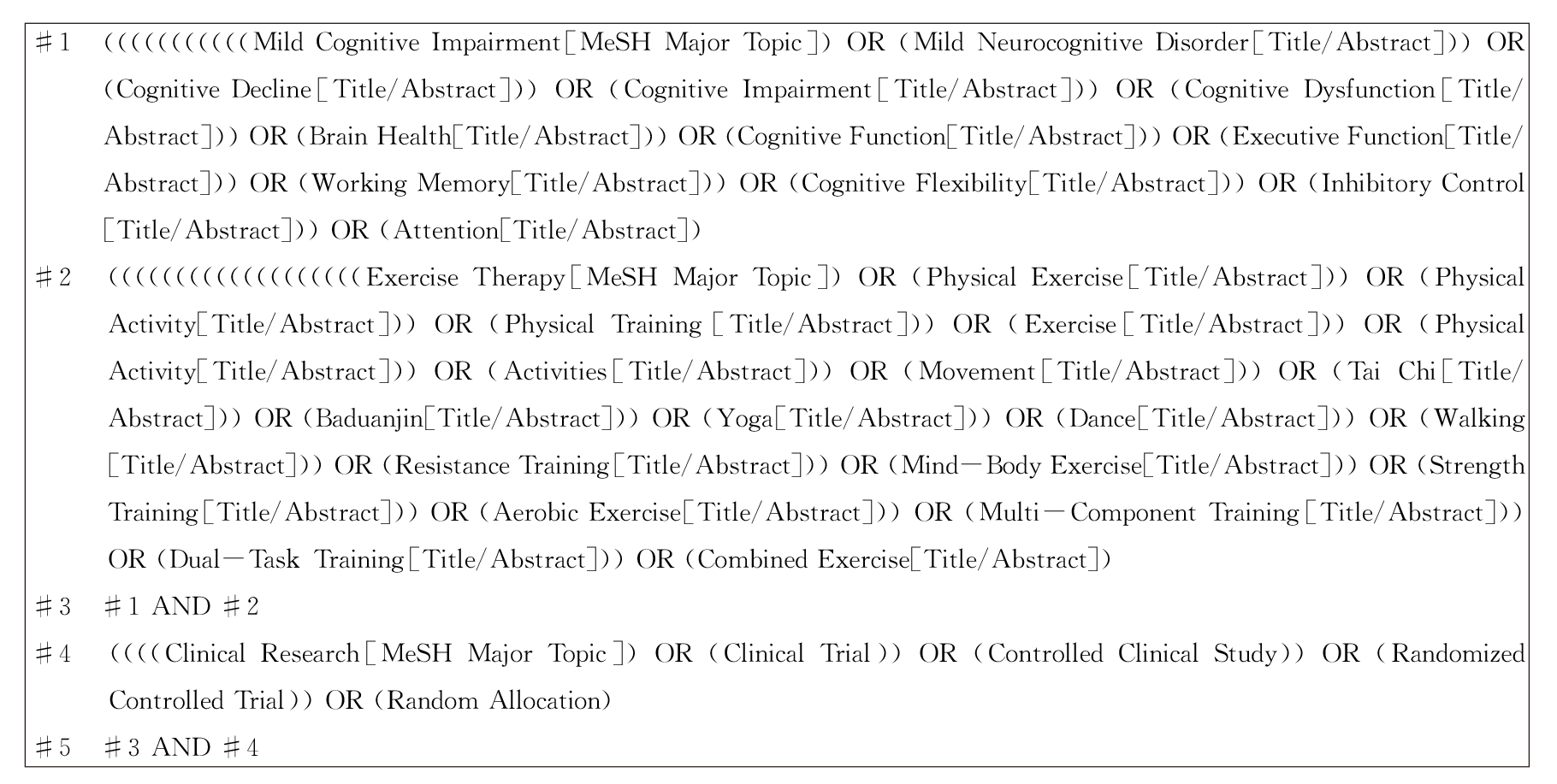
图1 PubMed数据库文献检索策略
Fig.1 Literature search strategy in the PubMed database
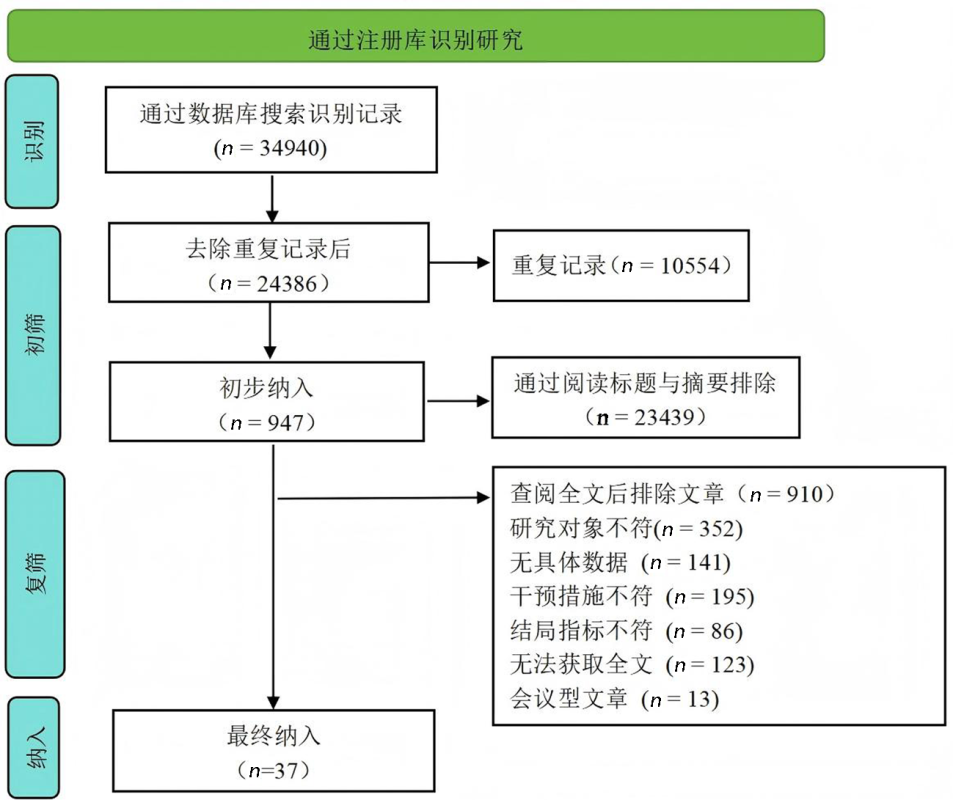
图2 文献筛选流程图
Fig.2 Flowchart of the study selection process
| 研究者 | 国家 | 干预方案 | 结局指标 | 研究对象 | 干预措施 | |||||||||||||||||
|---|---|---|---|---|---|---|---|---|---|---|---|---|---|---|---|---|---|---|---|---|---|---|
| 平均年龄(岁) | 样本量(T/C) | 女/男 | T | C | ||||||||||||||||||
| Lam等[ | 中国 | 30 min/d, 3次/周 | MMSE TMT-A TMT-B | T:77.2±6.3 C:78.3±6.6 | 389(171/218) | T:125/46 C:172/46 | MBE | 伸展 | ||||||||||||||
| Siu等[ | 中国 | 2次/周, 60 min/次, 16周 | CMMSE | - | 160(80/80) | T:58/22 C:60/20 | MBE | 常规护理 | ||||||||||||||
| 包娜娜[ | 中国 | 3次/周, 30 min/次, 6周 | MMSE MOCA | T:65.62±9.34 C:68.22±9.84 | 62(31/31) | T:16/15 C:17/14 | MBE | 健康教育 | ||||||||||||||
| Yu等[ | 中国 | 3次/周, 60 min/次, 24周 | MOCA TMT-A TMT-B | T1:67.3±4.2 T2:67.2±6.8 C:67.6±8.1 | 34(12/12/10) | T1:7/3 T2:8/4 C:10/2 | T1:MBE T2:MCT | 无干预 | ||||||||||||||
| Zheng等[ | 中国 | 3次/周, 60 min/次, 24周 | MOCA | T1:65.86±5.28 T2:64.88±3.30 C:65.79±4.35 | 69(23/23/23) | - | T1:MBE T2:MIAE | 无干预 | ||||||||||||||
| Liu等[ | 中国 | 3次/周, 50 min/次, - | MOCA TMT-A TMT-B | T1:74.6±6.1 T2:73.2±6.3 C:73.4±6.5 | 50(17/17/16) | T1:12/4 T2:12/5 C:11/6 | T1:DTT T2:MBE | 无干预 | ||||||||||||||
| Li等[ | 美国 | 2次/周, 60 min/次, 16周 | MOCA | T1:74.4±5.1 T2:74.5±5.6 C:74.9±6.3 | 69(23/22/24) | T1:16/7 T2:8/12 C:15/9 | T1:DTT T2:MBE | 日常活动 | ||||||||||||||
| Zhou等[ | 中国 | 12周 | MMSE MOCA TMT-A | - | 66(22/22/22) | - | T1:DTT T2:MBE | 日常活动 | ||||||||||||||
| Varela等[ | 西班牙 | 3次/周, 60 min/次, 12周 | MMSE | T1:79.24±10.7 T2:76.44+11.38 C:79.40±6.72 | 48(17/16/15) | - | T1:LIAE T2:MIAE | 娱乐活动 | ||||||||||||||
| Wei等[ | 中国 | 5次/周, 30 min/次, 24周 | MMSE | T:66.73±5.48 C:65.27±4.63 | 60(30/30) | T:9/21 C:11/19 | LIAE | 日常活动 | ||||||||||||||
| Zhang等[ | 美国 | 3次/周, 60 min/次, 12周 | MMSE MOCA | T1:66.67±6.04 T2:66.22±5.51 C:69.75±7.02 | 42(14/14/14) | - | T1:DTT T2:LIAE | 健康教育 | ||||||||||||||
| Krootnark等[ | 泰国 | 5次/周, 35 min/次, 共12周 | MOCA | T1:68.60±4.86 T2:68.70±4.72 C:69.70±5.55 | 90(30/30/30) | T1:24/6 T2:23/7 C:24/6 | T1:LIAE T2:LSRT | 日常活动 | ||||||||||||||
| Wang等[ | 中国 | 3次/周, 12周 | MMSE MOCA | T:81.06±5.17 C:81.09±7.44 | 66(33/33) | T:26/7 C:21/12 | MIAE | 日常活动 | ||||||||||||||
| Sánchez-Alcalá等[ 2025 | 西班牙 | 2次/周, 60 min/次, 12周 | MMSE MOCA TMT-A TMT-B | T:71.43±2.97 C:72.24±2.92 | 92(47/45) | T:29/35 C:29/32 | MIAE | 无干预 | ||||||||||||||
| Wu等[ | 中国 | 3次/周, 35 min/次, 12周 | MMSE MOCA TMT-A TMT-B | T:70.56±6.21 C:69.13±8.09 | 32(16/16) | T:11/5 C:12/4 | MIAE | 健康教育 | ||||||||||||||
| Qi等[ | 中国 | 3次/周, 12周 | MMSE MOCA | T:70.6±6.2 C:69.1±8.1 | 32(16/16) | T:11/5 C:12/4 | MIAE | 常规护理 | ||||||||||||||
| Ayari等[ | 法国 | 1次/周, 60 min/次, 16周 | MMSE | T:79.8±7.7 C:77.2±5.3 | 23(11/12) | T:9/2 C:7/5 | MIAE | 日常活动 | ||||||||||||||
| Zotcheva等[ | 挪威 | 2次/周, 50 min/次, - | MOCA | T1:72.3±2.05 T2:72.4±2.08 C:72.2±2.02 | 945 | T1:114/121 T2:97/119 C:239/255 | T1:MIAE T2:HIIT | 无干预 | ||||||||||||||
| Song等[ | 中国 | 3次/周, 60 min/次, 16周 | MOCA | T:76.22±5.76 C:75.33±6.78 | 120(60/60) | T:48/12 C:42/18 | MIAE | 健康教育 | ||||||||||||||
| 宋艳丽[ | 中国 | 4次/周, 30 min/次, 12周 | MOCA | T:70.34±9.24 C:69.97±10.0 | 59(29/30) | T:16/13 C:16/14 | MIAE | 日常活动 | ||||||||||||||
| Zhu等[ | 中国 | 3次/周, 35 min/次, 12周 | MOCA | T:70.3±6.7 C:69.0±7.3 | 54(27/27) | T:15/12 C:21/6 | MIAE | 常规护理 | ||||||||||||||
| Li等[ | 中国 | 5次/周, 30 min/次, 24周 | MMSE MOCA | - | 84(42/42) | T:27/15 C:24/18 | MCT | 健康教育 | ||||||||||||||
| Rivas-Campo等[ 2023 | 哥伦比亚 | 3次/周, 45 min/次, 12周 | MOCA TMT-A TMT-B | T:77.19±7.7 C:77.11±7.3 | 132(68/64) | T:41/27 C:38/26 | MCT | 无干预 | ||||||||||||||
| Buele等[ | 厄瓜多尔 | 2次/周, 40 min/次, 6周 | MOCA | T:75.41±5.76 C:77.35±6.75 | 34(17/17) | T:10/7 C:13/4 | MCT | 健康教育 | ||||||||||||||
| Wang等[ | 中国 | 3次/周, 60 min/次, 12周 | MOCA | T:68.37±5.27 C:68.24±5.15 | 111(57/54) | T:36/21 C:32/22 | MCT | 健康教育 | ||||||||||||||
| Choi等[ | 韩国 | 2次/周, 60 min/次, 6周 | MOCA | T:74.90±5.10 C:74.23±4.38 | 60(30/30) | T:24/6 C:25/5 | MCT | 常规护理 | ||||||||||||||
| Bademli等[ | 西班牙 | 2次/周, 60 min/次, 12周 | MMSE TMT-A TMT-B | T:72.88±5.60 C:77.29±5.16 | 31(17/14) | T:9/8 C:7/7 | SPAI | 日常活动 | ||||||||||||||
| Yang等[ | 中国 | 3次/周, 60 min/次, 12周 | MMSE | T:83.1±5.7 C:82.0±5.5 | 36(19/17) | T:16/3 C:10/7 | MCT | 无干预 | ||||||||||||||
| Bisbe等[ | 西班牙 | 2次/周, 60 min/次, 12周 | TMT-A TMT-B MMSE | T:72.88±5.60 C:77.29±5.16 | 31(17/14) | T:9/8 C:7/7 | SPAI | 日常活动 | ||||||||||||||
| Tsai等[ | 中国 | 3次/周, 16周 | MMSE | T1:66.00±7.68 T2:65.44±6.76 C:65.17±7.00 | 55(19/18/18) | T1:14/15 T2:11/7 C:13/5 | T1:SPAI T2:RT | 无干预 | ||||||||||||||
| Hong等[ | 韩国 | 2次/周, 60 min/次, 12周 | MOCA | - | 22(12/10) | T:7/3 C:9/3 | HSRT | 日常活动 | ||||||||||||||
| Yoon等[ | 韩国 | 2次/周, 60 min/次, 12周 | MMSE MOCA | T1:75.00±3.46 T2:76.00±3.94 C:78.00±2.77 | 30(14/9/7) | - | T1:HSRT T2:LSRT | 无干预 | ||||||||||||||
| Lü等[ | 中国 | 3次/周, 12周 | TMT-B | T:69.00±3.83 C:70.43±5.53 | 45(22/23) | T:16/6 C:16/7 | RT | 日常活动 | ||||||||||||||
| Tao等[ | 中国 | 2周/次, 60~90 min/次, 12周 | MMSE MOCA | T:73.41±7.785 C:74.90±6.613 | 103(51/52) | T:35/16 C:32/20 | DTT | 健康教育 | ||||||||||||||
| Baek等[ | 韩国 | 3次/周, 40 min/次, 共6周 | MMSE | T:82.40±4.46 C:81.04±4.93 | 44(22/22) | T:15/7 C:14/8 | DTT | 日常活动 | ||||||||||||||
| Langoni等[ | 巴西 | 2次/周, 60 min/次, 24周 | MMSE | T:72.6±7.8 C:71.9±7.9 | 52(26/26) | T:20/6 C:20/6 | MCT | 无干预 | ||||||||||||||
| Sousa等[ | 巴西 | 8周 | MMSE | T:63.25±2.96 C:66.00±6.39 | 31(16/15) | - | RT | 无干预 | ||||||||||||||
表1 纳入研究的基本资料
Tab.1 Basic characteristics of the included studies
| 研究者 | 国家 | 干预方案 | 结局指标 | 研究对象 | 干预措施 | |||||||||||||||||
|---|---|---|---|---|---|---|---|---|---|---|---|---|---|---|---|---|---|---|---|---|---|---|
| 平均年龄(岁) | 样本量(T/C) | 女/男 | T | C | ||||||||||||||||||
| Lam等[ | 中国 | 30 min/d, 3次/周 | MMSE TMT-A TMT-B | T:77.2±6.3 C:78.3±6.6 | 389(171/218) | T:125/46 C:172/46 | MBE | 伸展 | ||||||||||||||
| Siu等[ | 中国 | 2次/周, 60 min/次, 16周 | CMMSE | - | 160(80/80) | T:58/22 C:60/20 | MBE | 常规护理 | ||||||||||||||
| 包娜娜[ | 中国 | 3次/周, 30 min/次, 6周 | MMSE MOCA | T:65.62±9.34 C:68.22±9.84 | 62(31/31) | T:16/15 C:17/14 | MBE | 健康教育 | ||||||||||||||
| Yu等[ | 中国 | 3次/周, 60 min/次, 24周 | MOCA TMT-A TMT-B | T1:67.3±4.2 T2:67.2±6.8 C:67.6±8.1 | 34(12/12/10) | T1:7/3 T2:8/4 C:10/2 | T1:MBE T2:MCT | 无干预 | ||||||||||||||
| Zheng等[ | 中国 | 3次/周, 60 min/次, 24周 | MOCA | T1:65.86±5.28 T2:64.88±3.30 C:65.79±4.35 | 69(23/23/23) | - | T1:MBE T2:MIAE | 无干预 | ||||||||||||||
| Liu等[ | 中国 | 3次/周, 50 min/次, - | MOCA TMT-A TMT-B | T1:74.6±6.1 T2:73.2±6.3 C:73.4±6.5 | 50(17/17/16) | T1:12/4 T2:12/5 C:11/6 | T1:DTT T2:MBE | 无干预 | ||||||||||||||
| Li等[ | 美国 | 2次/周, 60 min/次, 16周 | MOCA | T1:74.4±5.1 T2:74.5±5.6 C:74.9±6.3 | 69(23/22/24) | T1:16/7 T2:8/12 C:15/9 | T1:DTT T2:MBE | 日常活动 | ||||||||||||||
| Zhou等[ | 中国 | 12周 | MMSE MOCA TMT-A | - | 66(22/22/22) | - | T1:DTT T2:MBE | 日常活动 | ||||||||||||||
| Varela等[ | 西班牙 | 3次/周, 60 min/次, 12周 | MMSE | T1:79.24±10.7 T2:76.44+11.38 C:79.40±6.72 | 48(17/16/15) | - | T1:LIAE T2:MIAE | 娱乐活动 | ||||||||||||||
| Wei等[ | 中国 | 5次/周, 30 min/次, 24周 | MMSE | T:66.73±5.48 C:65.27±4.63 | 60(30/30) | T:9/21 C:11/19 | LIAE | 日常活动 | ||||||||||||||
| Zhang等[ | 美国 | 3次/周, 60 min/次, 12周 | MMSE MOCA | T1:66.67±6.04 T2:66.22±5.51 C:69.75±7.02 | 42(14/14/14) | - | T1:DTT T2:LIAE | 健康教育 | ||||||||||||||
| Krootnark等[ | 泰国 | 5次/周, 35 min/次, 共12周 | MOCA | T1:68.60±4.86 T2:68.70±4.72 C:69.70±5.55 | 90(30/30/30) | T1:24/6 T2:23/7 C:24/6 | T1:LIAE T2:LSRT | 日常活动 | ||||||||||||||
| Wang等[ | 中国 | 3次/周, 12周 | MMSE MOCA | T:81.06±5.17 C:81.09±7.44 | 66(33/33) | T:26/7 C:21/12 | MIAE | 日常活动 | ||||||||||||||
| Sánchez-Alcalá等[ 2025 | 西班牙 | 2次/周, 60 min/次, 12周 | MMSE MOCA TMT-A TMT-B | T:71.43±2.97 C:72.24±2.92 | 92(47/45) | T:29/35 C:29/32 | MIAE | 无干预 | ||||||||||||||
| Wu等[ | 中国 | 3次/周, 35 min/次, 12周 | MMSE MOCA TMT-A TMT-B | T:70.56±6.21 C:69.13±8.09 | 32(16/16) | T:11/5 C:12/4 | MIAE | 健康教育 | ||||||||||||||
| Qi等[ | 中国 | 3次/周, 12周 | MMSE MOCA | T:70.6±6.2 C:69.1±8.1 | 32(16/16) | T:11/5 C:12/4 | MIAE | 常规护理 | ||||||||||||||
| Ayari等[ | 法国 | 1次/周, 60 min/次, 16周 | MMSE | T:79.8±7.7 C:77.2±5.3 | 23(11/12) | T:9/2 C:7/5 | MIAE | 日常活动 | ||||||||||||||
| Zotcheva等[ | 挪威 | 2次/周, 50 min/次, - | MOCA | T1:72.3±2.05 T2:72.4±2.08 C:72.2±2.02 | 945 | T1:114/121 T2:97/119 C:239/255 | T1:MIAE T2:HIIT | 无干预 | ||||||||||||||
| Song等[ | 中国 | 3次/周, 60 min/次, 16周 | MOCA | T:76.22±5.76 C:75.33±6.78 | 120(60/60) | T:48/12 C:42/18 | MIAE | 健康教育 | ||||||||||||||
| 宋艳丽[ | 中国 | 4次/周, 30 min/次, 12周 | MOCA | T:70.34±9.24 C:69.97±10.0 | 59(29/30) | T:16/13 C:16/14 | MIAE | 日常活动 | ||||||||||||||
| Zhu等[ | 中国 | 3次/周, 35 min/次, 12周 | MOCA | T:70.3±6.7 C:69.0±7.3 | 54(27/27) | T:15/12 C:21/6 | MIAE | 常规护理 | ||||||||||||||
| Li等[ | 中国 | 5次/周, 30 min/次, 24周 | MMSE MOCA | - | 84(42/42) | T:27/15 C:24/18 | MCT | 健康教育 | ||||||||||||||
| Rivas-Campo等[ 2023 | 哥伦比亚 | 3次/周, 45 min/次, 12周 | MOCA TMT-A TMT-B | T:77.19±7.7 C:77.11±7.3 | 132(68/64) | T:41/27 C:38/26 | MCT | 无干预 | ||||||||||||||
| Buele等[ | 厄瓜多尔 | 2次/周, 40 min/次, 6周 | MOCA | T:75.41±5.76 C:77.35±6.75 | 34(17/17) | T:10/7 C:13/4 | MCT | 健康教育 | ||||||||||||||
| Wang等[ | 中国 | 3次/周, 60 min/次, 12周 | MOCA | T:68.37±5.27 C:68.24±5.15 | 111(57/54) | T:36/21 C:32/22 | MCT | 健康教育 | ||||||||||||||
| Choi等[ | 韩国 | 2次/周, 60 min/次, 6周 | MOCA | T:74.90±5.10 C:74.23±4.38 | 60(30/30) | T:24/6 C:25/5 | MCT | 常规护理 | ||||||||||||||
| Bademli等[ | 西班牙 | 2次/周, 60 min/次, 12周 | MMSE TMT-A TMT-B | T:72.88±5.60 C:77.29±5.16 | 31(17/14) | T:9/8 C:7/7 | SPAI | 日常活动 | ||||||||||||||
| Yang等[ | 中国 | 3次/周, 60 min/次, 12周 | MMSE | T:83.1±5.7 C:82.0±5.5 | 36(19/17) | T:16/3 C:10/7 | MCT | 无干预 | ||||||||||||||
| Bisbe等[ | 西班牙 | 2次/周, 60 min/次, 12周 | TMT-A TMT-B MMSE | T:72.88±5.60 C:77.29±5.16 | 31(17/14) | T:9/8 C:7/7 | SPAI | 日常活动 | ||||||||||||||
| Tsai等[ | 中国 | 3次/周, 16周 | MMSE | T1:66.00±7.68 T2:65.44±6.76 C:65.17±7.00 | 55(19/18/18) | T1:14/15 T2:11/7 C:13/5 | T1:SPAI T2:RT | 无干预 | ||||||||||||||
| Hong等[ | 韩国 | 2次/周, 60 min/次, 12周 | MOCA | - | 22(12/10) | T:7/3 C:9/3 | HSRT | 日常活动 | ||||||||||||||
| Yoon等[ | 韩国 | 2次/周, 60 min/次, 12周 | MMSE MOCA | T1:75.00±3.46 T2:76.00±3.94 C:78.00±2.77 | 30(14/9/7) | - | T1:HSRT T2:LSRT | 无干预 | ||||||||||||||
| Lü等[ | 中国 | 3次/周, 12周 | TMT-B | T:69.00±3.83 C:70.43±5.53 | 45(22/23) | T:16/6 C:16/7 | RT | 日常活动 | ||||||||||||||
| Tao等[ | 中国 | 2周/次, 60~90 min/次, 12周 | MMSE MOCA | T:73.41±7.785 C:74.90±6.613 | 103(51/52) | T:35/16 C:32/20 | DTT | 健康教育 | ||||||||||||||
| Baek等[ | 韩国 | 3次/周, 40 min/次, 共6周 | MMSE | T:82.40±4.46 C:81.04±4.93 | 44(22/22) | T:15/7 C:14/8 | DTT | 日常活动 | ||||||||||||||
| Langoni等[ | 巴西 | 2次/周, 60 min/次, 24周 | MMSE | T:72.6±7.8 C:71.9±7.9 | 52(26/26) | T:20/6 C:20/6 | MCT | 无干预 | ||||||||||||||
| Sousa等[ | 巴西 | 8周 | MMSE | T:63.25±2.96 C:66.00±6.39 | 31(16/15) | - | RT | 无干预 | ||||||||||||||
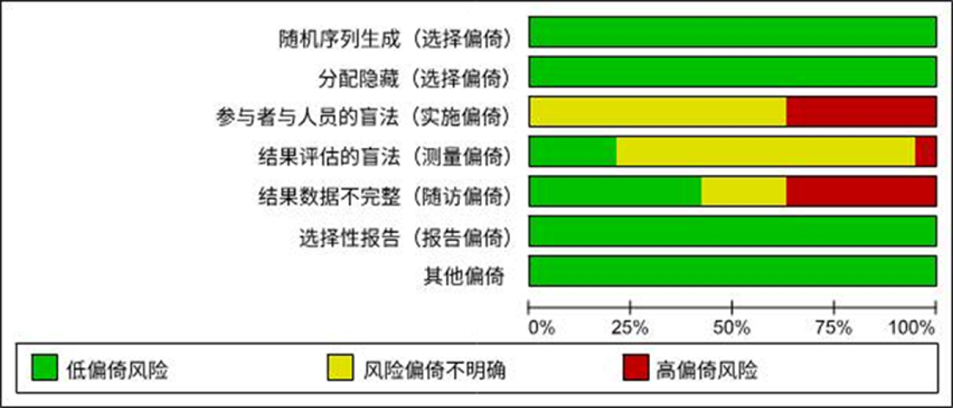
图3 纳入研究的偏倚风险评价图
Fig. 3 Risk of bias assessment for the included studies
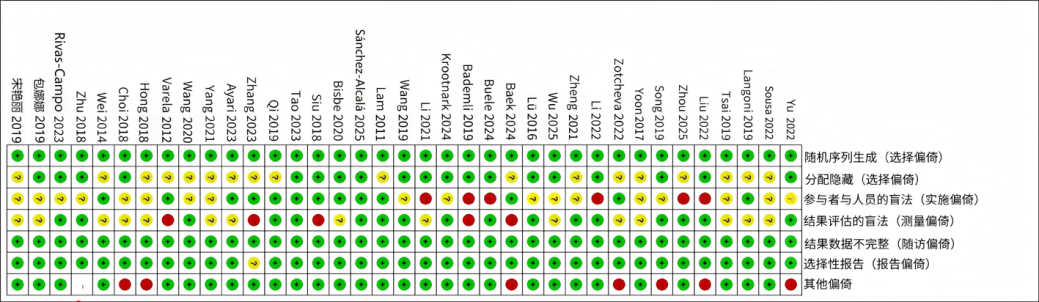
图4 纳入研究的偏倚风险总结图 注:“?”:文中未说明;“-”:高风险;“+”:低风险
Fig.4 Summary of risk of bias for the included studies
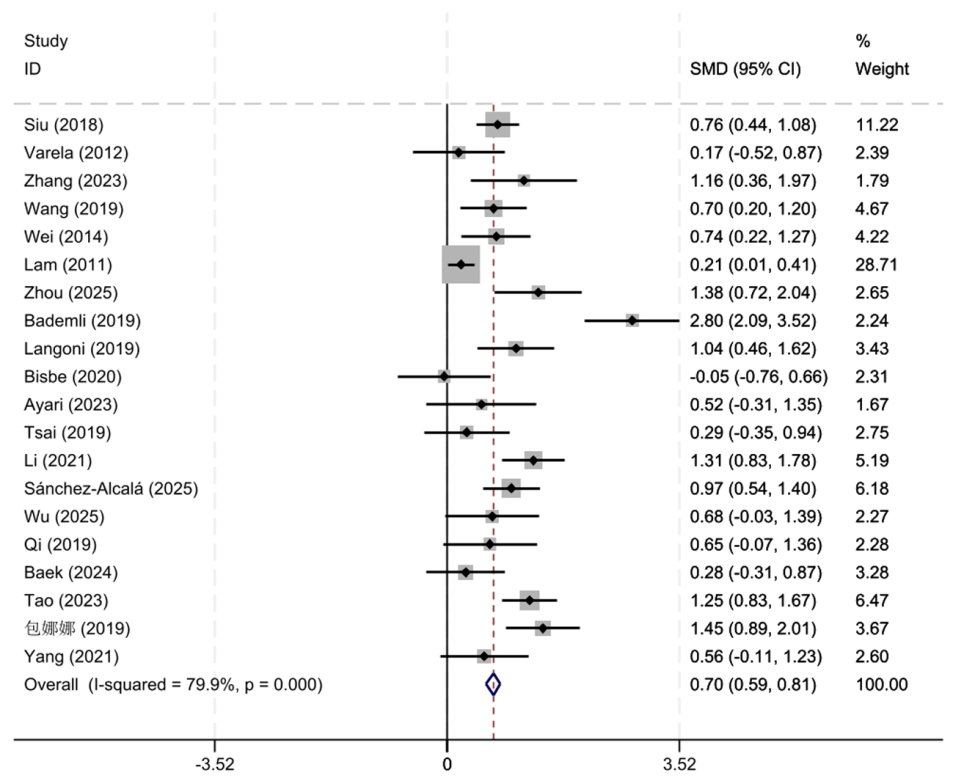
图5 以MMSE为结局指标评估的森林图
Fig.5 Forest plots of the assessment using the MMSE as an outcome measure
| 亚组 | No.Ofstudies | Hedges’sg With 95%CI | I2(%) | Pz | PQ | Test of group differences |
|---|---|---|---|---|---|---|
| 国家 | 20 | 0.83(0.57-1.09) | 80.69 | 0.00 | 0.00 | 0.00 |
| 中国 | 13 | 0.83(0.59-1.07) | 68.40 | 0.00 | 0.00 | |
| 西班牙 | 3 | 0.41(-0.23-1.05) | 71.43 | 0.21 | 0.02 | |
| 土耳其 | 1 | 2.77(2.06-3.47) | - | 0.00 | - | |
| 巴西 | 1 | 1.03(0.46-1.60) | - | 0.00 | - | |
| 法国 | 1 | 0.50(-0.30-1.30) | - | 0.00 | - | |
| 韩国 | 1 | 0.27(-0.31-0.86) | - | 0.00 | - | |
| 日本 | 1 | 0.17(-0.38-0.73) | - | 0.00 | - | |
| 对照组 | 20 | 0.83(0.57-1.09) | 80.69 | 0.00 | 0.00 | 0.00 |
| 无干预 | 8 | 1.08(0.62-1.53) | 84.23 | 0.00 | 0.00 | |
| 常规护理 | 2 | 1.06(0.27-1.84) | 68.31 | 0.01 | 0.08 | |
| 健康教育 | 4 | 1.16(0.89-1.43) | 0.00 | 0.00 | 0.49 | |
| 有氧运动 | 1 | 0.50(-0.30-1.30) | - | 0.22 | 0.00 | |
| 抗阻运动 | 1 | 0.27(-0.31-0.86) | - | 0.36 | - | |
| 拉伸 | 2 | 0.21(0.02-0.40) | 0.00 | 0.03 | 0.81 | |
| 多模态运动 | 1 | -0.05(-0.74-0.64) | - | 0.89 | - | |
| 娱乐活动 | 1 | 0.17(-0.51-0.85) | - | 0.63 | - | |
| 频率 | 19 | 0.80(0.53-1.07) | 80.88 | 0.00 | 0.00 | 0.00 |
| 1次/周 | 1 | 0.50(-0.30-1.30) | - | 0.22 | - | |
| 2次/周 | 5 | 0.83(0.46-1.20) | 63.32 | 0.00 | 0.04 | |
| 3次/周 | 10 | 0.57(0.31-0.84) | 59.02 | 0.00 | 0.01 | |
| 4次/周 | 1 | 2.77(2.06-3.47) | - | 0.00 | - | |
| 5次/周 | 1 | 0.73(0.22-1.25) | - | 0.01 | - | |
| 6次/周 | 1 | 1.24(0.82-1.66) | - | 0.00 | - | |
| 剂量 | 19 | 0.80(0.53-1.07) | 80.88 | 0.00 | 0.00 | 0.08 |
| 30/35 min | 5 | 0.69(0.30-1.08) | 74.80 | 0.00 | 0.00 | |
| 40 min | 3 | 0.38(0.01-0.74) | 0.00 | 0.04 | 0.70 | |
| 60 min | 10 | 0.81(0.54-1.09) | 60.21 | 0.00 | 0.01 | |
| 80 min | 1 | 2.77(2.06-3.47) | - | 0.00 | - | |
| 90 min | 1 | 0.17(-0.38-0.73) | - | 0.53 | - | |
| 周期 | 20 | 0.83(0.57-1.09) | 80.69 | 0.00 | 0.00 | 0.00 |
| 6周 | 1 | 0.27(-0.31-0.86) | - | 0.36 | - | |
| 12周 | 11 | 0.68(0.41-0.96) | 68.14 | 0.00 | 0.00 | |
| 16周 | 3 | 0.62(0.30-0.94) | 14.56 | 0.00 | 0.40 | |
| 20周 | 1 | 2.77(2.06-3.47) | - | 0.00 | - | |
| 24周 | 4 | 1.12(0.82-1.43) | 25.96 | 0.00 | 4.03 |
表2 以MMSE为结局指标的亚组分析
Tab.2 Subgroup analysis with the MMSE as the outcome measure
| 亚组 | No.Ofstudies | Hedges’sg With 95%CI | I2(%) | Pz | PQ | Test of group differences |
|---|---|---|---|---|---|---|
| 国家 | 20 | 0.83(0.57-1.09) | 80.69 | 0.00 | 0.00 | 0.00 |
| 中国 | 13 | 0.83(0.59-1.07) | 68.40 | 0.00 | 0.00 | |
| 西班牙 | 3 | 0.41(-0.23-1.05) | 71.43 | 0.21 | 0.02 | |
| 土耳其 | 1 | 2.77(2.06-3.47) | - | 0.00 | - | |
| 巴西 | 1 | 1.03(0.46-1.60) | - | 0.00 | - | |
| 法国 | 1 | 0.50(-0.30-1.30) | - | 0.00 | - | |
| 韩国 | 1 | 0.27(-0.31-0.86) | - | 0.00 | - | |
| 日本 | 1 | 0.17(-0.38-0.73) | - | 0.00 | - | |
| 对照组 | 20 | 0.83(0.57-1.09) | 80.69 | 0.00 | 0.00 | 0.00 |
| 无干预 | 8 | 1.08(0.62-1.53) | 84.23 | 0.00 | 0.00 | |
| 常规护理 | 2 | 1.06(0.27-1.84) | 68.31 | 0.01 | 0.08 | |
| 健康教育 | 4 | 1.16(0.89-1.43) | 0.00 | 0.00 | 0.49 | |
| 有氧运动 | 1 | 0.50(-0.30-1.30) | - | 0.22 | 0.00 | |
| 抗阻运动 | 1 | 0.27(-0.31-0.86) | - | 0.36 | - | |
| 拉伸 | 2 | 0.21(0.02-0.40) | 0.00 | 0.03 | 0.81 | |
| 多模态运动 | 1 | -0.05(-0.74-0.64) | - | 0.89 | - | |
| 娱乐活动 | 1 | 0.17(-0.51-0.85) | - | 0.63 | - | |
| 频率 | 19 | 0.80(0.53-1.07) | 80.88 | 0.00 | 0.00 | 0.00 |
| 1次/周 | 1 | 0.50(-0.30-1.30) | - | 0.22 | - | |
| 2次/周 | 5 | 0.83(0.46-1.20) | 63.32 | 0.00 | 0.04 | |
| 3次/周 | 10 | 0.57(0.31-0.84) | 59.02 | 0.00 | 0.01 | |
| 4次/周 | 1 | 2.77(2.06-3.47) | - | 0.00 | - | |
| 5次/周 | 1 | 0.73(0.22-1.25) | - | 0.01 | - | |
| 6次/周 | 1 | 1.24(0.82-1.66) | - | 0.00 | - | |
| 剂量 | 19 | 0.80(0.53-1.07) | 80.88 | 0.00 | 0.00 | 0.08 |
| 30/35 min | 5 | 0.69(0.30-1.08) | 74.80 | 0.00 | 0.00 | |
| 40 min | 3 | 0.38(0.01-0.74) | 0.00 | 0.04 | 0.70 | |
| 60 min | 10 | 0.81(0.54-1.09) | 60.21 | 0.00 | 0.01 | |
| 80 min | 1 | 2.77(2.06-3.47) | - | 0.00 | - | |
| 90 min | 1 | 0.17(-0.38-0.73) | - | 0.53 | - | |
| 周期 | 20 | 0.83(0.57-1.09) | 80.69 | 0.00 | 0.00 | 0.00 |
| 6周 | 1 | 0.27(-0.31-0.86) | - | 0.36 | - | |
| 12周 | 11 | 0.68(0.41-0.96) | 68.14 | 0.00 | 0.00 | |
| 16周 | 3 | 0.62(0.30-0.94) | 14.56 | 0.00 | 0.40 | |
| 20周 | 1 | 2.77(2.06-3.47) | - | 0.00 | - | |
| 24周 | 4 | 1.12(0.82-1.43) | 25.96 | 0.00 | 4.03 |
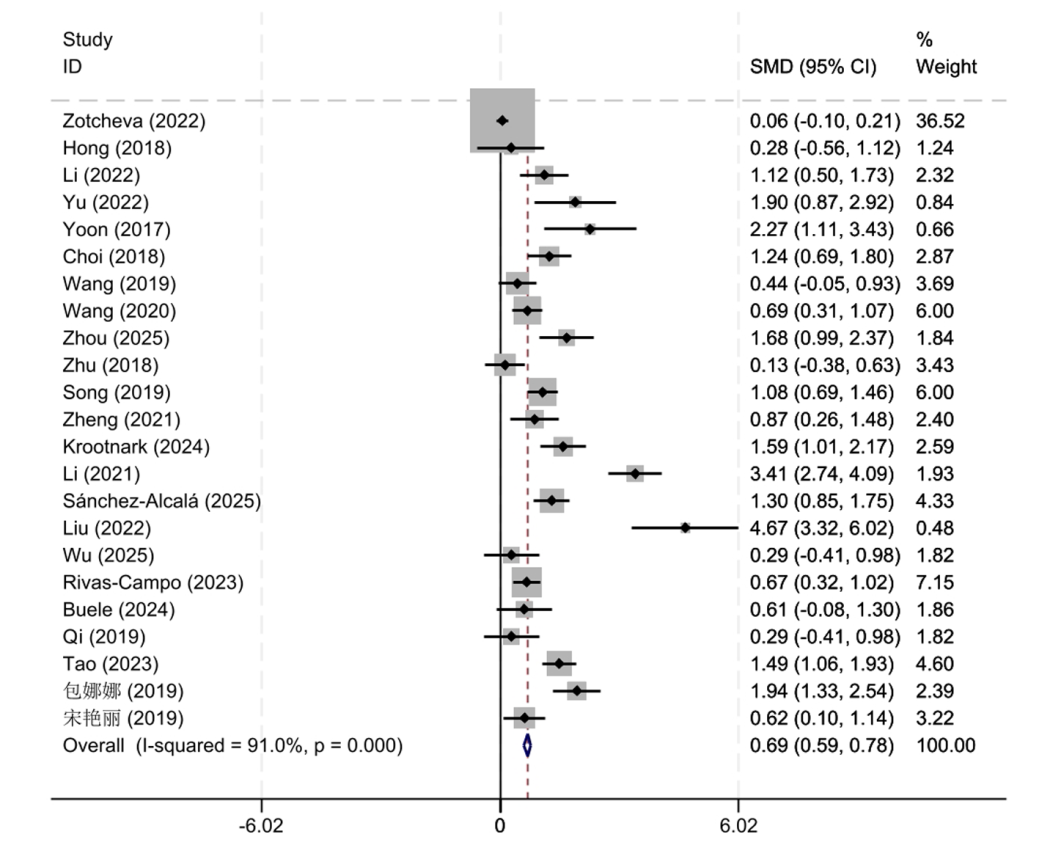
图6 以MoCA为结局指标评估的森林图
Fig.6 Forest plots of the assessment using the MoCA as an outcome measure
| 亚组 | No.Ofstudies | Hedges’sg With 95%CI | I2(%) | Pz | PQ | Test of group differences |
|---|---|---|---|---|---|---|
| 干预类型 | 23 | 1.16(0.77-1.55) | 93.00 | 0.00 | 0.00 | 0.01 |
| 中等强度有氧运动 | 8 | 0.52(0.19-0.86) | 80.30 | 0.00 | 0.00 | |
| 高速抗阻运动 | 2 | 1.19(-0.68-3.06) | 86.80 | 0.21 | 0.01 | |
| 双任务运动 | 5 | 1.80(0.58-3.03) | 95.70 | 0.00 | 0.00 | |
| 身心锻炼 | 3 | 1.50(0.78-2.21) | 68.07 | 0.00 | 0.03 | |
| 多成分运动 | 4 | 1.46(0.19-2.72) | 95.52 | 0.02 | 0.00 | |
| 低强度有氧运动 | 1 | 1.57(1.00-2.14) | - | 0.00 | - | |
| 国家 | 23 | 1.16(0.77-1.55) | 93.23 | 0.00 | 0.00 | 0.00 |
| 挪威 | 1 | 0.06(-0.10-0.21) | - | 0.46 | - | |
| 韩国 | 3 | 1.18(0.17-2.18) | 79.10 | 0.02 | 0.02 | |
| 中国 | 15 | 1.29(0.73-1.86) | 93.41 | 0.00 | 0.00 | |
| 泰国 | 1 | 1.57(1.00-2.14) | - | 0.00 | - | |
| 西班牙 | 1 | 1.29(0.85-1.74) | - | 0.00 | - | |
| 哥伦比亚 | 1 | 0.67(0.32-1.02) | - | 0.00 | - | |
| 厄尔多瓜 | 1 | 0.60(-0.07-1.27) | - | 0.08 | - | |
| 频率 | 22 | 1.14(0.74-1.55) | 93.62 | 0.00 | 0.00 | 0.05 |
| 2次/周 | 7 | 0.89(0.40-1.39) | 85.12 | 0.00 | 0.00 | |
| 3次/周 | 11 | 1.07(0.43-1.71) | 93.76 | 0.00 | 0.00 | |
| 4次/周 | 1 | 0.61(0.10-1.13) | - | 0.00 | 0.02 | |
| 5次/周 | 2 | 2.47(0.70-4.24) | 93.88 | 0.01 | 0.00 | |
| 2周/次 | 1 | 1.48(1.05-1.92) | - | 0.00 | - | |
| 剂量 | 23 | 1.16(0.77-1.55) | 93.00 | 0.00 | 0.00 | 0.87 |
| ≤30 min | 3 | 1.46(-0.39-3.32) | 97.10 | 0.12 | 0.00 | |
| 31~50 min | 8 | 1.11(0.18-2.04) | 97.02 | 0.00 | 0.02 | |
| ≥51 min | 12 | 1.14(0.85-1.43) | 68.11 | 0.00 | 0.00 | |
| 周期 | 22 | 1.14(0.74-1.55) | 93.23 | 0.00 | 0.00 | 0.00 |
| 12周 | 14 | 1.07(0.56-1.58) | 91.81 | 0.00 | 0.00 | |
| 16周 | 2 | 1.08(0.75-1.40) | 0.00 | 0.00 | 0.93 | |
| 6周 | 2 | 0.94(0.33-1.56) | 51.13 | 0.00 | 0.15 | |
| 24周 | 4 | 1.99(0.95-3.04) | 89.31 | 0.00 | 0.00 |
表3 以MoCA为结局指标的亚组分析
Tab.3 Subgroup analysis with the MoCA as the outcome measure
| 亚组 | No.Ofstudies | Hedges’sg With 95%CI | I2(%) | Pz | PQ | Test of group differences |
|---|---|---|---|---|---|---|
| 干预类型 | 23 | 1.16(0.77-1.55) | 93.00 | 0.00 | 0.00 | 0.01 |
| 中等强度有氧运动 | 8 | 0.52(0.19-0.86) | 80.30 | 0.00 | 0.00 | |
| 高速抗阻运动 | 2 | 1.19(-0.68-3.06) | 86.80 | 0.21 | 0.01 | |
| 双任务运动 | 5 | 1.80(0.58-3.03) | 95.70 | 0.00 | 0.00 | |
| 身心锻炼 | 3 | 1.50(0.78-2.21) | 68.07 | 0.00 | 0.03 | |
| 多成分运动 | 4 | 1.46(0.19-2.72) | 95.52 | 0.02 | 0.00 | |
| 低强度有氧运动 | 1 | 1.57(1.00-2.14) | - | 0.00 | - | |
| 国家 | 23 | 1.16(0.77-1.55) | 93.23 | 0.00 | 0.00 | 0.00 |
| 挪威 | 1 | 0.06(-0.10-0.21) | - | 0.46 | - | |
| 韩国 | 3 | 1.18(0.17-2.18) | 79.10 | 0.02 | 0.02 | |
| 中国 | 15 | 1.29(0.73-1.86) | 93.41 | 0.00 | 0.00 | |
| 泰国 | 1 | 1.57(1.00-2.14) | - | 0.00 | - | |
| 西班牙 | 1 | 1.29(0.85-1.74) | - | 0.00 | - | |
| 哥伦比亚 | 1 | 0.67(0.32-1.02) | - | 0.00 | - | |
| 厄尔多瓜 | 1 | 0.60(-0.07-1.27) | - | 0.08 | - | |
| 频率 | 22 | 1.14(0.74-1.55) | 93.62 | 0.00 | 0.00 | 0.05 |
| 2次/周 | 7 | 0.89(0.40-1.39) | 85.12 | 0.00 | 0.00 | |
| 3次/周 | 11 | 1.07(0.43-1.71) | 93.76 | 0.00 | 0.00 | |
| 4次/周 | 1 | 0.61(0.10-1.13) | - | 0.00 | 0.02 | |
| 5次/周 | 2 | 2.47(0.70-4.24) | 93.88 | 0.01 | 0.00 | |
| 2周/次 | 1 | 1.48(1.05-1.92) | - | 0.00 | - | |
| 剂量 | 23 | 1.16(0.77-1.55) | 93.00 | 0.00 | 0.00 | 0.87 |
| ≤30 min | 3 | 1.46(-0.39-3.32) | 97.10 | 0.12 | 0.00 | |
| 31~50 min | 8 | 1.11(0.18-2.04) | 97.02 | 0.00 | 0.02 | |
| ≥51 min | 12 | 1.14(0.85-1.43) | 68.11 | 0.00 | 0.00 | |
| 周期 | 22 | 1.14(0.74-1.55) | 93.23 | 0.00 | 0.00 | 0.00 |
| 12周 | 14 | 1.07(0.56-1.58) | 91.81 | 0.00 | 0.00 | |
| 16周 | 2 | 1.08(0.75-1.40) | 0.00 | 0.00 | 0.93 | |
| 6周 | 2 | 0.94(0.33-1.56) | 51.13 | 0.00 | 0.15 | |
| 24周 | 4 | 1.99(0.95-3.04) | 89.31 | 0.00 | 0.00 |
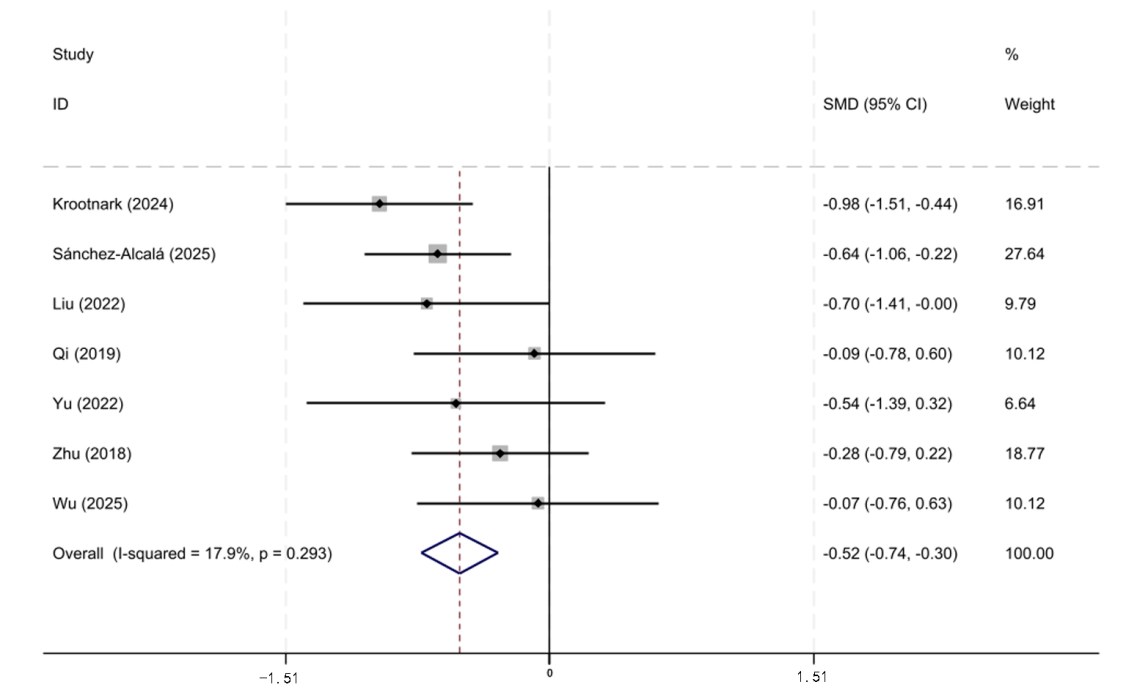
图7 以TMT-A为结局指标评估的森林图
Fig.7 Forest plots of the assessment using the TMT-A as an outcome measure
| 亚组 | No.Ofstudies | Hedges’sg With 95%CI | I2(%) | Pz | PQ | Test of group differences |
|---|---|---|---|---|---|---|
| 干预类型 | 7 | -0.50(-0.75--0.25) | 21.82 | 0.00 | 0.28 | 0.13 |
| 中等强度有氧运动 | 1 | -0.96(-1.49--0.43) | - | 0.00 | - | |
| 低强度有氧运动 | 4 | -0.35(-0.64--0.05) | 17.50 | 0.02 | 0.37 | |
| 身心锻炼 | 2 | -0.62(-1.14--0.09) | 0.00 | 0.02 | 0.76 | |
| 国家 | 7 | -0.50(-0.75--0.25) | 21.82 | 0.00 | 0.28 | 0.08 |
| 泰国 | 1 | -0.96(-1.49--0.43) | - | 0.00 | - | |
| 西班牙 | 1 | -0.64(-1.05--0.22) | - | 0.00 | - | |
| 中国 | 5 | -0.31(-0.60--0.02) | 0.00 | 0.04 | 0.67 | |
| 剂量 | 7 | -0.50(-0.75--0.25) | 21.82 | 0.00 | 0.28 | 0.65 |
| 35 min | 4 | -0.38(-0.81-0.05) | 52.69 | 0.08 | 0.10 | |
| 50 min | 1 | -0.69(1.37--0.00) | - | 0.05 | - | |
| 60 min | 2 | -0.61(-0.98--0.24) | 0.00 | 0.00 | 0.80 | |
| 频率 | 7 | -0.50(-0.75--0.25) | 21.82 | 0.00 | 0.28 | 0.08 |
| 2次/周 | 1 | -0.64(-1.05--0.22) | - | 0.00 | - | |
| 3次/周 | 5 | -0.31(-0.60--0.02) | 0.00 | 0.04 | 0.67 | |
| 5次/周 | 1 | -0.96(-1.49--0.43) | - | 0.00 | - | |
| 周期 | 7 | -0.50(-0.75--0.25) | 21.82 | 0.00 | 0.28 | 0.95 |
| 12周 | 6 | -0.49(-0.77--0.21) | 31.98 | 0.00 | 0.19 | |
| 24周 | 1 | -0.52(-1.34-0.30) | - | 0.22 | - | |
| 对照组 | 7 | -0.50(-0.75--0.25) | 21.82 | 0.00 | 0.28 | 0.05 |
| 无干预 | 4 | -0.72(-1.00--0.44) | 0.00 | 0.00 | 0.75 | |
| 常规护理 | 2 | -0.21(-0.62-0.19) | 0.00 | 0.3 | 0.65 | |
| 健康教育 | 1 | -0.07(-0.74-0.61) | - | 0.85 | - |
表4 以TMT-A为结局指标的亚组分析
Tab.4 Subgroup analysis with the TMT-A as the outcome measure
| 亚组 | No.Ofstudies | Hedges’sg With 95%CI | I2(%) | Pz | PQ | Test of group differences |
|---|---|---|---|---|---|---|
| 干预类型 | 7 | -0.50(-0.75--0.25) | 21.82 | 0.00 | 0.28 | 0.13 |
| 中等强度有氧运动 | 1 | -0.96(-1.49--0.43) | - | 0.00 | - | |
| 低强度有氧运动 | 4 | -0.35(-0.64--0.05) | 17.50 | 0.02 | 0.37 | |
| 身心锻炼 | 2 | -0.62(-1.14--0.09) | 0.00 | 0.02 | 0.76 | |
| 国家 | 7 | -0.50(-0.75--0.25) | 21.82 | 0.00 | 0.28 | 0.08 |
| 泰国 | 1 | -0.96(-1.49--0.43) | - | 0.00 | - | |
| 西班牙 | 1 | -0.64(-1.05--0.22) | - | 0.00 | - | |
| 中国 | 5 | -0.31(-0.60--0.02) | 0.00 | 0.04 | 0.67 | |
| 剂量 | 7 | -0.50(-0.75--0.25) | 21.82 | 0.00 | 0.28 | 0.65 |
| 35 min | 4 | -0.38(-0.81-0.05) | 52.69 | 0.08 | 0.10 | |
| 50 min | 1 | -0.69(1.37--0.00) | - | 0.05 | - | |
| 60 min | 2 | -0.61(-0.98--0.24) | 0.00 | 0.00 | 0.80 | |
| 频率 | 7 | -0.50(-0.75--0.25) | 21.82 | 0.00 | 0.28 | 0.08 |
| 2次/周 | 1 | -0.64(-1.05--0.22) | - | 0.00 | - | |
| 3次/周 | 5 | -0.31(-0.60--0.02) | 0.00 | 0.04 | 0.67 | |
| 5次/周 | 1 | -0.96(-1.49--0.43) | - | 0.00 | - | |
| 周期 | 7 | -0.50(-0.75--0.25) | 21.82 | 0.00 | 0.28 | 0.95 |
| 12周 | 6 | -0.49(-0.77--0.21) | 31.98 | 0.00 | 0.19 | |
| 24周 | 1 | -0.52(-1.34-0.30) | - | 0.22 | - | |
| 对照组 | 7 | -0.50(-0.75--0.25) | 21.82 | 0.00 | 0.28 | 0.05 |
| 无干预 | 4 | -0.72(-1.00--0.44) | 0.00 | 0.00 | 0.75 | |
| 常规护理 | 2 | -0.21(-0.62-0.19) | 0.00 | 0.3 | 0.65 | |
| 健康教育 | 1 | -0.07(-0.74-0.61) | - | 0.85 | - |
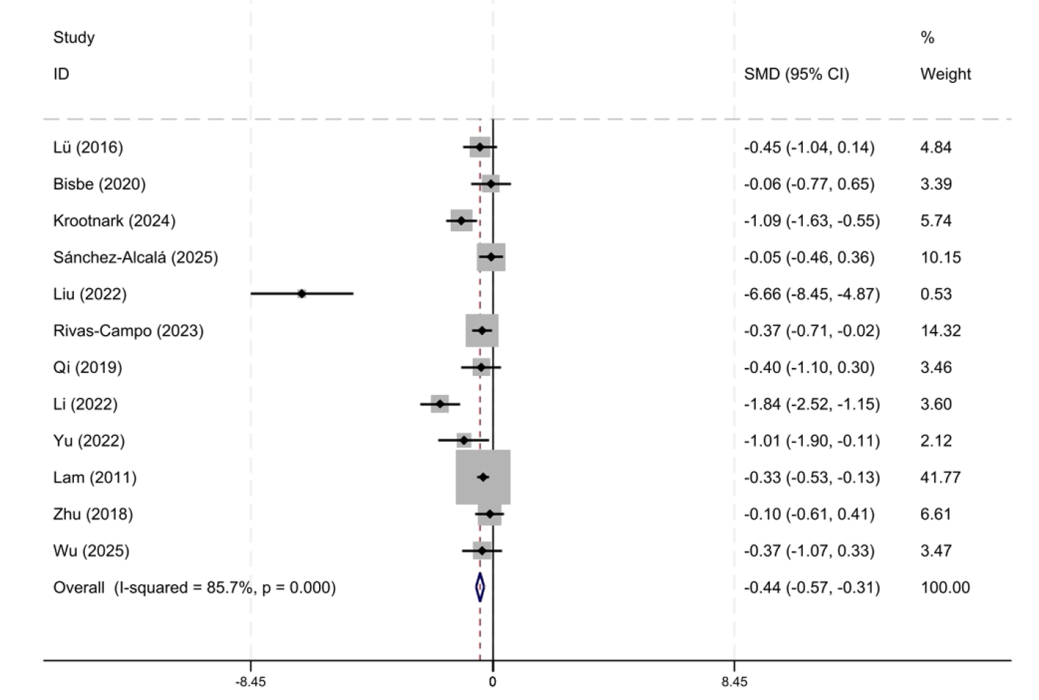
图8 以TMT-B为结局指标评估的森林图
Fig.8 Forest plots of the assessment using the TMT-B as an outcome measure
| 亚组 | No.Ofstudies | Hedges’sg With 95%CI | I2(%) | Pz | PQ | Test of group differences |
|---|---|---|---|---|---|---|
| 干预类型 | 12 | -0.92(-1.74--0.10) | 97.03 | 0.03 | 0.00 | 0.59 |
| 有氧运动 | 6 | -0.33(-0.67-0.01) | 53.60 | 0.06 | 0.06 | |
| 双任务运动 | 2 | -4.09(-8.68-0.51) | 96.04 | 0.08 | 0.00 | |
| 身心锻炼 | 2 | -0.51(-1.07-0.06) | 51.26 | 0.08 | 0.15 | |
| 多成分运动 | 1 | -0.37(-0.71--0.02) | - | 0.14 | - | |
| 国家 | 12 | -0.92(-1.74--0.10) | 97.03 | 0.03 | 0.00 | 0.00 |
| 中国 | 7 | -1.19(-2.74-0.35) | 98.21 | 0.13 | 0.00 | |
| 西班牙 | 2 | -0.05(-0.40-0.30) | 0.00 | 0.78 | 0.98 | |
| 泰国 | 1 | -1.08(-1.61--0.54) | - | 0.00 | - | |
| 哥伦比亚 | 1 | -0.37(-0.71--0.02) | - | 0.04 | - | |
| 美国 | 1 | -1.81(-2.48--1.14) | - | 0.00 | - | |
| 剂量 | 12 | -0.92(-1.74--0.10) | 97.03 | 0.03 | 0.00 | 0.00 |
| 30/35 min | 5 | -0.43(-0.75--0.12) | 54.01 | 0.01 | 0.09 | |
| 45 min | 1 | -0.37(-0.71--0.02) | - | 0.04 | - | |
| 50 min | 1 | -6.50(-8.20--4.80) | - | 0.00 | - | |
| 60 min | 5 | -0.64(-1.29-0.01) | 82.34 | 0.06 | 0.00 | |
| 周期 | 12 | -0.92(-1.74--0.10) | 97.03 | 0.03 | 0.00 | 0.00 |
| 12周 | 9 | -0.93(-2.09-0.24) | 97.50 | 0.12 | 0.00 | |
| 16周 | 1 | -1.81(-2.48--1.14) | - | 0.00 | - | |
| 24周 | 1 | -0.97(-1.83--0.11) | - | 0.03 | - | |
| 48周 | 1 | -0.33(-0.53--0.13) | - | 0.00 | - |
表5 以TMT-B为结局指标的亚组分析
Tab.5 Subgroup analysis with the TMT-B as the outcome measure
| 亚组 | No.Ofstudies | Hedges’sg With 95%CI | I2(%) | Pz | PQ | Test of group differences |
|---|---|---|---|---|---|---|
| 干预类型 | 12 | -0.92(-1.74--0.10) | 97.03 | 0.03 | 0.00 | 0.59 |
| 有氧运动 | 6 | -0.33(-0.67-0.01) | 53.60 | 0.06 | 0.06 | |
| 双任务运动 | 2 | -4.09(-8.68-0.51) | 96.04 | 0.08 | 0.00 | |
| 身心锻炼 | 2 | -0.51(-1.07-0.06) | 51.26 | 0.08 | 0.15 | |
| 多成分运动 | 1 | -0.37(-0.71--0.02) | - | 0.14 | - | |
| 国家 | 12 | -0.92(-1.74--0.10) | 97.03 | 0.03 | 0.00 | 0.00 |
| 中国 | 7 | -1.19(-2.74-0.35) | 98.21 | 0.13 | 0.00 | |
| 西班牙 | 2 | -0.05(-0.40-0.30) | 0.00 | 0.78 | 0.98 | |
| 泰国 | 1 | -1.08(-1.61--0.54) | - | 0.00 | - | |
| 哥伦比亚 | 1 | -0.37(-0.71--0.02) | - | 0.04 | - | |
| 美国 | 1 | -1.81(-2.48--1.14) | - | 0.00 | - | |
| 剂量 | 12 | -0.92(-1.74--0.10) | 97.03 | 0.03 | 0.00 | 0.00 |
| 30/35 min | 5 | -0.43(-0.75--0.12) | 54.01 | 0.01 | 0.09 | |
| 45 min | 1 | -0.37(-0.71--0.02) | - | 0.04 | - | |
| 50 min | 1 | -6.50(-8.20--4.80) | - | 0.00 | - | |
| 60 min | 5 | -0.64(-1.29-0.01) | 82.34 | 0.06 | 0.00 | |
| 周期 | 12 | -0.92(-1.74--0.10) | 97.03 | 0.03 | 0.00 | 0.00 |
| 12周 | 9 | -0.93(-2.09-0.24) | 97.50 | 0.12 | 0.00 | |
| 16周 | 1 | -1.81(-2.48--1.14) | - | 0.00 | - | |
| 24周 | 1 | -0.97(-1.83--0.11) | - | 0.03 | - | |
| 48周 | 1 | -0.33(-0.53--0.13) | - | 0.00 | - |
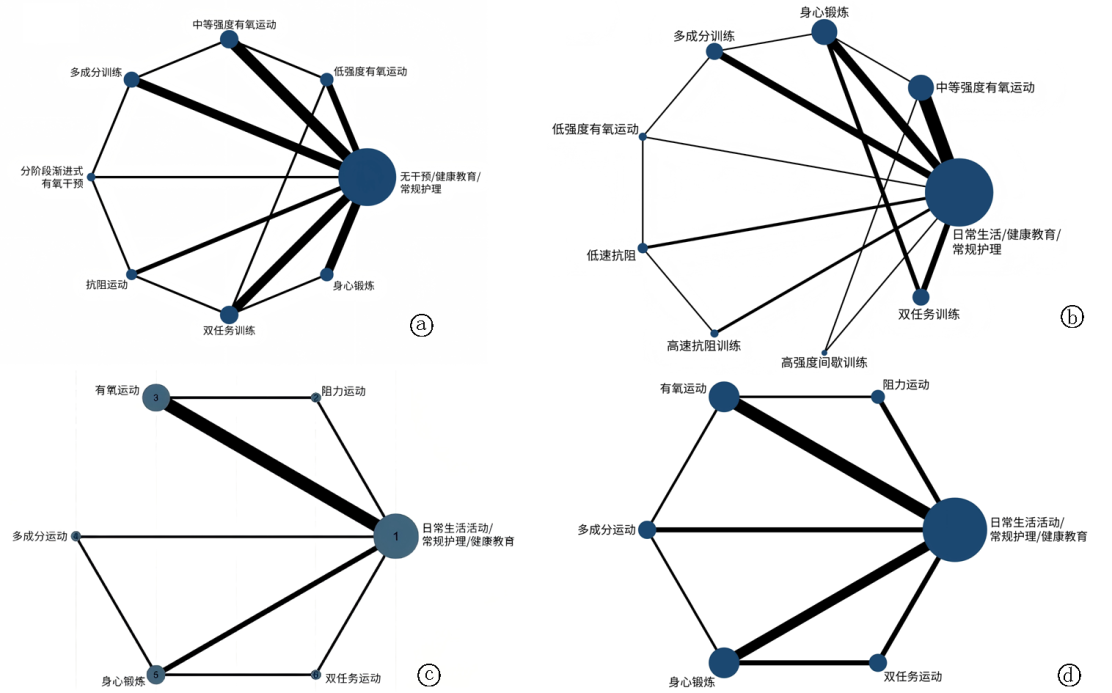
图9 网络证据图 注:a.MMSE;b.MOCA;c.TMT-A;d.TMT-B
Fig.9 Network plots of the evidence
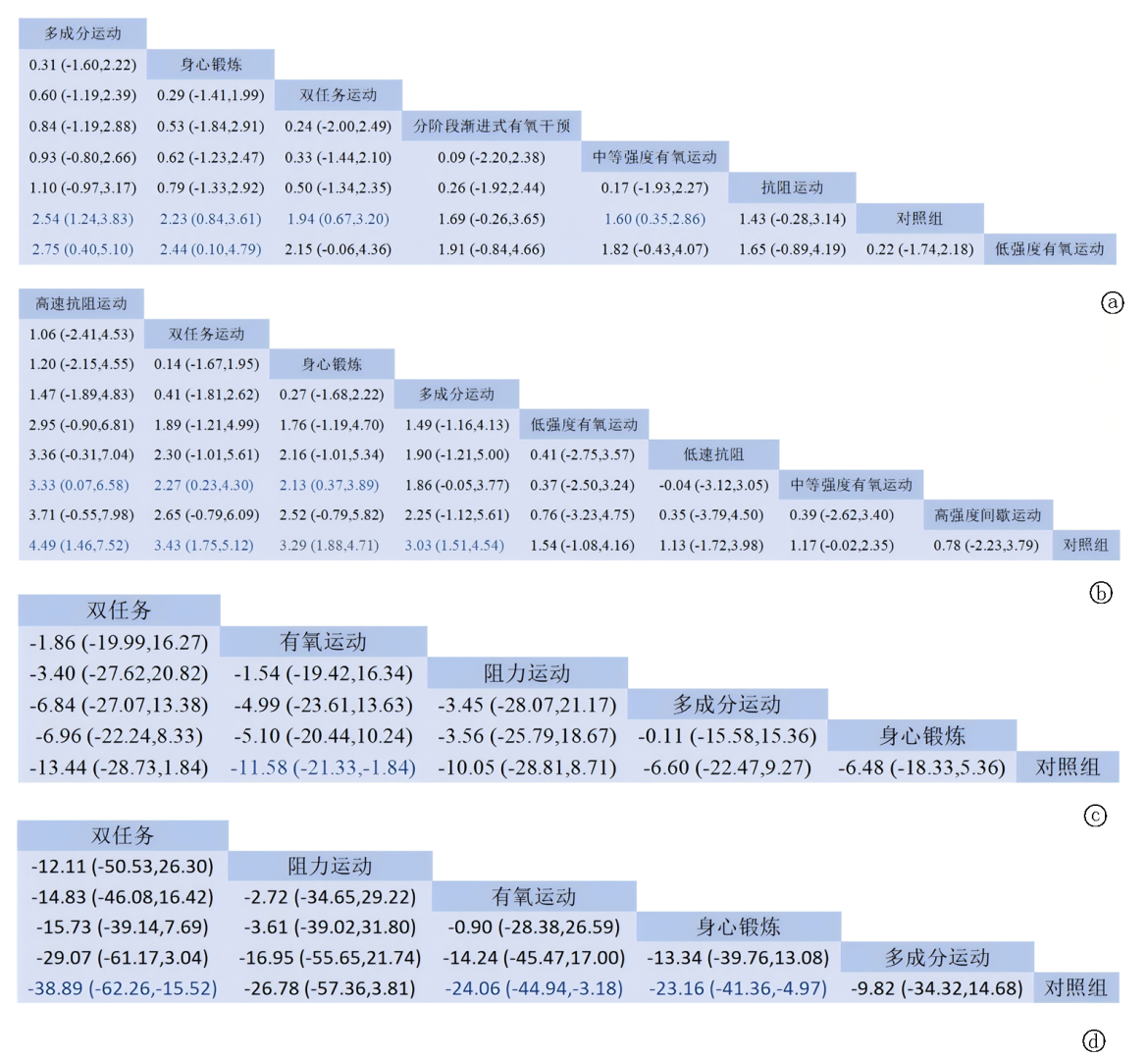
图10 网状meta分析结果
Fig.10 Results of the network meta-analysis
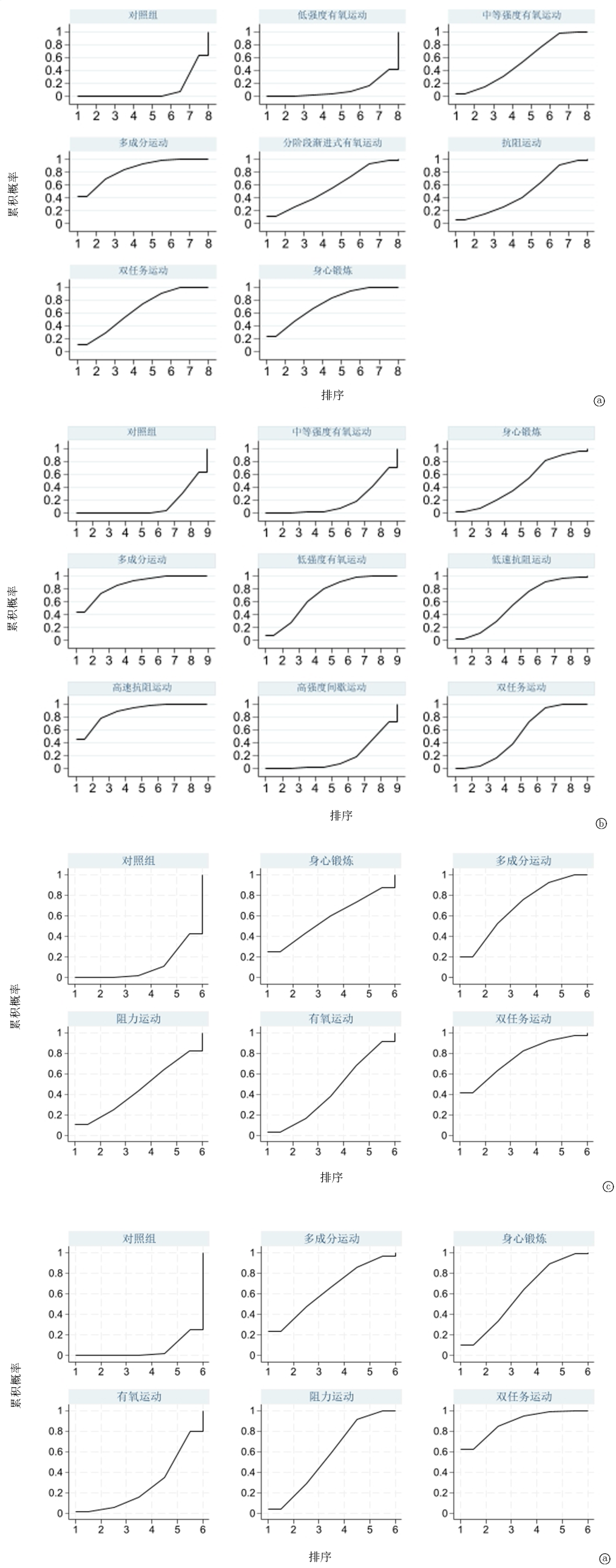
图11 累计概率排序图 a.MMSE评分;b.MOCA评分;c.TMT-A评分;d.TMT-B评分
Fig.11 Cumulative ranking probabilities plots
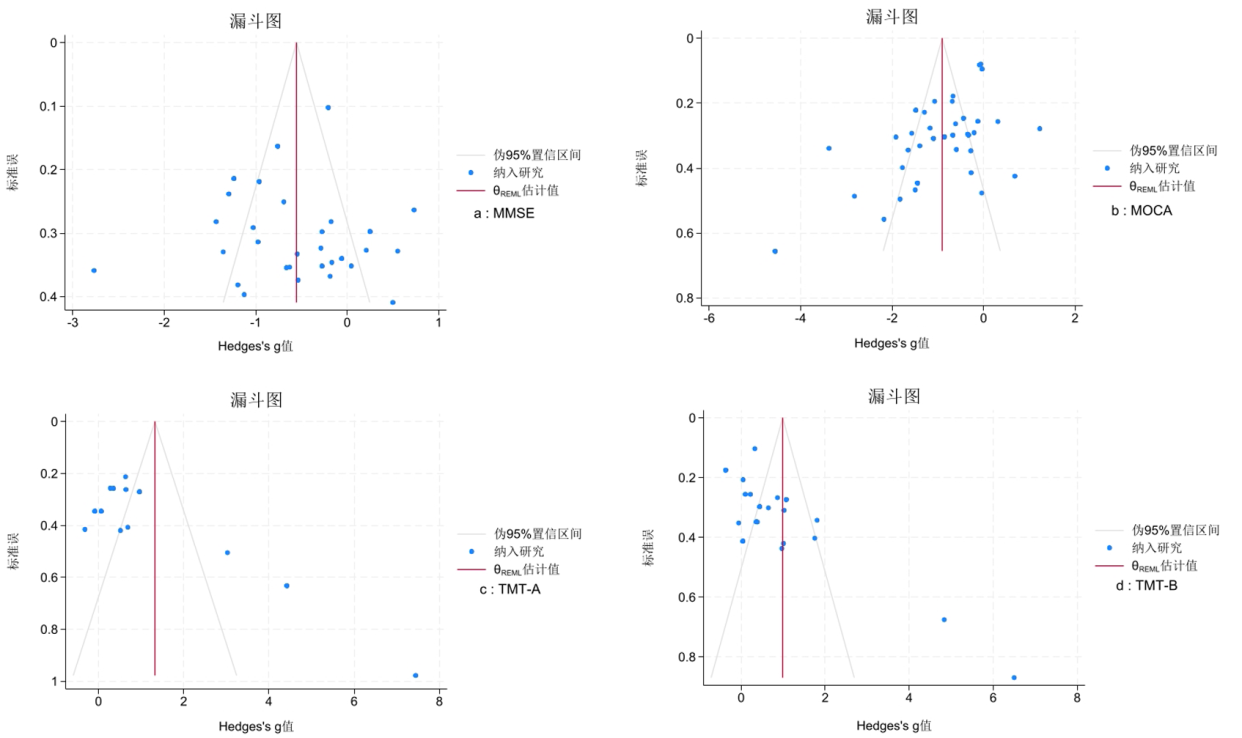
图12 发表偏倚漏斗图
Fig.12 Funnel plots for assessment of publication bias
| [1] | Petersen RC. Mild cognitive impairment[J]. N Engl J Med, 2011, 364(23): 2227-2234. doi: 10.1056/NEJMCp0910237. |
| [2] |
Jorm AF, Jolley D. The incidence of dementia: A meta-analysis[J]. Neurology, 1998, 51(3): 728-733. doi: 10.1212/wnl.51.3.728.
pmid: 9748017 |
| [3] |
Wimo A, Jönsson L, Bond J, et al. The worldwide economic impact of dementia 2010[J]. Alzheimers Dement, 2013, 9(1): 1-11. e3. doi: 10.1016/j.jalz.2012.11.006.
pmid: 23305821 |
| [4] |
Chapman DP, Williams SM, Strine TW, et al. Dementia and its implications for public health[J]. Prev Chronic Dis, 2006, 3(2): A34. PMID: 16539775.
URL pmid: 16539775 |
| [5] | Rabins PV, Mace NL, Lucas MJ. The impact of dementia on the family[J]. JAMA, 1982, 248(3): 333-335. doi:10.1001/jama.1982.03330030039022. |
| [6] | Spirduso WW, Clifford P. Replication of age and physical activity effects on reaction and movement time[J]. J Gerontol, 1978, 33(1): 26-30. doi: 10.1093/geronj/33.1.26 |
| [7] | Tomporowski PD. Effects of acute bouts of exercise on cognition[J]. Acta Psychol (Amst), 2003, 112(3): 297-324. doi: 10.1016/s0001-6918(02)00134-8. |
| [8] | Colcombe SJ, Erickson KI, Scalf PE, et al. Aerobic exercise training increases brain volume in aging humans[J]. J Gerontol A Biol Sci Med Sci, 2006, 61(11): 1166-1170. doi: 10.1093/gerona/61.11.1166. |
| [9] | Landrigan JF, Bell T, Crowe M, et al. Lifting cognition: A meta-analysis of effects of resistance exercise on cognition[J]. Psychol Res, 2020, 84(5): 1167-1183. doi: 10.1007/s00426-019-01145-x. |
| [10] |
Chang YK, Labban JD, Gapin JI, et al. The effects of acute exercise on cognitive performance: A meta-analysis[J]. Brain Res, 2012, 1453: 87-101. doi: 10.1016/j.brainres.2012.02.068.
pmid: 22480735 |
| [11] | Singh B, Bennett H, Miatke A, et al. Effectiveness of exercise for improving cognition, memory and executive function: A systematic umbrella review and meta-meta-analysis[J]. Br J Sports Med, 2025, 59(12): 866-876. doi: 10.1136/bjsports-2024-108589. |
| [12] | Petersen RC, Smith GE, Waring SC, et al. Mild cognitive impairment: Clinical characterization and outcome[J]. Arch Neurol, 1999, 56(3): 303-308. doi: 10.1001/archneur.56.3.303. |
| [13] |
Sachdev PS, Blacker D, Blazer DG, et al. Classifying neurocognitive disorders: The DSM-5 approach[J]. Nat Rev Neurol, 2014, 10(11): 634-642. doi: 10.1038/nrneurol.2014.181.
pmid: 25266297 |
| [14] |
Cockrell JR, Folstein MF. Mini-Mental State Examination (MMSE)[J]. Psychopharmacol Bull, 1988, 24(4):689-692.
pmid: 3249771 |
| [15] | Nasreddine ZS, Phillips N A, Bédirian V, et al. The montreal cognitive assessment, MoCA: A brief screening tool for mild cognitive impairment[J]. J Am Geriatr Soc, 2005, 53(4): 695-699. doi: 10.1111/j.1532-5415.2005.53221.x. |
| [16] |
Bowie CR, Harvey PD. Administration and interpretation of the Trail Making Test[J]. Nat Protoc, 2006, 1(5): 2277-2281. doi: 10.1038/nprot.2006.390.
pmid: 17406468 |
| [17] | Lam LC, Chau RC, Wong BM, et al. Interim follow-up of a randomized controlled trial comparing Chinese style mind body (Tai Chi) and stretching exercises on cognitive function in subjects at risk of progressive cognitive decline[J]. Int J Geriatr Psychiatry, 2011, 26(7): 733-740. doi: 10.1002/gps.2602. |
| [18] | Siu MY, Lee DTF. Effects of tai chi on cognition and instrumental activities of daily living in community dwelling older people with mild cognitive impairment[J]. BMC Geriatr, 2018, 18(1): 37.doi: 10.1186/s12877-018-0720-8. |
| [19] | 包娜娜, 刘超. 太极拳对遗忘型轻度认知功能障碍患者认知功能影响的研究[J]. 医学信息, 2019, 32(2): 115-117.doi: CNKI:SUN:YXXX.0.2019-02-032. |
| [20] |
Yu AP, Chin EC, Yu DJ, et al. Tai Chi versus conventional exercise for improving cognitive function in older adults: A pilot randomized controlled trial[J]. Sci Rep, 2022, 12(1): 8868.doi: 10.1038/s41598-022-12526-5.
pmid: 35614144 |
| [21] |
Zheng G, Ye B, Xia R, et al. Traditional chinese mind-body exercise baduanjin modulate gray matter and cognitive function in older adults with mild cognitive impairment: A brain imaging study[J]. Brain Plast, 2021, 7(2): 131-142.doi: 10.3233/bpl-210121.
pmid: 34868878 |
| [22] | Liu CL, Cheng FY, Wwi MJ, et al. Effects of exergaming-based tai chi on cognitive function and dual-task gait performance in older adults with mild cognitive impairment: A randomized control trial[J]. Front Aging Neurosci, 2022, 14: 761053.doi: 10.3389/fnagi.2022.761053. |
| [23] |
Li F, Harmer P, Fitzgerald K, et al. A cognitively enhanced online Tai Ji Quan training intervention for community-dwelling older adults with mild cognitive impairment: A feasibility trial[J]. BMC Geriatr, 2022, 22(1): 76.doi: 10.1186/s12877-021-02747-0.
pmid: 35078407 |
| [24] | Zhou C. Effect of Tai Chi combined with music therapy on the cognitive function in older adult individuals with mild cognitive impairment[J]. Front Public Health, 2025, 13: 1475863.doi: 10.3389/fpubh.2025.1475863. |
| [25] |
Varela S, Ayán C, Cancela JM, et al. Effects of two different intensities of aerobic exercise on elderly people with mild cognitive impairment: A randomized pilot study[J]. Clin Rehabil, 2012, 26(5): 442-50.doi: 10.1177/0269215511425835.
pmid: 22116953 |
| [26] | Wei XH, Ji LL. Effect of handball training on cognitive ability in elderly with mild cognitive impairment[J]. Neurosci Lett, 2014, 566: 98-101. doi: 10.1016/j.neulet.2014.02.035. |
| [27] | Zhang Q, Zhu M, Huang L, et al. A study on the effect of traditional chinese exercise combined with rhythm training on the intervention of older adults with mild cognitive impairment[J]. Am J Alzheimers Dis Other Demen, 2023, 38: 15333175231190626.doi: 10.1177/15333175231190626. |
| [28] | Krootnark K, Chaikeeree N, Saengsirisuwan V, et al. Effects of low-intensity home-based exercise on cognition in older persons with mild cognitive impairment: A direct comparison of aerobic versus resistance exercises using a randomized controlled trial design[J]. Front Med (Lausanne), 2024, 11: 1392429.doi: 10.3389/fmed.2024.1392429. |
| [29] |
Wang S, Yin H, Meng X, et al. Effects of Chinese square dancing on older adults with mild cognitive impairment[J]. Geriatr Nurs, 2020, 41(3): 290-296.doi: 10.1016/j.gerinurse.2019.10.009.
pmid: 31727347 |
| [30] | Sánchez-Alcalá M, Aibar-Almazán A, Carcelén-Fraile MD, et al. Effects of dance-based aerobic training on frailty and cognitive function in older adults with mild cognitive impairment: A randomized controlled trial[J]. Diagnostics (Basel), 2025, 15(3).doi: 10.3390/diagnostics15030351. |
| [31] | Wu H, Zhu Y, Yang X, et al. White matter integrity of default mode network after a 3-month aerobic dance program in patients with amnestic mild cognitive impairment: Asecondary analysis of a randomized clinical trial[J]. Quant Imaging Med Surg, 2025, 15(3): 2016-2028. doi: 10.21037/qims-24-1212. |
| [32] |
Qi M, Zhu Y, Zhang L, et al. The effect of aerobic dance intervention on brain spontaneous activity in older adults with mild cognitive impairment: A resting-state functional MRI study[J]. Exp Ther Med, 2019, 17(1): 715-722.doi: 10.3892/etm.2018.7006.
pmid: 30651855 |
| [33] |
Ayari S, Abellard A, Sakrani S, et al. Comparison of dance and aerobic exercise on cognition and neuropsychiatric symptoms in sedentary older adults with cognitive impairment[J]. Eur Geriatr Med, 2023, 14(6): 1289-1299. doi: 10.1007/s41999-023-00849-z.
pmid: 37656350 |
| [34] | Zotcheva E, Håberg AK, Wisløff U, et al. Effects of 5 years aerobic exercise on cognition in older adults: The generation 100 study: A randomized controlled trial[J]. Sports Med, 2022, 52(7): 1689-1699.doi: 10.1007/s40279-021-01608-5. |
| [35] |
Song D, Yu DSF. Effects of a moderate-intensity aerobic exercise programme on the cognitive function and quality of life of community-dwelling elderly people with mild cognitive impairment: A randomised controlled trial[J]. Int J Nurs Stud, 2019, 93: 97-105.doi: 10.1016/j.ijnurstu.2019.02.019.
pmid: 30901716 |
| [36] | 宋艳丽, 刘伟. 有氧运动操对养老机构轻度认知障碍老人的干预[J]. 中国老年学杂志, 2019, 39(13): 3176-3178. doi: CNKI:SUN:ZLXZ.0.2019-13-033. |
| [37] |
Zhu Y, Wu H, Qi M, et al. Effects of a specially designed aerobic dance routine on mild cognitive impairment[J]. Clin Interv Aging, 2018, 13: 1691-1700.doi: 10.2147/cia.S163067.
pmid: 30237705 |
| [38] |
Li L, Liu M, Zeng H, et al. Multi-component exercise training improves the physical and cognitive function of the elderly with mild cognitive impairment: A six-month randomized controlled trial[J]. Ann Palliat Med, 2021, 10(8): 8919-8929.doi: 10.21037/apm-21-1809.
pmid: 34488379 |
| [39] | Rivas-Campo Y, Aibar-Almazán A, Rodríguez-López C, et al. Enhancing cognition in older adults with mild cognitive impairment through high-intensity functional training: A single-blind randomized controlled trial[J]. J Clin Med, 2023, 12(12).doi: 10.3390/jcm12124049. |
| [40] |
Buele J, Avilés-Castillo F, Delvallesoto C, et al. Correction: Effects of a dual intervention (motor and virtual reality-based cognitive) on cognition in patients with mild cognitive impairment: A single-blind, randomized controlled trial[J]. J Neuroeng Rehabil, 2024, 21(1): 149. doi: 10.1186/s12984-024-01443-5.
pmid: 39217349 |
| [41] | Wang L, Wu B, Tao H, et al. Effects and mediating mechanisms of a structured limbs-exercise program on general cognitive function in older adults with mild cognitive impairment: A randomized controlled trial[J]. Int J Nurs Stud, 2020, 110: 103706.doi: 10.1016/j.ijnurstu.2020.103706. |
| [42] | Choi W, Lee S. Ground kayak paddling exercise improves postural balance, muscle performance, and cognitive function in older adults with mild cognitive impairment: A randomized controlled trial[J]. Med Sci Monit, 2018, 24: 3909-3915.doi: 10.12659/msm.908248. |
| [43] | Bademli K, Lok N, Canbaz M, et al. Effects of Physical Activity Program on cognitive function and sleep quality in elderly with mild cognitive impairment: A randomized controlled trial[J]. Perspect Psychiatr Care, 2019, 55(3): 401-408.doi: 10.1111/ppc.12324. |
| [44] |
Langoni CD, Resende TL, Barcellos AB, et al. The effect of group exercises on balance, mobility, and depressive symptoms in older adults with mild cognitive impairment: A randomized controlled trial[J]. Clin Rehabil, 2019, 33(3): 439-449.doi: 10.1177/0269215518815218.
pmid: 30514115 |
| [45] | Yang SY, Lee HC, Huang CM, et al. Efficacy of tai chi-style multi-component exercise on frontal-related cognition and physical health in elderly with amnestic mild cognitive impairment[J]. Front Aging, 2021, 2: 636390.doi: 10.3389/fragi.2021.636390. |
| [46] |
Bisbe M, Fuente-Vidal A, López E, et al. Comparative cognitive effects of choreographed exercise and multimodal physical therapy in older adults with amnestic mild cognitive impairment: Randomized clinical trial[J]. J Alzheimers Dis, 2020, 73(2): 769-783.doi: 10.3233/jad-190552.
pmid: 31868666 |
| [47] | Tsai CL, Pai MC, Ukropec J, et al. Distinctive effects of aerobic and resistance exercise modes on neurocognitive and biochemical changes in individuals with mild cognitive impairment[J]. Curr Alzheimer Res, 2019, 16(4): 316-332.doi: 10.2174/1567205016666190228125429. |
| [48] | Hong SG, Kim JH, Jun TW. Effects of 12-week resistance exercise on electroencephalogram patterns and cognitive function in the elderly with mild cognitive impairment: A randomized controlled trial[J]. Clin J Sport Med, 2018, 28(6): 500-508.doi: 10.1097/jsm.0000000000000476. |
| [49] |
Yoon DH, Kang D, Kim HJ, et al. Effect of elastic band-based high-speed power training on cognitive function, physical performance and muscle strength in older women with mild cognitive impairment[J]. Geriatr Gerontol Int, 2017, 17(5): 765-772.doi: 10.1111/ggi.12784.
pmid: 27396580 |
| [50] |
Lü J, Sun M, Liang L, et al. Effects of momentum-based dumbbell training on cognitive function in older adults with mild cognitive impairment: A pilot randomized controlled trial[J]. Clin Interv Aging, 2016, 11: 9-16.doi: 10.2147/cia.S96042.
pmid: 26766905 |
| [51] | Tao M, Liu H, Cheng J, et al. Motor-cognitive interventions may effectively improve cognitive function in older adults with mild cognitive impairment: A randomized controlled trial[J]. Behav Sci (Basel), 2023, 13(9).doi: 10.3390/bs13090737. |
| [52] | Baek JE, Hyeon SJ, Kim M, et al. Effects of dual-task resistance exercise on cognition, mood, depression, functional fitness, and activities of daily living in older adults with cognitive impairment: A single-blinded, randomized controlled trial[J]. BMC Geriatr, 2024, 24(1): 369.doi: 10.1186/s12877-024-04942-1. |
| [53] |
Makizako H, Doi T, Shimada H, et al. Does a multicomponent exercise program improve dual-task performance in amnestic mild cognitive impairment? A randomized controlled trial[J]. Aging Clin Exp Res, 2012, 24(6): 640-6.doi: /10.3275/8760.
pmid: 23211228 |
| [54] | Langoni CD, Resende TL, Barcellos AB, et al. Effect of exercise on cognition, conditioning, muscle endurance, and balance in older adults with mild cognitive impairment: A randomized controlled trial[J]. J Geriatr Phys Ther, 2019, 42(2): E15-e22.doi: 10.1519/jpt.0000000000000191. |
| [55] | Sousa B, Durans R, Silva DP, et al. Effects of resistance training in elderly women with cognitive decline[J]. Fisioter Mov, 2022, 35, e35121. doi: 10.1590/fm.2022.35121. |
| [56] |
Law LL, Mok VC, Yaum MK. Effects of functional tasks exercise on cognitive functions of older adults with mild cognitive impairment: A randomized controlled pilot trial[J]. Alzheimers Res Ther, 2019, 11(1): 98. doi: 10.1186/s13195-019-0548-2.
pmid: 31801630 |
| [57] |
Ciesielska N, Sokołowski R, Mazur E, et al. Is the montreal cognitive assessment (moca) test better suited than the mini-mental state examination (MMSE) in mild cognitive impairment (MCI) detection among people aged over 60? Meta-analysis[J]. Psychiatr Pol, 2016, 50: 1039-1052.doi: 10.12740/PP/45368.
pmid: 27992895 |
| [58] | Martins AD, Fernandes O, Pereir AA, et al. The effects of high-speed resistance training on health outcomes in independent older adults: A systematic review and meta-analysis[J]. Int J Environ Res Public Health, 2022, 19(9): 5390.doi: 10.3390/ijerph19095390. |
| [59] | Kelty TJ, Schachtman TR, Mao X, et al. Resistance-exercise training ameliorates LPS-induced cognitive impairment concurrent with molecular signaling changes in the rat dentate gyrus[J]. J Appl Physiol (1985), 2019, 127(1):254-263.doi: 10.1152/japplphysiol.00249.2019. |
| [60] |
Vilela TC, Mullrr AP, Damiani AP, et al. Strength and aerobic exercises improve spatial memory in aging rats through stimulating distinct neuroplasticity mechanisms[J]. Mol Neurobiol, 2017, 54(10): 7928-7937.doi: 10.1007/s12035-016-0272-x.
pmid: 27878552 |
| [61] | Stein AM, Silva TM, Coelho FG, et al. Physical exercise, IGF-1 and cognition A systematic review of experimental studies in the elderly[J]. Dement Neuropsychol, 2018, 12(2): 114-122.doi: 10.1590/1980-57642018dn12-020003. |
| [62] | 王思诺, 曹娅军, 向青, 等. 跑台运动对自然衰老小鼠海马突触可塑性及其相关蛋白表达的影响[J]. 康复学报, 2023, 33(3): 241-250. doi: CNKI:SUN:FYXB.0.2023-03-011. |
| [63] | Oliff HS, Berchtold NC, Isackson P, et al. Exercise-induced regulation of brain-derived neurotrophic factor (BDNF) transcripts in the rat hippocampus[J]. Brain Res Mol Brain Res, 1998, 61(1-2): 147-153. doi: 10.1016/s0169-328x(98)00222-8. |
| [64] | Kramer AF, Larish JF, Strayer DL. Training for attentional control in dual task settings: A comparison of young and old adults[J]. J Exp Psychol Appl, 1995, 1(1): 50. doi: 10.1037/1076-898x.1.1.50. |
| [1] | 徐胜, 杨青青, 张敏. 基于功能性近红外光谱技术, 观察脑机接口训练系统对亚急性期脑卒中后上肢功能障碍患者功能连接网络的影响[J]. 临床荟萃, 2025, 40(5): 428-433. |
| [2] | 张秀玲, 张丽, 陈金湘. 个体化前庭康复方案在治疗前庭神经炎中的临床疗效观察[J]. 临床荟萃, 2025, 40(3): 227-230. |
| [3] | 刘述廷, 曲艳, 崔雅婷, 温瑶, 李晓红. 帕金森病眼球扫视运动异常的多维剖析及干预应用的研究进展[J]. 临床荟萃, 2025, 40(11): 1052-1056. |
| [4] | 张中楼, 崔坤, 孟晋启. 运动保护心血管系统的研究进展[J]. 临床荟萃, 2024, 39(9): 855-860. |
| [5] | 李静, 郑华城, 吕静静. 阿立哌唑治疗抽动障碍的应用进展[J]. 临床荟萃, 2024, 39(9): 861-864. |
| [6] | 李星, 冯华平, 蓝胜峰, 李志勇. 不同超声评估方法在左前降支狭窄中的临床价值[J]. 临床荟萃, 2024, 39(8): 693-699. |
| [7] | 胡泽林, 吴美璇, 梅佳, 孟书静, 张强, 秦殿菊. 膝骨关节炎患者运动干预的证据总结[J]. 临床荟萃, 2024, 39(5): 396-400. |
| [8] | 师丽琪, 雷普文, 钱宝堂. 高强度间歇训练在接受经皮冠状动脉介入治疗冠心病患者心脏康复中的研究进展[J]. 临床荟萃, 2024, 39(5): 466-469. |
| [9] | 王九雪, 李娜, 靳玮, 王硕, 常雅君, 王天俊. 帕金森病患者血清尿酸、同型半胱氨酸和胱抑素C水平与运动症状及认知功能的相关性[J]. 临床荟萃, 2024, 39(2): 125-129. |
| [10] | 储丽清, 杨敏. 运动疗法在慢性肾脏病中的应用进展[J]. 临床荟萃, 2024, 39(2): 183-187. |
| [11] | 肖煌怡, 袁建坤, 严梓予, 曾雯姝, 鲁兰莫, 王峻. 认知干预对遗忘型轻度认知障碍老年患者干预效果的meta分析[J]. 临床荟萃, 2024, 39(1): 12-19. |
| [12] | 余一夫, 袁春华. 膈肌放松技术结合抗阻呼吸训练对脑卒中患者运动能力的影响研究[J]. 临床荟萃, 2023, 38(11): 1002-1007. |
| [13] | 吕静静, 李静, 郑华城. 儿童抽动障碍与精神心理及环境因素的研究进展[J]. 临床荟萃, 2023, 38(11): 1031-1033. |
| [14] | 尹贻锟, 尹逊伟, 王佳林, 孙君志. 太极拳锻炼周期对原发性高血压的血压及心血管危险因素的影响:系统性评价和Meta分析[J]. 临床荟萃, 2022, 37(7): 599-606. |
| [15] | 张海福, 叶向晴, 陈者旭, 陈施鉴, 杨栋, 张邢炜. 适量运动对心房颤动患者预后的影响:系统综述与Meta分析[J]. 临床荟萃, 2022, 37(6): 485-489. |
| 阅读次数 | ||||||
|
全文 |
|
|||||
|
摘要 |
|
|||||
