
临床荟萃 ›› 2026, Vol. 41 ›› Issue (10): 881-890.doi: 10.3969/j.issn.1004-583X.2026.10.003
王启龙, 齐鑫, 赵东荣( )
收稿日期:2026-09-30
出版日期:2026-10-20
发布日期:2026-10-10
通讯作者:
赵东荣
E-mail:13919131767@163.com
基金资助:
Wang Qilong, Qi Xin, Zhao Dongrong()
Received:2026-09-30
Online:2026-10-20
Published:2026-10-10
Contact:
Zhao Dongrong
E-mail:13919131767@163.com
摘要:
目的 探讨中国中老年人群时变主客观健康表型与新发抑郁症状风险的前瞻性关联。方法 基于中国健康与养老追踪调查(CHARLS,2011-2020年),纳入基线年龄≥50岁且无抑郁症状的受试者6 193人,共贡献15 892个人-周期。结合自评健康与慢性病共病界定4类时变表型,采用离散时间互补双对数生存模型分析风险。结果 随访期间新发抑郁症状2 845例。全调整模型显示,相对于自评良好且无共病组,自评不良且无共病组(HR=1.54,95%CI:1.39~1.71)、自评良好伴共病组(HR=1.40,95%CI:1.14~1.71)和自评不良且伴共病组(HR=2.11,95%CI:1.88~2.36)风险均升高,交互检验均差异未达到统计学意义(P均>0.05)。结论 时变主客观健康表型与新发抑郁症状风险相关,自评不良且伴共病者风险最高。联合评估主客观健康状况有助于识别高风险人群。
中图分类号:
王启龙, 齐鑫, 赵东荣. 中国中老年人时变主客观健康不一致与新发抑郁的前瞻性队列研究[J]. 临床荟萃, 2026, 41(10): 881-890.
Wang Qilong, Qi Xin, Zhao Dongrong. A prospective cohort study of time-updated discrepancies between subjective and objective health and incident depressive symptoms in Chinese middle-aged and older adults[J]. Clinical Focus, 2026, 41(10): 881-890.
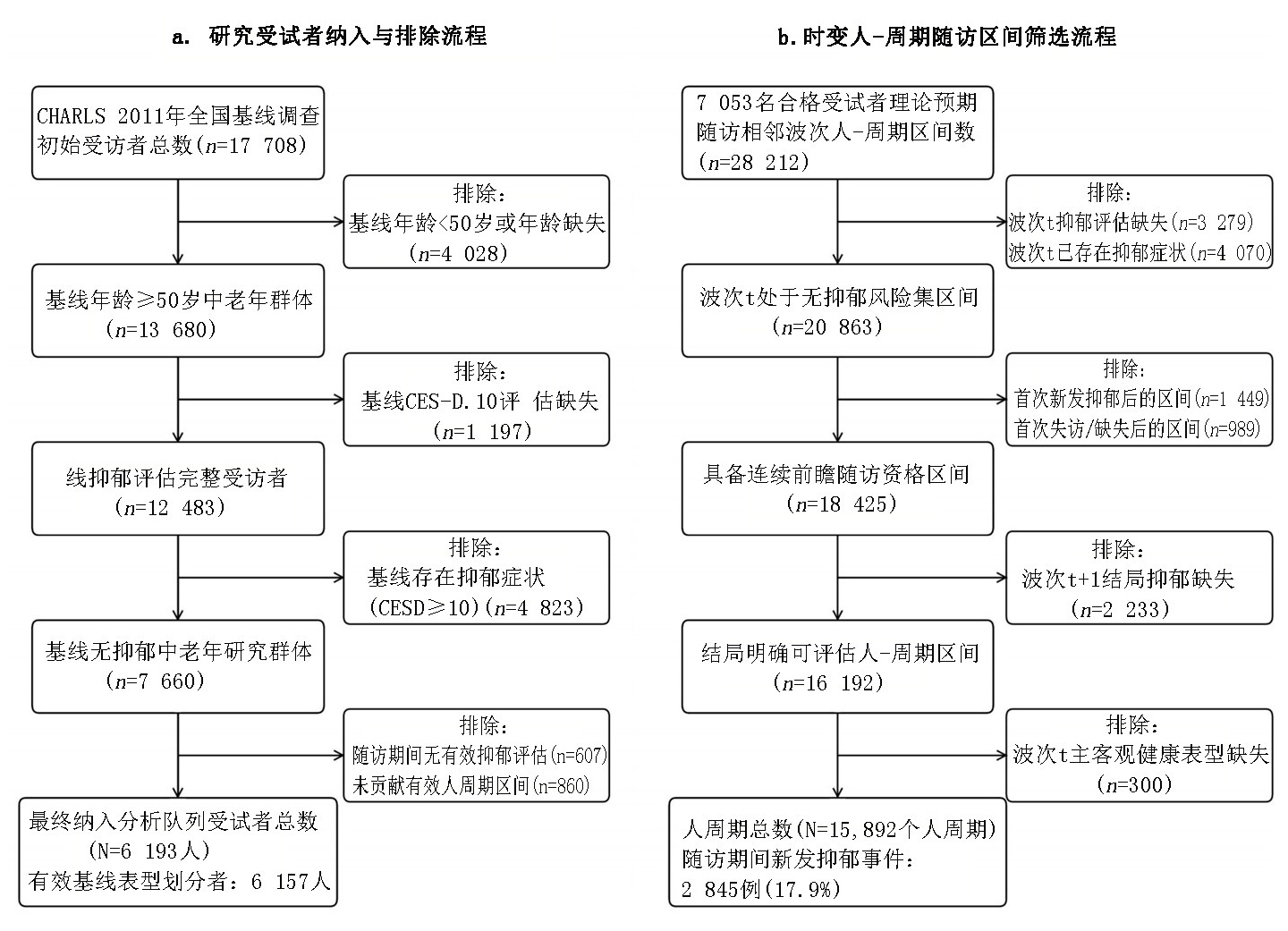
图1 中国中老年人群队列筛选与人-周期随访区间构建流程图 a. 受试者纳入与排除流程; b. 时变人-周期随访区间与新发抑郁结局筛选流程 注:CHARLS:中国健康与养老追踪调查(China Health and Retirement Longitudinal Study);CES-D-10:简版流调中心抑郁量表(Center for Epidemiologic Studies Depression Scale-10)。
Fig. 1 Flowchart of cohort selection in Chinese middle-aged and older adults and construction of the person-period follow-up interval a. Participant inclusion and exclusion flow; b. Flowchart for selection based on time-updated person-period follow-up intervals and incident depression outcome
| 特征指标 | 总体 (N=6157) | 自评良好-无共病 (n=1 614) | 自评不良-无共病 (n=3 242) | 自评良好-伴共病 (n=202) | 自评不良-伴共病 (n=1099) | 统计量 | P值 | |||||
|---|---|---|---|---|---|---|---|---|---|---|---|---|
| 例数[例(%)] | 6 157(100.0) | 1 614(26.2) | 3 242(52.7) | 202(3.3) | 1 099(17.8) | - | - | |||||
| 年龄(岁) | 61.5±7.9 | 60.7±7.7 | 61.2±7.8 | 63.5±8.8 | 63.4±7.7 | F=34.60 | <0.001 | |||||
| 年龄分段[例(%)] | χ2=81.43 | <0.001 | ||||||||||
| <65岁 | 4 230(68.7) | 1 182(73.2) | 2 285(70.5) | 120(59.4) | 643(58.5) | |||||||
| ≥65岁 | 1 927(31.3) | 432(26.8) | 957(29.5) | 82(40.6) | 456(41.5) | |||||||
| 性别[例(%)] | χ2=27.65 | <0.001 | ||||||||||
| 男 | 2 764(44.9) | 660(40.9) | 1 446(44.6) | 100(49.5) | 558(50.8) | |||||||
| 女 | 3 393(55.1) | 954(59.1) | 1 796(55.4) | 102(50.5) | 541(49.2) | |||||||
| 受教育程度[例(%)] | χ2=17.21 | 0.009 | ||||||||||
| 初中及以下 | 5 359(87.0) | 1 371(84.9) | 2 847(87.8) | 173(85.6) | 968(88.1) | |||||||
| 高中/中专 | 676(11.0) | 203(12.6) | 343(10.6) | 20(9.9) | 110(10.0) | |||||||
| 大专及以上 | 122(2.0) | 40(2.5) | 52(1.6) | 9(4.5) | 21(1.9) | |||||||
| 家庭人均年收入[例(%)] | χ2=32.57 | <0.001 | ||||||||||
| 低收入组 | 2 058(33.4) | 514(31.8) | 1 125(34.7) | 59(29.2) | 360(32.8) | |||||||
| 中等收入组 | 2 052(33.3) | 507(31.4) | 1 134(35.0) | 55(27.2) | 356(32.4) | |||||||
| 高收入组 | 2 047(33.2) | 593(36.7) | 983(30.3) | 88(43.6) | 383(34.8) | |||||||
| 在业状态[例(%)] | χ2=150.06 | <0.001 | ||||||||||
| 非在业 | 2 306(37.5) | 525(32.5) | 1 110(34.2) | 86(42.6) | 585(53.2) | |||||||
| 在业 | 3 851(62.5) | 1 089(67.5) | 2 132(65.8) | 116(57.4) | 514(46.8) | |||||||
| 婚姻状况[例(%)] | χ2=10.96 | 0.012 | ||||||||||
| 无伴侣(离异/丧偶/未婚) | 661(10.7) | 179(11.1) | 314(9.7) | 23(11.4) | 145(13.2) | |||||||
| 已婚/有伴侣 | 5 496(89.3) | 1 435(88.9) | 2 928(90.3) | 179(88.6) | 954(86.8) | |||||||
| 与子女同住情况[例(%)] | χ2=11.74 | 0.008 | ||||||||||
| 否 | 2 696(43.8) | 714(44.2) | 1 367(42.2) | 104(51.5) | 511(46.5) | |||||||
| 是 | 3 461(56.2) | 900(55.8) | 1 875(57.8) | 98(48.5) | 588(53.5) | |||||||
| 体质量指数(BMI, kg/m2) | 23.6±3.7 | 23.6±3.6 | 22.9±3.6 | 25.2±3.9 | 25.0±4.0 | F=102.60 | <0.001 | |||||
| 体质量分类[例(%)] | χ2=225.49 | <0.001 | ||||||||||
| 正常(18.5~23.9) | 3 260(52.9) | 869(53.8) | 1 900(58.6) | 74(36.6) | 417(37.9) | |||||||
| 消瘦(<18.5) | 353(5.7) | 72(4.5) | 228(7.0) | 6(3.0) | 47(4.3) | |||||||
| 超重/肥胖(≥24.0) | 2 544(41.3) | 673(41.7) | 1 114(34.4) | 122(60.4) | 635(57.8) | |||||||
| 吸烟状况[例(%)] | χ2=44.43 | <0.001 | ||||||||||
| 否 | 4 083(66.3) | 1 029(63.8) | 2 091(64.5) | 146(72.3) | 817(74.3) | |||||||
| 是 | 2 074(33.7) | 585(36.2) | 1 151(35.5) | 56(27.7) | 282(25.7) | |||||||
| 饮酒状况[例(%)] | χ2=50.94 | <0.001 | ||||||||||
| 否 | 3 936(63.9) | 933(57.8) | 2 088(64.4) | 135(66.8) | 780(71.0) | |||||||
| 是 | 2 221(36.1) | 681(42.2) | 1 154(35.6) | 67(33.2) | 319(29.0) | |||||||
| 高血压[例(%)] | χ2=1 889.99 | <0.001 | ||||||||||
| 否 | 4 525(73.5) | 1 412(87.5) | 2 771(85.5) | 48(23.8) | 294(26.8) | |||||||
| 是 | 1 632(26.5) | 202(12.5) | 471(14.5) | 154(76.2) | 805(73.2) | |||||||
| 心脏病[例(%)] | χ2=1 426.44 | <0.001 | ||||||||||
| 否 | 5 478(89.0) | 1 583(98.1) | 3 114(96.1) | 142(70.3) | 639(58.1) | |||||||
| 是 | 675(11.0) | 31(1.9) | 128(3.9) | 60(29.7) | 456(41.5) | |||||||
| 糖尿病[例(%)] | χ2=699.89 | <0.001 | ||||||||||
| 否 | 5 760(93.6) | 1 589(98.5) | 3 168(97.7) | 153(75.7) | 850(77.3) | |||||||
| 是 | 383(6.2) | 25(1.5) | 74(2.3) | 47(23.3) | 237(21.6) | |||||||
| 脑卒中[例(%)] | χ2=312.72 | <0.001 | ||||||||||
| 否 | 6 029(97.9) | 1 607(99.6) | 3 229(99.6) | 190(94.1) | 1 003(91.3) | |||||||
| 是 | 126(2.0) | 7(0.4) | 13(0.4) | 12(5.9) | 94(8.6) | |||||||
| 慢性肺部疾患[例(%)] | χ2=503.90 | <0.001 | ||||||||||
| 否 | 5 610(91.1) | 1 555(96.3) | 3 074(94.8) | 163(80.7) | 818(74.4) | |||||||
| 是 | 543(8.8) | 59(3.7) | 168(5.2) | 39(19.3) | 277(25.2) | |||||||
| 恶性肿瘤[例(%)] | χ2=64.86 | <0.001 | ||||||||||
| 否 | 6 089(98.9) | 1 610(99.8) | 3 223(99.4) | 196(97.0) | 1 060(96.5) | |||||||
| 是 | 61(1.0) | 4(0.2) | 19(0.6) | 5(2.5) | 33(3.0) | |||||||
| 关节炎/风湿病[例(%)] | χ2=1 024.91 | <0.001 | ||||||||||
| 否 | 4 388(71.3) | 1 398(86.6) | 2 517(77.6) | 78(38.6) | 395(35.9) | |||||||
| 是 | 1 769(28.7) | 216(13.4) | 725(22.4) | 124(61.4) | 704(64.1) | |||||||
| 累积慢性病种数[例(%)] | χ2=6 291.62 | <0.001 | ||||||||||
| 0种 | 2 714(44.1) | 1 070(66.3) | 1 644(50.7) | 0(0) | 0(0.8) | |||||||
| 1种 | 2 142(34.8) | 544(33.7) | 1 598(49.3) | 0(0) | 0(0) | |||||||
| ≥2种 | 1 301(21.1) | 0(0.0) | 0(0.0) | 202(100.0) | 1 099(100.0) | |||||||
| 基线CES-D-10评分(分) | 4.5±2.8 | 3.5±2.7 | 4.7±2.7 | 3.9±2.8 | 5.1±2.7 | F=92.40 | <0.001 | |||||
表1 中国中老年人基线特征分布与心身健康表型比较(N=6 157)
Tab. 1 Comparison of baseline characteristics distribution and psychosomatic health phenotypes in Chinese middle-aged and older adults (N=6 157)
| 特征指标 | 总体 (N=6157) | 自评良好-无共病 (n=1 614) | 自评不良-无共病 (n=3 242) | 自评良好-伴共病 (n=202) | 自评不良-伴共病 (n=1099) | 统计量 | P值 | |||||
|---|---|---|---|---|---|---|---|---|---|---|---|---|
| 例数[例(%)] | 6 157(100.0) | 1 614(26.2) | 3 242(52.7) | 202(3.3) | 1 099(17.8) | - | - | |||||
| 年龄(岁) | 61.5±7.9 | 60.7±7.7 | 61.2±7.8 | 63.5±8.8 | 63.4±7.7 | F=34.60 | <0.001 | |||||
| 年龄分段[例(%)] | χ2=81.43 | <0.001 | ||||||||||
| <65岁 | 4 230(68.7) | 1 182(73.2) | 2 285(70.5) | 120(59.4) | 643(58.5) | |||||||
| ≥65岁 | 1 927(31.3) | 432(26.8) | 957(29.5) | 82(40.6) | 456(41.5) | |||||||
| 性别[例(%)] | χ2=27.65 | <0.001 | ||||||||||
| 男 | 2 764(44.9) | 660(40.9) | 1 446(44.6) | 100(49.5) | 558(50.8) | |||||||
| 女 | 3 393(55.1) | 954(59.1) | 1 796(55.4) | 102(50.5) | 541(49.2) | |||||||
| 受教育程度[例(%)] | χ2=17.21 | 0.009 | ||||||||||
| 初中及以下 | 5 359(87.0) | 1 371(84.9) | 2 847(87.8) | 173(85.6) | 968(88.1) | |||||||
| 高中/中专 | 676(11.0) | 203(12.6) | 343(10.6) | 20(9.9) | 110(10.0) | |||||||
| 大专及以上 | 122(2.0) | 40(2.5) | 52(1.6) | 9(4.5) | 21(1.9) | |||||||
| 家庭人均年收入[例(%)] | χ2=32.57 | <0.001 | ||||||||||
| 低收入组 | 2 058(33.4) | 514(31.8) | 1 125(34.7) | 59(29.2) | 360(32.8) | |||||||
| 中等收入组 | 2 052(33.3) | 507(31.4) | 1 134(35.0) | 55(27.2) | 356(32.4) | |||||||
| 高收入组 | 2 047(33.2) | 593(36.7) | 983(30.3) | 88(43.6) | 383(34.8) | |||||||
| 在业状态[例(%)] | χ2=150.06 | <0.001 | ||||||||||
| 非在业 | 2 306(37.5) | 525(32.5) | 1 110(34.2) | 86(42.6) | 585(53.2) | |||||||
| 在业 | 3 851(62.5) | 1 089(67.5) | 2 132(65.8) | 116(57.4) | 514(46.8) | |||||||
| 婚姻状况[例(%)] | χ2=10.96 | 0.012 | ||||||||||
| 无伴侣(离异/丧偶/未婚) | 661(10.7) | 179(11.1) | 314(9.7) | 23(11.4) | 145(13.2) | |||||||
| 已婚/有伴侣 | 5 496(89.3) | 1 435(88.9) | 2 928(90.3) | 179(88.6) | 954(86.8) | |||||||
| 与子女同住情况[例(%)] | χ2=11.74 | 0.008 | ||||||||||
| 否 | 2 696(43.8) | 714(44.2) | 1 367(42.2) | 104(51.5) | 511(46.5) | |||||||
| 是 | 3 461(56.2) | 900(55.8) | 1 875(57.8) | 98(48.5) | 588(53.5) | |||||||
| 体质量指数(BMI, kg/m2) | 23.6±3.7 | 23.6±3.6 | 22.9±3.6 | 25.2±3.9 | 25.0±4.0 | F=102.60 | <0.001 | |||||
| 体质量分类[例(%)] | χ2=225.49 | <0.001 | ||||||||||
| 正常(18.5~23.9) | 3 260(52.9) | 869(53.8) | 1 900(58.6) | 74(36.6) | 417(37.9) | |||||||
| 消瘦(<18.5) | 353(5.7) | 72(4.5) | 228(7.0) | 6(3.0) | 47(4.3) | |||||||
| 超重/肥胖(≥24.0) | 2 544(41.3) | 673(41.7) | 1 114(34.4) | 122(60.4) | 635(57.8) | |||||||
| 吸烟状况[例(%)] | χ2=44.43 | <0.001 | ||||||||||
| 否 | 4 083(66.3) | 1 029(63.8) | 2 091(64.5) | 146(72.3) | 817(74.3) | |||||||
| 是 | 2 074(33.7) | 585(36.2) | 1 151(35.5) | 56(27.7) | 282(25.7) | |||||||
| 饮酒状况[例(%)] | χ2=50.94 | <0.001 | ||||||||||
| 否 | 3 936(63.9) | 933(57.8) | 2 088(64.4) | 135(66.8) | 780(71.0) | |||||||
| 是 | 2 221(36.1) | 681(42.2) | 1 154(35.6) | 67(33.2) | 319(29.0) | |||||||
| 高血压[例(%)] | χ2=1 889.99 | <0.001 | ||||||||||
| 否 | 4 525(73.5) | 1 412(87.5) | 2 771(85.5) | 48(23.8) | 294(26.8) | |||||||
| 是 | 1 632(26.5) | 202(12.5) | 471(14.5) | 154(76.2) | 805(73.2) | |||||||
| 心脏病[例(%)] | χ2=1 426.44 | <0.001 | ||||||||||
| 否 | 5 478(89.0) | 1 583(98.1) | 3 114(96.1) | 142(70.3) | 639(58.1) | |||||||
| 是 | 675(11.0) | 31(1.9) | 128(3.9) | 60(29.7) | 456(41.5) | |||||||
| 糖尿病[例(%)] | χ2=699.89 | <0.001 | ||||||||||
| 否 | 5 760(93.6) | 1 589(98.5) | 3 168(97.7) | 153(75.7) | 850(77.3) | |||||||
| 是 | 383(6.2) | 25(1.5) | 74(2.3) | 47(23.3) | 237(21.6) | |||||||
| 脑卒中[例(%)] | χ2=312.72 | <0.001 | ||||||||||
| 否 | 6 029(97.9) | 1 607(99.6) | 3 229(99.6) | 190(94.1) | 1 003(91.3) | |||||||
| 是 | 126(2.0) | 7(0.4) | 13(0.4) | 12(5.9) | 94(8.6) | |||||||
| 慢性肺部疾患[例(%)] | χ2=503.90 | <0.001 | ||||||||||
| 否 | 5 610(91.1) | 1 555(96.3) | 3 074(94.8) | 163(80.7) | 818(74.4) | |||||||
| 是 | 543(8.8) | 59(3.7) | 168(5.2) | 39(19.3) | 277(25.2) | |||||||
| 恶性肿瘤[例(%)] | χ2=64.86 | <0.001 | ||||||||||
| 否 | 6 089(98.9) | 1 610(99.8) | 3 223(99.4) | 196(97.0) | 1 060(96.5) | |||||||
| 是 | 61(1.0) | 4(0.2) | 19(0.6) | 5(2.5) | 33(3.0) | |||||||
| 关节炎/风湿病[例(%)] | χ2=1 024.91 | <0.001 | ||||||||||
| 否 | 4 388(71.3) | 1 398(86.6) | 2 517(77.6) | 78(38.6) | 395(35.9) | |||||||
| 是 | 1 769(28.7) | 216(13.4) | 725(22.4) | 124(61.4) | 704(64.1) | |||||||
| 累积慢性病种数[例(%)] | χ2=6 291.62 | <0.001 | ||||||||||
| 0种 | 2 714(44.1) | 1 070(66.3) | 1 644(50.7) | 0(0) | 0(0.8) | |||||||
| 1种 | 2 142(34.8) | 544(33.7) | 1 598(49.3) | 0(0) | 0(0) | |||||||
| ≥2种 | 1 301(21.1) | 0(0.0) | 0(0.0) | 202(100.0) | 1 099(100.0) | |||||||
| 基线CES-D-10评分(分) | 4.5±2.8 | 3.5±2.7 | 4.7±2.7 | 3.9±2.8 | 5.1±2.7 | F=92.40 | <0.001 | |||||
| 健康不一致表型 (第t波) | 人-周期数 | 新发抑郁 事件数 | 粗发病率 (%) | 模型1 | 模型2 | 模型3 | |||||
|---|---|---|---|---|---|---|---|---|---|---|---|
| HR(95%CI) | P值 | HR(95%CI) | P值 | HR(95%CI) | P值 | ||||||
| 自评良好-无共病(参照组) | 4 265 | 514 | 12.05 | 1.00[参照] | - | 1.00[参照] | - | 1.00[参照] | - | ||
| 自评不良-无共病 | 7 473 | 1 419 | 18.99 | 1.63(1.47~1.80) | <0.001 | 1.60(1.45~1.77) | <0.001 | 1.54(1.39~1.71) | <0.001 | ||
| 自评良好-伴共病 | 754 | 120 | 15.92 | 1.37(1.13~1.68) | 0.002 | 1.32(1.08~1.61) | 0.007 | 1.40(1.14~1.71) | 0.001 | ||
| 自评不良-伴共病 | 3 400 | 792 | 23.29 | 2.08(1.86~2.33) | <0.001 | 2.01(1.79~2.25) | <0.001 | 2.11(1.88~2.36) | <0.001 | ||
表2 中国中老年人时变主客观健康不一致表型与后续新发抑郁症状风险的离散时间生存模型分析
Tab. 2 Discrete-time survival model analysis of the risk of incident depression associated with time-updated discrepancies between subjective and objective health phenotypes in Chinese middle-aged and older adults
| 健康不一致表型 (第t波) | 人-周期数 | 新发抑郁 事件数 | 粗发病率 (%) | 模型1 | 模型2 | 模型3 | |||||
|---|---|---|---|---|---|---|---|---|---|---|---|
| HR(95%CI) | P值 | HR(95%CI) | P值 | HR(95%CI) | P值 | ||||||
| 自评良好-无共病(参照组) | 4 265 | 514 | 12.05 | 1.00[参照] | - | 1.00[参照] | - | 1.00[参照] | - | ||
| 自评不良-无共病 | 7 473 | 1 419 | 18.99 | 1.63(1.47~1.80) | <0.001 | 1.60(1.45~1.77) | <0.001 | 1.54(1.39~1.71) | <0.001 | ||
| 自评良好-伴共病 | 754 | 120 | 15.92 | 1.37(1.13~1.68) | 0.002 | 1.32(1.08~1.61) | 0.007 | 1.40(1.14~1.71) | 0.001 | ||
| 自评不良-伴共病 | 3 400 | 792 | 23.29 | 2.08(1.86~2.33) | <0.001 | 2.01(1.79~2.25) | <0.001 | 2.11(1.88~2.36) | <0.001 | ||
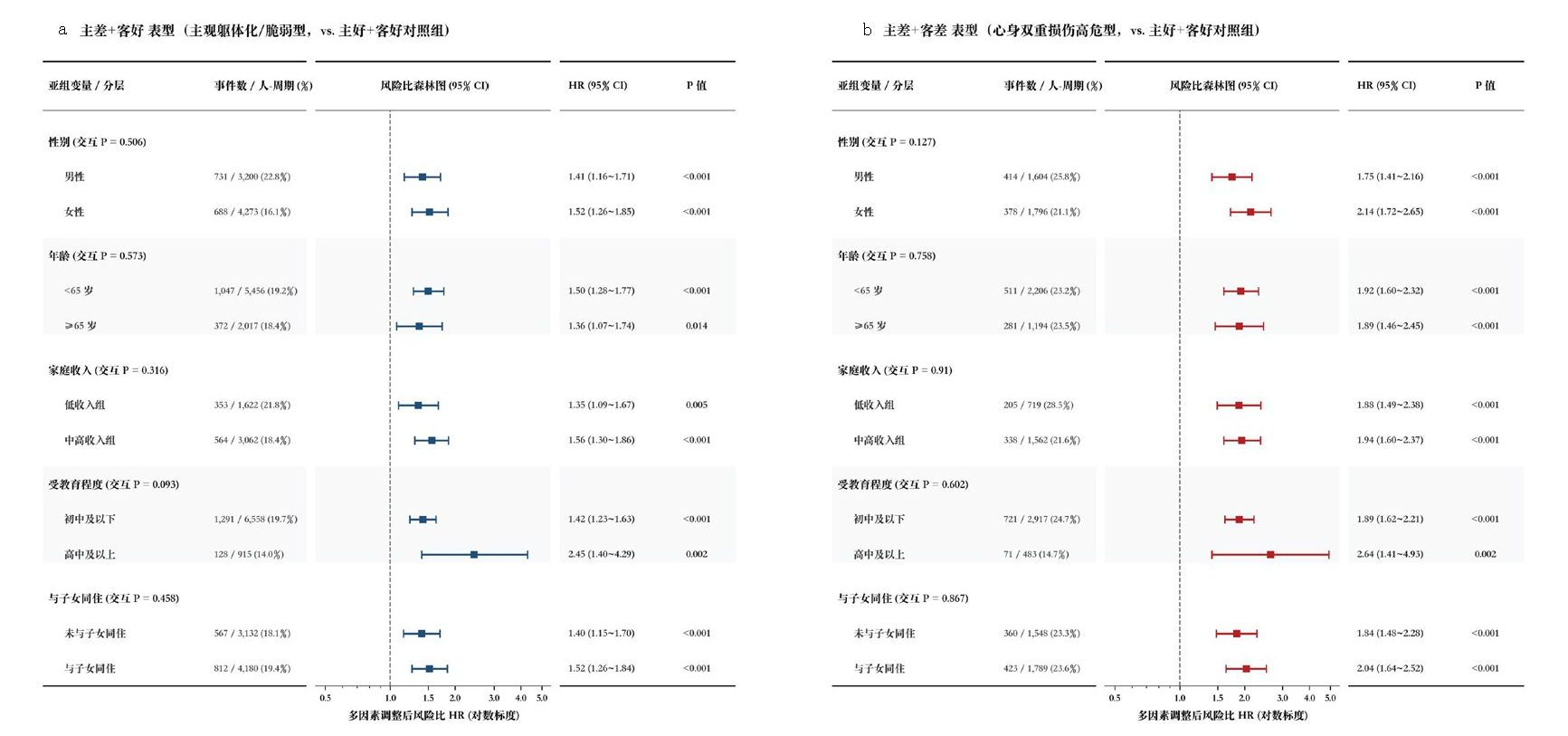
图2 CHARLS队列中老年人群不同临床特征亚组中时变主客观健康不一致表型的新发抑郁风险森林图 a. 自评不良且无共病表型各亚组离散生存模型森林图; b. 自评不良且伴共病表型各亚组离散生存模型森林图 注:各亚组分析均基于多因素全调整离散生存模型(模型3,分层变量本身除外)。实心方块表示HR点估计值,水平线段表示95%CI,垂直虚线为无效假设线(HR=1.00)。交互P值为Wald 交互检验P值。全量亚组数据详见表3。HR:风险比(Hazard Ratio);CI:置信区间(Confidence Interval);CHARLS:中国健康与养老追踪调查(China Health and Retirement Longitudinal Study)。
Fig. 2 Forest plots of the risk of incident depression associated with time-updated discrepancies between subjective and objective health phenotypes across clinical subgroups in older adults in the CHARLS cohort a. Forest plots of discrete-time survival model estimates for subgroups within the phenotype of poor self-rated health without comorbidity; b. Forest plots of discrete-time survival model estimates for subgroups within the phenotype of poor self-rated health with comorbidity
| 亚组分类 | 分层水平 | 健康不一致表型 | 人-周期数 | 新发抑郁 (例) | 发病率 (%) | HR(95%CI) | P值 | 交互P值 |
|---|---|---|---|---|---|---|---|---|
| 性别 | 男性 | 自评不良-无共病 | 3 200 | 731 | 22.84 | 1.41(1.16~1.71) | <0.001 | 0.506 |
| 自评良好-伴共病 | 359 | 66 | 18.38 | 1.26(0.87~1.82) | 0.215 | 0.222 | ||
| 自评不良-伴共病 | 1 604 | 414 | 25.81 | 1.75(1.41~2.16) | <0.001 | 0.127 | ||
| 女性 | 自评不良-无共病 | 4 273 | 688 | 16.10 | 1.52(1.26~1.85) | <0.001 | 0.506 | |
| 自评良好-伴共病 | 395 | 54 | 13.67 | 1.68(1.17~2.41) | 0.005 | 0.222 | ||
| 自评不良-伴共病 | 1 796 | 378 | 21.05 | 2.14(1.72~2.65) | <0.001 | 0.127 | ||
| 年龄 | <65岁 | 自评不良-无共病 | 5 456 | 1 047 | 19.19 | 1.50(1.28~1.77) | <0.001 | 0.573 |
| 自评良好-伴共病 | 454 | 78 | 17.18 | 1.52(1.09~2.11) | 0.013 | 0.509 | ||
| 自评不良-伴共病 | 2 206 | 511 | 23.16 | 1.92(1.60~2.32) | <0.001 | 0.758 | ||
| ≥65岁 | 自评不良-无共病 | 2017 | 372 | 18.44 | 1.36(1.07~1.74) | 0.014 | 0.573 | |
| 自评良好-伴共病 | 300 | 42 | 14.00 | 1.32(0.88~1.99) | 0.186 | 0.509 | ||
| 自评不良-伴共病 | 1 194 | 281 | 23.53 | 1.89(1.46~2.45) | <0.001 | 0.758 | ||
| 家庭人均年收入 | 低收入组 | 自评不良-无共病 | 1 622 | 353 | 21.76 | 1.35(1.09~1.67) | 0.005 | 0.316 |
| 自评良好-伴共病 | 148 | 27 | 18.24 | 1.23(0.79~1.90) | 0.354 | 0.404 | ||
| 自评不良-伴共病 | 719 | 205 | 28.51 | 1.88(1.49~2.38) | <0.001 | 0.910 | ||
| 中高收入组 | 自评不良-无共病 | 3062 | 564 | 18.42 | 1.56(1.30~1.86) | <0.001 | 0.316 | |
| 自评良好-伴共病 | 350 | 53 | 15.14 | 1.54(1.12~2.12) | 0.008 | 0.404 | ||
| 自评不良-伴共病 | 1 562 | 338 | 21.64 | 1.94(1.60~2.37) | <0.001 | 0.910 | ||
| 受教育程度 | 初中及以下 | 自评不良-无共病 | 6558 | 1 291 | 19.69 | 1.42(1.23~1.63) | <0.001 | 0.093 |
| 自评良好-伴共病 | 645 | 109 | 16.90 | 1.40(1.07~1.83) | 0.013 | 0.458 | ||
| 自评不良-伴共病 | 2 917 | 721 | 24.72 | 1.89(1.62~2.21) | <0.001 | 0.602 | ||
| 高中及以上 | 自评不良-无共病 | 915 | 128 | 13.99 | 2.45(1.40~4.29) | 0.002 | 0.093 | |
| 自评良好-伴共病 | 109 | 11 | 10.09 | 2.09(0.85~5.18) | 0.109 | 0.458 | ||
| 自评不良-伴共病 | 483 | 71 | 14.70 | 2.64(1.41~4.93) | 0.002 | 0.602 | ||
| 与子女同住情况 | 未同住 | 自评不良-无共病 | 3132 | 567 | 18.10 | 1.40(1.15~1.70) | <0.001 | 0.458 |
| 自评良好-伴共病 | 345 | 56 | 16.23 | 1.40(0.96~2.03) | 0.078 | 0.943 | ||
| 自评不良-伴共病 | 1 548 | 360 | 23.26 | 1.84(1.48~2.28) | <0.001 | 0.867 | ||
| 同住 | 自评不良-无共病 | 4 180 | 812 | 19.43 | 1.52(1.26~1.84) | <0.001 | 0.458 | |
| 自评良好-伴共病 | 396 | 61 | 15.40 | 1.47(1.03~2.11) | 0.034 | 0.943 | ||
| 自评不良-伴共病 | 1 789 | 423 | 23.64 | 2.04(1.64~2.52) | <0.001 | 0.867 |
表3 CHARLS 队列中老年人群不同临床特征亚组中时变主客观健康不一致表型与新发抑郁风险的关联及交互作用分析
Tab. 3 Association and interaction analysis of time-updated discrepancies between subjective and objective health phenotypes with risk of incident depression across clinical subgroups in older adults in the CHARLS cohort
| 亚组分类 | 分层水平 | 健康不一致表型 | 人-周期数 | 新发抑郁 (例) | 发病率 (%) | HR(95%CI) | P值 | 交互P值 |
|---|---|---|---|---|---|---|---|---|
| 性别 | 男性 | 自评不良-无共病 | 3 200 | 731 | 22.84 | 1.41(1.16~1.71) | <0.001 | 0.506 |
| 自评良好-伴共病 | 359 | 66 | 18.38 | 1.26(0.87~1.82) | 0.215 | 0.222 | ||
| 自评不良-伴共病 | 1 604 | 414 | 25.81 | 1.75(1.41~2.16) | <0.001 | 0.127 | ||
| 女性 | 自评不良-无共病 | 4 273 | 688 | 16.10 | 1.52(1.26~1.85) | <0.001 | 0.506 | |
| 自评良好-伴共病 | 395 | 54 | 13.67 | 1.68(1.17~2.41) | 0.005 | 0.222 | ||
| 自评不良-伴共病 | 1 796 | 378 | 21.05 | 2.14(1.72~2.65) | <0.001 | 0.127 | ||
| 年龄 | <65岁 | 自评不良-无共病 | 5 456 | 1 047 | 19.19 | 1.50(1.28~1.77) | <0.001 | 0.573 |
| 自评良好-伴共病 | 454 | 78 | 17.18 | 1.52(1.09~2.11) | 0.013 | 0.509 | ||
| 自评不良-伴共病 | 2 206 | 511 | 23.16 | 1.92(1.60~2.32) | <0.001 | 0.758 | ||
| ≥65岁 | 自评不良-无共病 | 2017 | 372 | 18.44 | 1.36(1.07~1.74) | 0.014 | 0.573 | |
| 自评良好-伴共病 | 300 | 42 | 14.00 | 1.32(0.88~1.99) | 0.186 | 0.509 | ||
| 自评不良-伴共病 | 1 194 | 281 | 23.53 | 1.89(1.46~2.45) | <0.001 | 0.758 | ||
| 家庭人均年收入 | 低收入组 | 自评不良-无共病 | 1 622 | 353 | 21.76 | 1.35(1.09~1.67) | 0.005 | 0.316 |
| 自评良好-伴共病 | 148 | 27 | 18.24 | 1.23(0.79~1.90) | 0.354 | 0.404 | ||
| 自评不良-伴共病 | 719 | 205 | 28.51 | 1.88(1.49~2.38) | <0.001 | 0.910 | ||
| 中高收入组 | 自评不良-无共病 | 3062 | 564 | 18.42 | 1.56(1.30~1.86) | <0.001 | 0.316 | |
| 自评良好-伴共病 | 350 | 53 | 15.14 | 1.54(1.12~2.12) | 0.008 | 0.404 | ||
| 自评不良-伴共病 | 1 562 | 338 | 21.64 | 1.94(1.60~2.37) | <0.001 | 0.910 | ||
| 受教育程度 | 初中及以下 | 自评不良-无共病 | 6558 | 1 291 | 19.69 | 1.42(1.23~1.63) | <0.001 | 0.093 |
| 自评良好-伴共病 | 645 | 109 | 16.90 | 1.40(1.07~1.83) | 0.013 | 0.458 | ||
| 自评不良-伴共病 | 2 917 | 721 | 24.72 | 1.89(1.62~2.21) | <0.001 | 0.602 | ||
| 高中及以上 | 自评不良-无共病 | 915 | 128 | 13.99 | 2.45(1.40~4.29) | 0.002 | 0.093 | |
| 自评良好-伴共病 | 109 | 11 | 10.09 | 2.09(0.85~5.18) | 0.109 | 0.458 | ||
| 自评不良-伴共病 | 483 | 71 | 14.70 | 2.64(1.41~4.93) | 0.002 | 0.602 | ||
| 与子女同住情况 | 未同住 | 自评不良-无共病 | 3132 | 567 | 18.10 | 1.40(1.15~1.70) | <0.001 | 0.458 |
| 自评良好-伴共病 | 345 | 56 | 16.23 | 1.40(0.96~2.03) | 0.078 | 0.943 | ||
| 自评不良-伴共病 | 1 548 | 360 | 23.26 | 1.84(1.48~2.28) | <0.001 | 0.867 | ||
| 同住 | 自评不良-无共病 | 4 180 | 812 | 19.43 | 1.52(1.26~1.84) | <0.001 | 0.458 | |
| 自评良好-伴共病 | 396 | 61 | 15.40 | 1.47(1.03~2.11) | 0.034 | 0.943 | ||
| 自评不良-伴共病 | 1 789 | 423 | 23.64 | 2.04(1.64~2.52) | <0.001 | 0.867 |
| 第t波初始健康状态 | 第t+1波: 自评良好-无共病 | 第t+1波: 自评不良-无共病 | 第t+1波: 自评良好-伴共病 | 第t+1波: 自评不良-伴共病 | 第t+1波: 新发抑郁 | 随访总人- 周期数 |
|---|---|---|---|---|---|---|
| 自评良好-无共病 | 2 028(47.9%) | 1 422(33.6%) | 118(2.8%) | 149(3.5%) | 514(12.1%) | 4 231 |
| 自评不良-无共病 | 1 384(18.8%) | 3 887(52.7%) | 95(1.3%) | 593(8.0%) | 1 419(19.2%) | 7 378 |
| 自评良好-伴共病 | 0(0.0%) | 0(0.0%) | 270(35.9%) | 363(48.2%) | 120(15.9%) | 753 |
| 自评不良-伴共病 | 0(0.0%) | 0(0.0%) | 373(11.0%) | 2 233(65.7%) | 792(23.3%) | 3 398 |
表4 CHARLS 队列中老年人群主客观健康状态相邻波次转移概率及新发抑郁去向矩阵(人-周期视角,N=15 760)
Tab. 4 Adjacentwave transition probabilities of subjective and objective health status and transition matrix of incident depression outcomes in the CHARLS cohort from a person-period perspective(N=15 760)
| 第t波初始健康状态 | 第t+1波: 自评良好-无共病 | 第t+1波: 自评不良-无共病 | 第t+1波: 自评良好-伴共病 | 第t+1波: 自评不良-伴共病 | 第t+1波: 新发抑郁 | 随访总人- 周期数 |
|---|---|---|---|---|---|---|
| 自评良好-无共病 | 2 028(47.9%) | 1 422(33.6%) | 118(2.8%) | 149(3.5%) | 514(12.1%) | 4 231 |
| 自评不良-无共病 | 1 384(18.8%) | 3 887(52.7%) | 95(1.3%) | 593(8.0%) | 1 419(19.2%) | 7 378 |
| 自评良好-伴共病 | 0(0.0%) | 0(0.0%) | 270(35.9%) | 363(48.2%) | 120(15.9%) | 753 |
| 自评不良-伴共病 | 0(0.0%) | 0(0.0%) | 373(11.0%) | 2 233(65.7%) | 792(23.3%) | 3 398 |
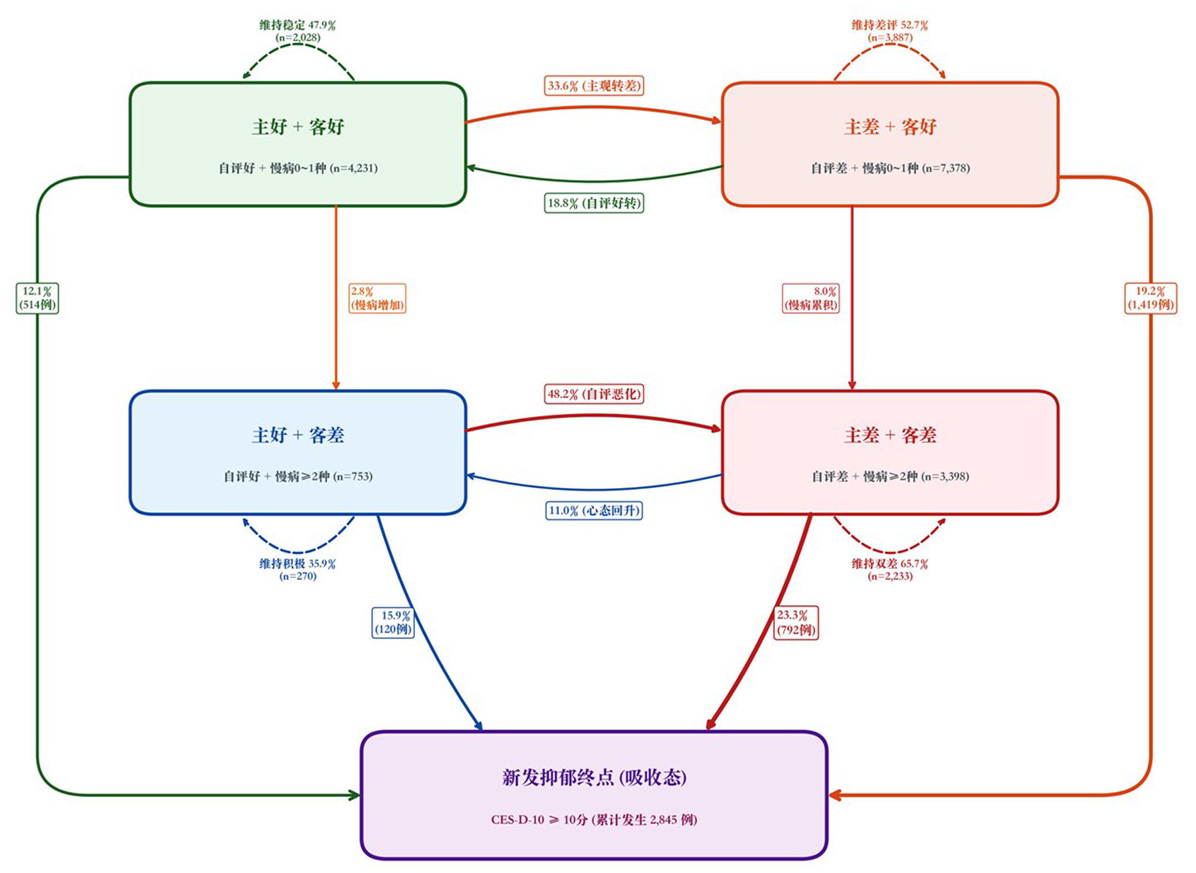
图3 CHARLS队列中老年人群主客观健康状态多状态转移图 注:带数值箭头表示相邻波次状态间的一步转移概率(%);环形箭头表示维持原状态的留存概率;深紫色框代表发病终点吸收态(新发抑郁,CES-D-10 ≥ 10分)。CES-D-10:简版流调中心抑郁量表(Center for Epidemiologic Studies Depression Scale-10);CHARLS:中国健康与养老追踪调查(China Health and Retirement Longitudinal Study)。
Fig. 3 Multi-state transition diagram of subjective and objective health status in older adults in the CHARLS cohort
| 敏感性检验模型方案 | 人-周期数 | 抑郁事件 | 自评良好- 无共病 | 自评不良-无共病 HR或OR(95%CI) | 自评良好-伴共病 HR或OR(95%CI) | 自评不良-伴共病 HR或OR(95%CI) |
|---|---|---|---|---|---|---|
| 主分析:基准多因素全调整离散生存模型(模型3) | 15 892 | 2 845 | 1.00[参照] | 1.54(1.39~1.71)△ | 1.40(1.14~1.71)# | 2.11(1.88~2.36)△ |
| 敏感性分析1:逆概率加权(IPCW)校正失访与损耗偏倚 | 15 892 | 2 845 | 1.00[参照] | 1.52(1.37~1.69)△ | 1.38(1.12~1.70)# | 2.07(1.84~2.33)△ |
| 敏感性分析2:完全个案分析(排除插补,限制无缺失者) | 13 428 | 2 412 | 1.00[参照] | 1.56(1.40~1.74)△ | 1.39(1.11~1.73)# | 2.13(1.89~2.40)△ |
| 敏感性分析3:排除首个随访波次内事件(滞后排除反向因果) | 9 735 | 2 331 | 1.00[参照] | 1.51(1.34~1.70)△ | 1.37(1.08~1.74)* | 2.08(1.82~2.37)△ |
| 敏感性分析4:提高客观共病切点阈值(重构为累积确诊≥3种慢性病) | 15 892 | 2 845 | 1.00[参照] | 1.53(1.38~1.70)△ | 1.42(1.13~1.79)# | 2.05(1.81~2.32)△ |
| 敏感性分析5:采用Logit连接函数拟合离散时间模型(OR) | 15 892 | 2 845 | 1.00[参照] | 1.58(1.41~1.77)△ | 1.43(1.15~1.77)# | 2.22(1.96~2.52)△ |
表5 CHARLS队列中老年人群时变主客观健康不一致与新发抑郁离散生存模型的多重敏感性分析检验
Tab. 5 Multiple sensitivity analyses of discrete-time survival models for time-updated discrepancies between subjective and objective health and incident depression in older adults in the CHARLS cohort
| 敏感性检验模型方案 | 人-周期数 | 抑郁事件 | 自评良好- 无共病 | 自评不良-无共病 HR或OR(95%CI) | 自评良好-伴共病 HR或OR(95%CI) | 自评不良-伴共病 HR或OR(95%CI) |
|---|---|---|---|---|---|---|
| 主分析:基准多因素全调整离散生存模型(模型3) | 15 892 | 2 845 | 1.00[参照] | 1.54(1.39~1.71)△ | 1.40(1.14~1.71)# | 2.11(1.88~2.36)△ |
| 敏感性分析1:逆概率加权(IPCW)校正失访与损耗偏倚 | 15 892 | 2 845 | 1.00[参照] | 1.52(1.37~1.69)△ | 1.38(1.12~1.70)# | 2.07(1.84~2.33)△ |
| 敏感性分析2:完全个案分析(排除插补,限制无缺失者) | 13 428 | 2 412 | 1.00[参照] | 1.56(1.40~1.74)△ | 1.39(1.11~1.73)# | 2.13(1.89~2.40)△ |
| 敏感性分析3:排除首个随访波次内事件(滞后排除反向因果) | 9 735 | 2 331 | 1.00[参照] | 1.51(1.34~1.70)△ | 1.37(1.08~1.74)* | 2.08(1.82~2.37)△ |
| 敏感性分析4:提高客观共病切点阈值(重构为累积确诊≥3种慢性病) | 15 892 | 2 845 | 1.00[参照] | 1.53(1.38~1.70)△ | 1.42(1.13~1.79)# | 2.05(1.81~2.32)△ |
| 敏感性分析5:采用Logit连接函数拟合离散时间模型(OR) | 15 892 | 2 845 | 1.00[参照] | 1.58(1.41~1.77)△ | 1.43(1.15~1.77)# | 2.22(1.96~2.52)△ |
| [1] | 黄悦勤, 王向群, 陆林, 等. 中国精神障碍患病率和疾病负担研究[J]. 中华精神科杂志, 2020, 53(5): 348-352. doi: 10.3760/cma.j.cn113661-20200527-00184. |
| [2] | 中国老年保健协会, 北京协和医学院. 中国老年健康研究报告(2020-2021)[M]. 北京: 社会科学文献出版社, 2021: 110-135. |
| [3] |
Jylhä M. What is self-rated health and why does it predict mortality? Towards a unified conceptual model[J]. Soc Sci Med, 2009, 69(3): 307-316. doi: 10.1016/j.socscimed.2009.05.013.
pmid: 19520474 |
| [4] |
Wu S, Wang R, Zhao Y, et al. The relationship between self-rated health and objective health status: A population-based study[J]. BMC Public Health, 2013, 13: 320. doi: 10.1186/1471-2458-13-320.
pmid: 23570559 |
| [5] |
Johnston MC, Crilly M, Black C, et al. Defining and measuring multimorbidity: A systematic review of systematic reviews[J]. Eur J Public Health, 2019, 29(1): 182-189. doi: 10.1093/eurpub/cky098.
pmid: 29878097 |
| [6] |
Pinquart M. Correlates of subjective health in older adults: a meta-analysis[J]. Psychol Aging, 2001, 16(3): 414-426. doi: 10.1037/0882-7974.16.3.414.
pmid: 11554520 |
| [7] |
Zhao Y, Hu Y, Smith JP, et al. Cohort profile: The China Health and Retirement Longitudinal Study (CHARLS)[J]. Int J Epidemiol, 2014, 43(1): 61-68. doi: 10.1093/ije/dys203.
pmid: 23243115 |
| [8] | von Elm E, Altman DG, Egger M, et al. The Strengthening the Reporting of Observational Studies in Epidemiology (STROBE) statement: Guidelines for reporting observational studies[J]. Lancet, 2007, 370(9596): 1453-1457. doi: 10.1016/S0140-6736(07)61602-X. |
| [9] |
Andresen EM, Malmgren JA, Carter WB, et al. Screening for depression in well older adults: Evaluation of a short form of the CES-D (Center for Epidemiologic Studies Depression Scale)[J]. Am J Prev Med, 1994, 10(2): 77-84. doi: 10.1016/S0749-3797(18)30622-6.
pmid: 8037935 |
| [10] |
Chen H, Mui AC. Factorial validity of the Center for Epidemiologic Studies Depression Scale short form in older population in China[J]. Int Psychogeriatr, 2014, 26(1): 49-57. doi: 10.1017/S1041610213001701.
pmid: 24125553 |
| [11] | 中国肥胖问题工作组. 中国成人超重和肥胖症预防与控制指南(节录)[J]. 营养学报, 2004, 26(1):1-4. doi:10.3321/j.issn:0512-7955.2004.01.001. |
| [12] | van Buuren S, Groothuis-Oudshoorn K. Mice: Multivariate imputation by chained equations in R[J]. J Stat Softw, 2011, 45(3): 1-67. doi: 10.18637/jss.v045.i03. |
| [13] |
Prentice RL, Gloeckler LA. Regression analysis of grouped survival data with application to breast cancer data[J]. Biometrics, 1978, 34(1): 57-67. doi: 10.2307/2529588.
pmid: 630037 |
| [14] | McEwen BS. Neurobiological and systemic effects of chronic stress[J]. Chronic Stress (Thousand Oaks), 2017, 1: 1-11. doi: 10.1177/2470547017692328. |
| [15] |
Thayer JF, Sternberg EM. Neural aspects of immunomodulation: Focus on the vagus nerve[J]. Brain Behav Immun, 2010, 24(8): 1223-1230. doi: 10.1016/j.bbi.2010.07.247.
pmid: 20674737 |
| [16] |
Christian LM, Glaser R, Porter K, et al. Poorer self-rated health is associated with elevated inflammatory markers among older adults[J]. Psychoneuroendocrinology, 2011, 36(10): 1495-1504. doi: 10.1016/j.psyneuen.2011.04.003.
pmid: 21601365 |
| [17] |
Miller AH, Raison CL. The role of inflammation in depression: From evolutionary imperative to modern treatment target[J]. Nat Rev Immunol, 2016, 16(1): 22-34. doi: 10.1038/nri.2015.5.
pmid: 26711676 |
| [18] |
Craig AD. How do you feel? Interoception: The sense of the physiological condition of the body[J]. Nat Rev Neurosci, 2002, 3(8): 655-666. doi: 10.1038/nrn894.
pmid: 12154366 |
| [19] | Barsky AJ, Wyshak G. Hypochondriasis and somatosensory amplification[J]. Br J Psychiatry, 1990, 157(3): 404-409. doi: 10.1192/bjp.157.3.404. |
| [20] |
Rief W, Broadbent E. Explaining medically unexplained symptoms-models and mechanisms[J]. Clin Psychol Rev, 2007, 27(7): 821-841. doi: 10.1016/j.cpr.2007.07.005.
pmid: 17716793 |
| [21] |
Albert PR. Why is depression more prevalent in women?[J]. J Psychiatry Neurosci, 2015, 40(4): 219-221. doi: 10.1503/jpn.150205.
pmid: 26107348 |
| [22] |
Pinquart M, Sörensen S. Spouses, adult children, and children-in-law as caregivers of older adults: A meta-analytic comparison[J]. Psychol Aging, 2011, 26(1): 1-14. doi: 10.1037/a0021863.
pmid: 21417538 |
| [23] |
Lachman ME, Weaver SL. The sense of control as a moderator of social class differences in health and well-being[J]. J Pers Soc Psychol, 1998, 74(3): 763-773. doi: 10.1037/0022-3514.74.3.763.
pmid: 9523418 |
| [24] | Silverstein M, Cong Z, Li S. Intergenerational transfers and living arrangements of older people in rural China: Consequences for psychological well-being[J]. J Gerontol B Psychol Sci Soc Sci, 2006, 61(5): S256-S266. doi: 10.1093/geronb/61.5.s256. |
| [25] | Lazarus RS, Folkman S. Stress, appraisal, and coping[M]. New York: Springer Publishing Company, 1984: 117-140. |
| [26] |
Southwick SM, Charney DS. The science of resilience: Implications for the prevention and treatment of depression[J]. Science, 2012, 338(6103): 79-82. doi: 10.1126/science.1222942.
pmid: 23042887 |
| [27] | Steptoe A, Wardle J, Marmot M. Positive affect and health-related neuroendocrine, cardiovascular, and inflammatory processes[J]. Proc Natl Acad Sci U S A, 2005, 102(18): 6508-6512. doi: 10.1073/pnas.0409174102. |
| [28] | Bowling A. Just one question: If one question works, why ask several?[J]. J Epidemiol Community Health, 2005, 59(5): 342-345. doi: 10.1136/jech.2004.021204. |
| [29] | Cuijpers P, Quero S, Dowrick C, et al. Psychological treatment of depression in primary care: Recent developments[J]. Curr Psychiatry Rep, 2019, 21(12): 129. doi: 10.1007/s11920-019-1117-x. |
| [30] | 中华医学会心身医学分会躯体症状及相关障碍学组. 躯体症状障碍多学科诊疗专家共识[J]. 中华精神科杂志, 2024, 57(3): 140-151. doi: 10.3760/cma.j.cn113661-20240115-00018. |
| [1] | 王筱涵, 王栋泽, 韩冰. 炎症细胞比值与抑郁症状及短期疗效的关系[J]. 临床荟萃, 2026, 41(10): 891-900. |
| [2] | 胡萍, 韩冰, 王玉平. 帕金森共病抑郁患者使用抗抑郁药诱发的SIADH诊治1例——精神神经融合的实践体会[J]. 临床荟萃, 2026, 41(10): 933-937. |
| [3] | 朱卓豪, 黄园园, 李荷花, 吴逢春. DNA甲基化与脑影像学改变在抑郁症中的研究进展——基于病理假说视角[J]. 临床荟萃, 2026, 41(5): 457-461. |
| [4] | 刘栋, 杨启昌, 李欣然. 抑郁症与肠道菌群关联性的研究进展及趋势分析[J]. 临床荟萃, 2026, 41(3): 285-288. |
| [5] | 卢远思, 吕见君, 官计彬, 操龙斌. 双相情感障碍患者外周血中FGF1的表达与糖脂代谢的相关性[J]. 临床荟萃, 2025, 40(7): 619-623. |
| [6] | 陆香秀, 王海明, 张轶杰, 邱尔仙. 认知行为疗法对首发抑郁障碍患者认知功能的影响[J]. 临床荟萃, 2024, 39(4): 320-324. |
| [7] | 原风英, 马晓玲, 曲军民. 阿戈美拉汀结合扑克牌类娱疗对首发重度抑郁症患者认知功能的影响[J]. 临床荟萃, 2024, 39(2): 130-133. |
| [8] | 段登艾, 邓燕, 张志雄, 谷樟林. 辩证行为疗法联合舍曲林对伴有非自杀性自伤的青少年抑郁障碍患者的影响[J]. 临床荟萃, 2023, 38(4): 319-323. |
| [9] | 陈轩轩, 高树贵. 改良无抽搐电休克治疗抑郁症所致记忆损害临床干预策略[J]. 临床荟萃, 2023, 38(1): 75-78. |
| [10] | 曲伊平, 梁慧杰, 陈允恩. 重复经颅磁刺激治疗青少年抑郁症认知功能损害的研究进展[J]. 临床荟萃, 2022, 37(10): 957-960. |
| [11] | 黄永兰;章华;陈振华;杨灿;朱志先. 双相情感障碍224例用药分析[J]. 临床荟萃, 2015, 30(8): 935-937. |
| [12] | 赵媛媛;赵晓川;谭莉;王金成;金圭星. 双相情感障碍抑郁发作与单相抑郁症患者执行功能损害的对照研究[J]. 临床荟萃, 2014, 29(7): 769-770774. |
| [13] | 赵鹏;杨海龙;沈迪文;张宇哲;曹秋云. 综合性医院精神科门诊初诊患者分析[J]. 临床荟萃, 2013, 28(10): 1081-1.08211e+007. |
| [14] | 张哲;蒋国卿;范明月;余洪敏;倪连俊. 米氮平治疗卒中后抑郁伴发失眠的疗效观察[J]. 临床荟萃, 2013, 28(8): 920-922. |
| [15] | 胡蕊;王志峰;游道峰;李幼东;王冉;王岚;王学义. 帕罗西汀联合高压氧治疗抑郁症患者睡眠障碍的临床疗效[J]. 临床荟萃, 2013, 28(6): 630-632. |
| 阅读次数 | ||||||
|
全文 |
|
|||||
|
摘要 |
|
|||||
