临床荟萃 ›› 2026, Vol. 41 ›› Issue (8): 685-689.doi: 10.3969/j.issn.1004-583X.2026.08.002

• 论著 • 上一篇    下一篇

心电图aVR导联ST段抬高与QRS波时限评估急性前壁心肌梗死患者并发心源性休克风险的价值

周丽莉1(), 严霞1, 严瑾2   

  1. 1 泰兴市人民医院 心电诊断科,江苏 泰兴 225400
    2 南通大学 医学院,江苏 南通 226001
  • 收稿日期:2026-05-08 出版日期:2026-08-20 发布日期:2026-08-25
  • 通讯作者: 周丽莉 E-mail:zhouli248@126.com

Value of ST segment elevation in lead aVR and QRS duration on electrocardiogram for assessing the risk of cardiogenic shock in patients with acute anterior myocardial infarction

Zhou Lili1(), Yan Xia1, Yan Jin2   

  1. 1 Department of Electrocardiography,Taixing People's Hospital,Taixing 225400,China
    2 Medical College of Nantong University,Nantong 226001,China
  • Received:2026-05-08 Online:2026-08-20 Published:2026-08-25
  • Contact: Zhou Lili E-mail:zhouli248@126.com

摘要:

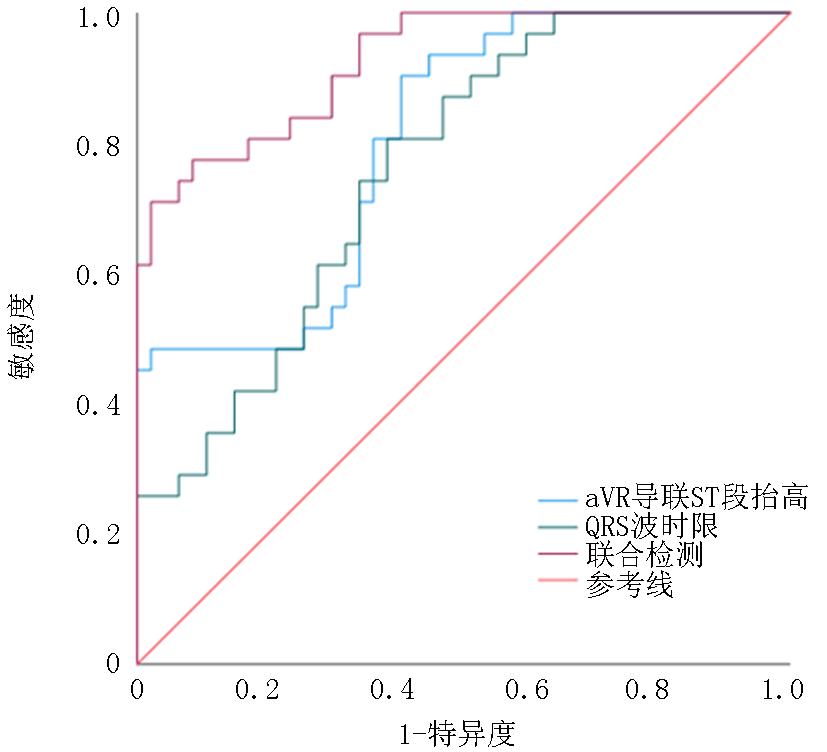
目的 探讨心电图aVR导联ST段抬高与QRS波时限对急性前壁心肌梗死(AAMI)患者并发心源性休克(CS)风险的评估价值。方法 回顾性纳入2022年10月-2025年10月泰兴市人民医院收治的AAMI患者178例,根据是否发生CS,将患者分为CS组(46例)和非CS组(132例)。比较两组临床资料,采用单因素和多因素logistic回归分析AAMI患者并发CS的价值。结果 CS组Killip分级≥Ⅲ级、左室射血分数(LVEF)<50%的比例高于非CS组,并且aVR导联ST段抬高幅度、QRS波时限高于非CS组(P<0.05);经多因素logistic分析,Killip分级、LVEF<50%、aVR导联ST段抬高、QRS波时限是AAMI患者并发心源性休克的危险因素(P<0.05);经受试者工作特征(ROC)曲线分析,aVR导联ST段抬高、QRS波时限单独及联合评估AAMI患者并发心源性休克的曲线下面积为0.812、0.785、0.935,敏感度为0.761、0.739、0.848,特异度为0.758、0.765、0.886。结论 心电图aVR导联ST段抬高和QRS波时限延长是AAMI患者并发CS的独立危险因素,二者联合检测可作为AAMI患者CS风险早期识别的辅助指标,有助于临床高危人群的识别和干预。

关键词: 前壁心肌梗死, 心源性休克, aVR导联, ST段抬高, QRS波时限

Abstract:

Objective To investigate the value of ST segment elevation in lead aVR and QRS duration on electrocardiogram for assessing the risk of cardiogenic shock (CS) in patients with acute anterior myocardial infarction (AAMI).Methods A total of 178 patients with AAMI admitted to our hospital from October 2022 to October 2025 were retrospectively enrolled. According to the occurrence of CS, patients were divided into a CS group (46 cases) and a non-CS group (132 cases). Clinical data were compared between the two groups. Univariate and multivariate logistic regression analyses were used to evaluate the risk of CS in patients with AAMI. Results The proportions of patients with Killip class ≥ III and left ventricular ejection fraction (LVEF) <50% were significantly higher in the CS group than in the non-CS group, and the magnitude of ST segment elevation in lead aVR and QRS duration were also greater in the CS group (P<0.05). Multivariate logistic regression analysis showed that Killip class, LVEF <50%, ST segment elevation in lead aVR, and QRS duration were risk factors for cardiogenic shock in patients with AAMI (P<0.05). Receiver operating characteristic (ROC) curve analysis showed that the areas under the curve for ST segment elevation in lead aVR and QRS duration alone, as well as in combination, in predicting cardiogenic shock in patients with AAMI were 0.812, 0.785, and 0.935, respectively; the corresponding sensitivities were 0.761, 0.739, and 0.848, and the specificities were 0.758, 0.765, and 0.886. Conclusion ST segment elevation in lead aVR and prolonged QRS duration on electrocardiogram are independent risk factors for cardiogenic shock in patients with AAMI. Combined detection of these two indicators may serve as an auxiliary marker for early identification of CS risk in patients with AAMI, thereby facilitating the identification and intervention of high-risk patients in clinical practice.

Key words: anterior myocardial infarction, cardiogenic shock, aVR lead, ST segment elevation, QRS wave duration

中图分类号: