
临床荟萃 ›› 2025, Vol. 40 ›› Issue (10): 897-903.doi: 10.3969/j.issn.1004-583X.2025.10.004
刘胜华( )
)
收稿日期:2025-06-05
出版日期:2025-10-20
发布日期:2025-10-31
通讯作者:
刘胜华
E-mail:sci_publishing@qq.com
Liu Shenghua()
Received:2025-06-05
Online:2025-10-20
Published:2025-10-31
Contact:
Liu Shenghua
E-mail:sci_publishing@qq.com
摘要:
目的 探讨游离甲状腺素(free thyroxine 4,FT4)联合左室射血分数(left ventricular ejection fraction,LVEF)对甲状腺功能亢进症(甲亢)患者并发甲亢性心脏病(hyperthyroid heart disease,HHD)的评估价值。方法 本研究为回顾性研究,纳入2023年1月-2025年1月于北京市仁和医院心内科门诊及住院部诊断为甲亢或HHD的患者104例,依据是否合并HHD分为甲亢组(n=64)和HHD组(n=40)。比较两组一般资料(性别、年龄、吸烟史)、甲状腺功能指标(游离三碘甲状腺原氨酸、FT4、促甲状腺激素)及心功能指标(左室舒张末期直径、左室收缩末期直径、LVEF)等的差异;采用多因素logistic回归分析HHD的独立危险因素,通过绘制受试者工作特征曲线分析各指标对HHD的预测效能。结果 HHD组年龄和吸烟史占比均大于甲亢组(P<0.05)。甲亢组游离三碘甲状腺原氨酸水平、FT4水平、左室舒张末期直径和左室收缩末期直径均低于HHD组(P<0.05),甲亢组促甲状腺激素与LVEF均高于HHD组(P<0.05)。多因素logistic回归分析显示,年龄、吸烟史、FT3、FT4、LVESD和LVEDD均为甲亢患者合并HHD的危险因素,TSH和LVEF是其保护性因素,差异有统计学意义(P<0.05)。经受试者工作特征曲线检验,甲状腺功能指标及心功能指标对HHD均具有预测价值(P<0.05)。FT4联合LVEF指标的评估价值更高,其曲线下面积为0.98,特异度为64.06%,敏感度为51.82%(P<0.001)。结论 FT4和LVEF对甲亢并发HHD有一定的评估价值,且FT4联合LVEF的预测价值更高,可作为临床预测甲亢并发HHD的重要参考指标。
中图分类号:
刘胜华. 游离甲状腺素联合左室射血分数对甲亢性心脏病的评估价值[J]. 临床荟萃, 2025, 40(10): 897-903.
Liu Shenghua. Assessment value of FT4 combined with LVEF in hyperthyroid heart disease[J]. Clinical Focus, 2025, 40(10): 897-903.
| 典型症状群 | 高代谢症候群:体重进行性下降、怕热多汗、食欲亢进 |
|---|---|
| 神经兴奋性增加:手颤、失眠、易激惹等 | |
| 影像学证据 | 甲状腺肿大 |
| 实验室指标 | 血清甲状腺激素水平上升、促甲状腺激素(thyroid stimulating hormone,TSH)降低 |
表1 甲亢诊断标准
Tab.1 Diagnostic criteria for hyperthyroidism
| 典型症状群 | 高代谢症候群:体重进行性下降、怕热多汗、食欲亢进 |
|---|---|
| 神经兴奋性增加:手颤、失眠、易激惹等 | |
| 影像学证据 | 甲状腺肿大 |
| 实验室指标 | 血清甲状腺激素水平上升、促甲状腺激素(thyroid stimulating hormone,TSH)降低 |
| 必要条件 | 确诊甲亢 |
|---|---|
| 次要条件 | ①明显的房性心律失常:房性心动过速、心房扑动、心房颤动;②心力衰竭;③心脏扩大 |
| 排除条件 | 其他原因导致的心脏疾病 |
表2 HHD诊断标准
Tab.2 Diagnostic criteria for HHD
| 必要条件 | 确诊甲亢 |
|---|---|
| 次要条件 | ①明显的房性心律失常:房性心动过速、心房扑动、心房颤动;②心力衰竭;③心脏扩大 |
| 排除条件 | 其他原因导致的心脏疾病 |
| 组别 | 例数 | 女性 [例(%)] | 年龄 (岁) | 吸烟史 [例(%)] |
|---|---|---|---|---|
| 甲亢组 | 64 | 35(54.69) | 34.78±8.37 | 8(12.50) |
| HHD组 | 40 | 22(55.00) | 40.13±10.61 | 16(40.00) |
| t/χ2值 | 0.001 | 2.853 | 10.490 | |
| P值 | 0.975 | 0.005 | 0.001 |
表3 两组一般资料比较
Tab.3 Comparison of general data between the two groups
| 组别 | 例数 | 女性 [例(%)] | 年龄 (岁) | 吸烟史 [例(%)] |
|---|---|---|---|---|
| 甲亢组 | 64 | 35(54.69) | 34.78±8.37 | 8(12.50) |
| HHD组 | 40 | 22(55.00) | 40.13±10.61 | 16(40.00) |
| t/χ2值 | 0.001 | 2.853 | 10.490 | |
| P值 | 0.975 | 0.005 | 0.001 |
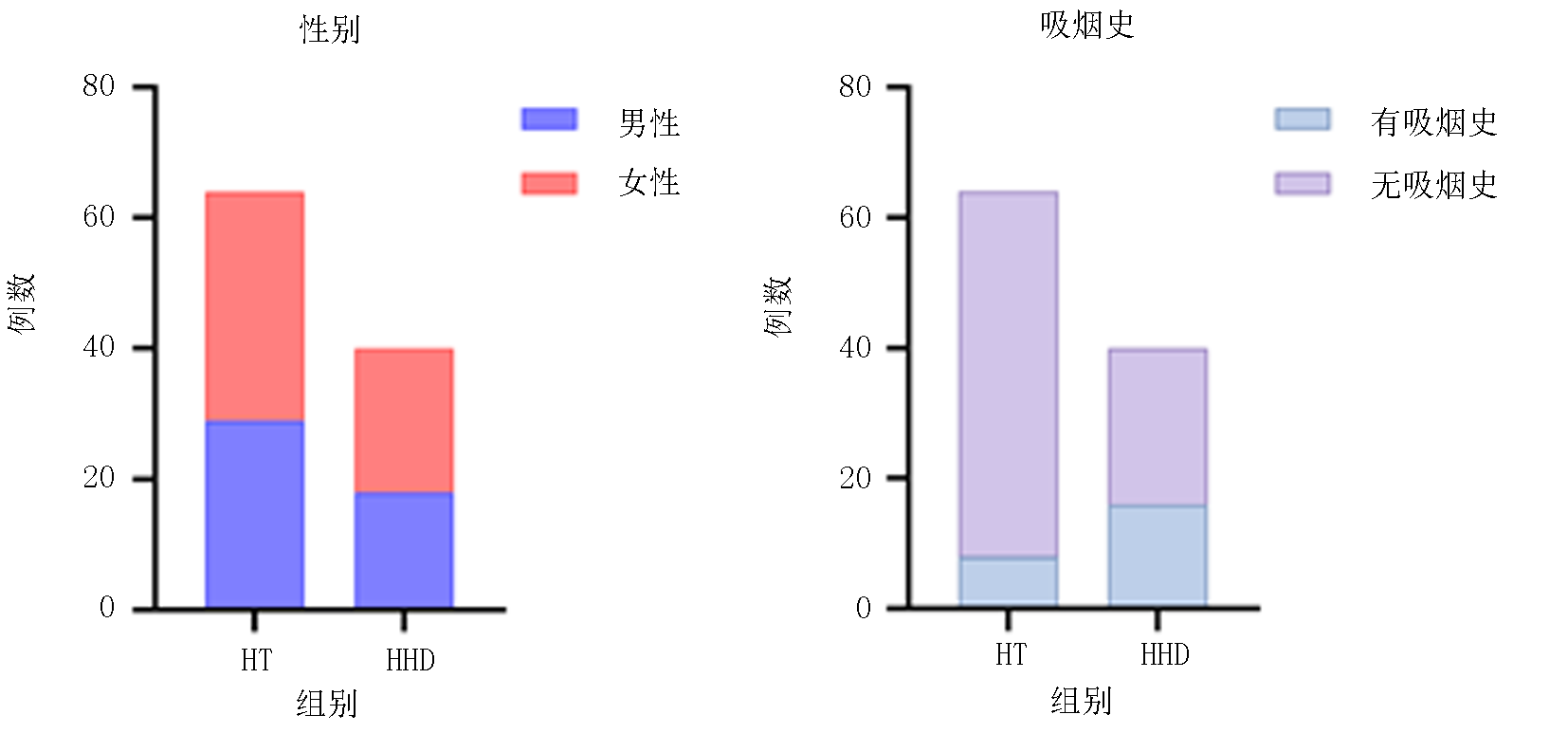
图1 两组性别和吸烟史的堆叠图
Fig.1 Stack diagram of gender and smoking history between the two groups
| 组别 | 例数 | FT3(ng/L) | FT4(ng/L) | TSH(mIU/L) | LVEDD(mm) | LVESD(mm) | LVEF(%) |
|---|---|---|---|---|---|---|---|
| 甲亢组 | 64 | 10.45±3.56 | 39.40±6.90 | 0.08(0.07, 0.09) | 50.09±4.26 | 39.66±3.58 | 55.43±6.63 |
| HHD组 | 40 | 12.69±2.92 | 55.10±11.80 | 0.06(0.04, 0.08) | 54.85±5.73 | 43.79±3.66 | 51.59±6.06 |
| t/Z值 | 3.340 | 5.350 | -3.971 | 4.532 | 5.681 | 2.968 | |
| P值 | 0.001 | <0.001 | <0.001 | <0.001 | <0.001 | 0.004 |
表4 两组临床资料比较
Tab.4 Comparison of clinical data between the two groups
| 组别 | 例数 | FT3(ng/L) | FT4(ng/L) | TSH(mIU/L) | LVEDD(mm) | LVESD(mm) | LVEF(%) |
|---|---|---|---|---|---|---|---|
| 甲亢组 | 64 | 10.45±3.56 | 39.40±6.90 | 0.08(0.07, 0.09) | 50.09±4.26 | 39.66±3.58 | 55.43±6.63 |
| HHD组 | 40 | 12.69±2.92 | 55.10±11.80 | 0.06(0.04, 0.08) | 54.85±5.73 | 43.79±3.66 | 51.59±6.06 |
| t/Z值 | 3.340 | 5.350 | -3.971 | 4.532 | 5.681 | 2.968 | |
| P值 | 0.001 | <0.001 | <0.001 | <0.001 | <0.001 | 0.004 |
| 变量 | 赋值 |
|---|---|
| 因变量 | |
| 分组 | 0=甲亢,1=HHD |
| 自变量 | |
| 年龄 | 连续性变量 |
| 吸烟史 | 1=无,2=有 |
| FT3、FT4、TSH | 连续性变量 |
| LVESD、LVEDD、LVEF | 连续性变量 |
表5 统计学因变量与自变量的赋值
Tab.5 Coding of statistical dependent and independent variables
| 变量 | 赋值 |
|---|---|
| 因变量 | |
| 分组 | 0=甲亢,1=HHD |
| 自变量 | |
| 年龄 | 连续性变量 |
| 吸烟史 | 1=无,2=有 |
| FT3、FT4、TSH | 连续性变量 |
| LVESD、LVEDD、LVEF | 连续性变量 |
| 因素 | 回归系数 | 标准误 | Wald χ2值 | P值 | 95%可信区间 | |
|---|---|---|---|---|---|---|
| 下限 | 上限 | |||||
| FT3 | 0.201 | 0.065 | 9.488 | 0.002 | 0.073 | 0.329 |
| FT4 | 1.115 | 0.251 | 19.750 | <0.001 | 0.623 | 1.606 |
| TSH | -34.220 | 9.938 | 11.857 | 0.001 | -53.698 | -14.742 |
| LVESD | 0.194 | 0.048 | 16.311 | <0.001 | 0.100 | 0.288 |
| LVEDD | 0.323 | 0.072 | 19.845 | <0.001 | 0.181 | 0.465 |
| LVEF | -0.094 | 0.034 | 7.665 | 0.006 | -0.161 | -0.028 |
| 年龄 | 0.061 | 0.023 | 7.074 | 0.008 | 0.016 | 0.106 |
| 吸烟史 | 1.540 | 0.497 | 9.606 | 0.002 | 0.566 | 2.515 |
表6 多因素logistic回归分析
Tab.6 Multiple logistic regression
| 因素 | 回归系数 | 标准误 | Wald χ2值 | P值 | 95%可信区间 | |
|---|---|---|---|---|---|---|
| 下限 | 上限 | |||||
| FT3 | 0.201 | 0.065 | 9.488 | 0.002 | 0.073 | 0.329 |
| FT4 | 1.115 | 0.251 | 19.750 | <0.001 | 0.623 | 1.606 |
| TSH | -34.220 | 9.938 | 11.857 | 0.001 | -53.698 | -14.742 |
| LVESD | 0.194 | 0.048 | 16.311 | <0.001 | 0.100 | 0.288 |
| LVEDD | 0.323 | 0.072 | 19.845 | <0.001 | 0.181 | 0.465 |
| LVEF | -0.094 | 0.034 | 7.665 | 0.006 | -0.161 | -0.028 |
| 年龄 | 0.061 | 0.023 | 7.074 | 0.008 | 0.016 | 0.106 |
| 吸烟史 | 1.540 | 0.497 | 9.606 | 0.002 | 0.566 | 2.515 |
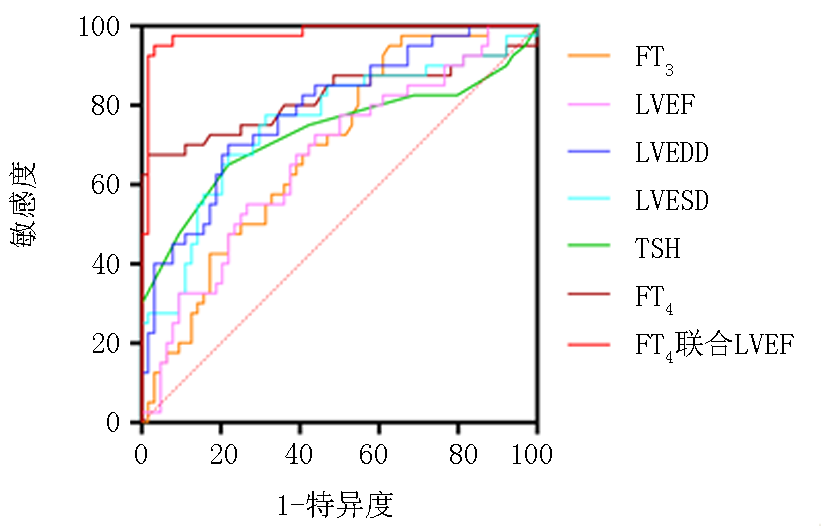
图2 甲状腺功能指标和心功能指标预测甲亢患者HHD的ROC曲线
Fig.2 ROC curve of thyroid function index and cardiac function index in predicting HHD in patients with hyperthyroidism
| 预测项目 | AUC | 截断值 | 95%可信区间 | 特异度(%) | 灵敏度(%) | P值 | |
|---|---|---|---|---|---|---|---|
| 下限 | 上限 | ||||||
| FT4联合LVEF | 0.98 | -3.14 | 0.871 | 0.999 | 64.06 | 51.82 | <0.001 |
| FT4 | 0.82 | 4.98 | 0.723 | 0.920 | 96.88 | 67.50 | <0.001 |
| LVEDD | 0.79 | 44.23 | 0.698 | 0.877 | 79.10 | 89.06 | <0.001 |
| LVESD | 0.75 | 57.85 | 0.653 | 0.855 | 95.31 | 27.50 | <0.001 |
| TSH | 0.73 | 0.05 | 0.618 | 0.842 | 90.63 | 47.50 | <0.001 |
| FT3 | 0.69 | 16.20 | 0.590 | 0.791 | 96.88 | 12.50 | 0.001 |
| LVEF | 0.67 | 62.39 | 0.559 | 0.773 | 12.50 | 97.50 | <0.001 |
表7 甲状腺功能指标和心功能指标对HHD的诊断及预测价值分析
Tab.7 The diagnostic and predictive value of thyroid function index and cardiac function index for HHD
| 预测项目 | AUC | 截断值 | 95%可信区间 | 特异度(%) | 灵敏度(%) | P值 | |
|---|---|---|---|---|---|---|---|
| 下限 | 上限 | ||||||
| FT4联合LVEF | 0.98 | -3.14 | 0.871 | 0.999 | 64.06 | 51.82 | <0.001 |
| FT4 | 0.82 | 4.98 | 0.723 | 0.920 | 96.88 | 67.50 | <0.001 |
| LVEDD | 0.79 | 44.23 | 0.698 | 0.877 | 79.10 | 89.06 | <0.001 |
| LVESD | 0.75 | 57.85 | 0.653 | 0.855 | 95.31 | 27.50 | <0.001 |
| TSH | 0.73 | 0.05 | 0.618 | 0.842 | 90.63 | 47.50 | <0.001 |
| FT3 | 0.69 | 16.20 | 0.590 | 0.791 | 96.88 | 12.50 | 0.001 |
| LVEF | 0.67 | 62.39 | 0.559 | 0.773 | 12.50 | 97.50 | <0.001 |
| [1] | 许波进, 彭文芳, 黄珊. 2022版《中国甲状腺功能亢进症和其他原因所致甲状腺毒症诊治指南》解读[J]. 外科理论与实践, 2023, 28(6): 512-519. doi:10.16139/j.1007-9610.2023.06.05. |
| [2] | 蔡丹阳, 李洁, 李运伦. 以线粒体自噬为靶点的益气活血类中药保护心肌缺血再灌注损伤研究进展[J]. 环球中医药, 2023, 16(9): 1913-1919. doi:CNKI:SUN:HQZY.0.2023-09-041. |
| [3] |
Rhodes MA, Adams CS, Bragg S, et al. Thyroid and parathyroid conditions: Hyperthyroidism[J]. FP Essent, 2022, 514: 11-17.
pmid: 35235281 |
| [4] | 徐鑫, 赵锴, 杨孜. 131I联合生脉注射液治疗甲亢性心脏病的临床研究[J]. 中西医结合心脑血管病杂志, 2018, 16(18): 2612-2615. |
| [5] |
Polikar R, Burger AG, Scherrer U, et al. The thyroid and the heart[J]. Circulation, 1993, 87(5): 1435-1441. doi: 10.1161/01.cir.87.5.1435.
pmid: 8490997 |
| [6] | Liu J, Wu G, Li S, et al. The genetic association between hyperthyroidism and heart failure: A Mendelian randomization study[J]. Front Endocrinol (Lausanne), 2024, 15: 1344282. doi: 10.3389/fendo.2024.1344282. |
| [7] | 王双. 甲亢性心脏病相关临床检验指标探析[J]. 中西医结合心血管病电子杂志, 2022, 10(22): 139-141+130. doi:10.16282/j.cnki.cn11-9336/r.2022.22.014. |
| [8] | 吴清原, 郭思佳, 孙增涛, 等. 基于线粒体功能探讨培宗气理论治疗慢性阻塞性肺疾病的机制研究[J]. 天津中医药, 2024, 41(1): 117-122. doi:CNKI:SUN:TJZY.0.2024-01-020. |
| [9] | 任艳茹, 马俊, 刘萍, 等. 甲状腺功能亢进性心脏病相关危险因素分析[J]. 宁夏医学杂志, 2020, 42(5): 406-408. doi:10.13621/j.1001-5949.2020.05.0406. |
| [10] | Haidous M, Al Armashi AR, Balozian P, et al. A case of severe dilated cardiomyopathy and hyperthyroidism[J]. Cureus, 2022, 14(3): e22968. doi:10.7759/cureus.22968. |
| [11] | 中华医学会内分泌学分会《中国甲状腺疾病诊治指南》编写组. 中国甲状腺疾病诊治指南——甲状腺功能亢进症[J]. 中华内科杂志, 2007, 46(10): 876-882. doi:CNKI:SUN:ZHNK.0.2007-10-044. |
| [12] |
Li H, Zeng RL, Liao YF, et al. Association of plasma connective tissue growth factor levels with hyperthyroid heart disease[J]. Curr Med Sci, 2021, 41(2): 348-355. doi: 10.1007/s11596-021-2354-x. Epub 2021 Apr 20.
pmid: 33877553 |
| [13] | 张成伟, 马慧慧, 魏琴, 等. 老年甲亢性心脏病患者血清TPO-Ab、BNP、Tg-Ab水平与心肌损伤标志物的关系[J]. 中国老年学杂志, 2024, 44(20): 4865-4869. doi:CNKI:SUN:ZLXZ.0.2024-20-001. |
| [14] |
Zubair Khan M, Gupta A, Hodge J, et al. Clinical outcomes of atrial fibrillation with hyperthyroidism[J]. J Arrhythm, 2021, 37(4): 942-948. doi: 10.1002/joa3.12550.
pmid: 34386120 |
| [15] | Huang PS, Cheng JF, Chen JJ, et al. Higher risk of incident hyperthyroidism in patients with atrial fibrillation[J]. J Clin Endocrinol Metab, 2023, 109(1): 92-99. doi: 10.1210/clinem/dgad448. |
| [16] | Petrie MA, Taylor EB, Suneja M, et al. Genomic and epigenomic evaluation of electrically induced exercise in people with spinal cord injury: Application to precision rehabilitation[J]. Phys Ther, 2022, 102(1):pzab243. doi: 10.1093/ptj/pzab243. |
| [17] | Okafor EN, Ugonabo MC, Chukwukelu EE, et al. Prevalence and pattern of thyroid disorders among patients attending University of Nigeria Teaching Hospital, Enugu, Southeastern Nigeria[J]. Niger Med J, 2019, 60(2): 62-67. doi: 10.4103/nmj.NMJ_34_19. |
| [18] |
Fages-Masmiquel E, Ponjoan A, Blanch J, et al. The effect of age and sex on factors associated with dementia[J]. Rev Neurol, 2021, 73(12): 409-415. Spanish. doi: 10.33588/rn.7312.2021301.
pmid: 34877643 |
| [19] | Naz F, Malik S, Asif K, et al. Unravelling atrial fibrillation aetiology and anticoagulation trends in stroke: Where do we stand? A study from Northern Pakistan[J]. J Ayub Med Coll Abbottabad, 2024, 36(3): 470-4747. doi: 10.55519/JAMC-03-13418. |
| [20] |
Kim HJ, Kang T, Kang MJ, et al. Incidence and mortality of myocardial infarction and stroke in patients with hyperthyroidism: A nationwide cohort study in Korea[J]. Thyroid, 2020, 30(7): 955-965. doi: 10.1089/thy.2019.0543. Epub 2020 Mar 26.
pmid: 32093587 |
| [21] | Zhang X, Chen L, Sheng J, et al. The association of autoantibodies in hyperthyroid heart disease combined with pulmonary hypertension[J]. Int J Endocrinol, 2019:9325289. doi: 10.1155/2019/9325289. |
| [22] |
Sönmez E, Bulur O, Ertugrul DT, et al. Hyperthyroidism influences renal function[J]. Endocrine, 2019, 65(1): 144-148. doi: 10.1007/s12020-019-01903-2. Epub 2019 Mar 23.
pmid: 30904999 |
| [23] | Janus I, Noszczyk-Nowak A, Bubak J, et al. Comparative cardiac macroscopic and microscopic study in cats with hyperthyroidism vs. cats with hypertrophic cardiomyopathy[J]. Vet Q, 2023, 43(1): 1-11. doi: 10.1080/01652176.2023.2234436. |
| [24] | Nie D, Xia C, Wang Z, et al. CaMKII inhibition protects against hyperthyroid arrhythmias and adverse myocardial remodeling[J]. Biochem Biophys Res Commun, 2022, 615: 136-142. doi: 10.1016/j.bbrc.2022.04.082. Epub 2022 Apr 20. |
| [25] | Lin C, Kuo FC, Chau T, et al. Artificial intelligence-enabled electrocardiography contributes to hyperthyroidism detection and outcome prediction[J]. Commun Med (Lond), 2024, 4(1): 42. doi:10.1038/s43856-024-00472-4. |
| [26] | Bektur Aykanat NE, Şahin E, Kaçar S, et al. Investigation of the effect of hyperthyroidism on endoplasmic reticulum stress and tran- sient receptor potential canonical 1 channel in the kidney[J]. Turk J Med Sci, 2021, 51(3): 1554-1563. doi: 10.3906/sag-2007-109. |
| [27] | Fan SWD, Ong LT. Prevalence and risk factors of heart failure in patients diagnosed with hyperthyroidism: A systematic review and meta-analysis[J]. touchREV Endocrinol, 2024, 20(2): 91-99. doi: 10.17925/EE.2024.20.2.12. Epub 2024 Jul 22. |
| [28] | Naser JA, Pislaru S, Stan MN, et al. Incidence, risk factors, natural history and outcomes of heart failure in patients with Graves' disease[J]. Heart, 2022, 108(11): 868-874. doi: 10.1136/heartjnl-2021-319752. |
| [29] |
Mastroianno S, Di Stolfo G, Maggio A, et al. Role of Subclinical iatrogenic hyperthyroidism in the setting of heart disease and arrhythmic burden[J]. Endocr Metab Immune Disord Drug Targets, 2020, 20(6):959-962. doi: 10.2174/1871530320666191227103627.
pmid: 31880254 |
| [30] | 刘盼茹, 郭玺, 唐乙朝, 等. 自身免疫性疾病与肠道菌群互作及中药干预研究进展[J]. 南京中医药大学学报, 2023, 39(7): 693-700. doi:10.14148/j.issn.1672-0482.2023.0693. |
| [31] | 李丹, 黄峰. 血清FT3、FT4水平对甲亢患者并发甲亢性心脏病的评估价值[J]. 医学临床研究, 2024, 41(3): 368-370+374. doi:CNKI:SUN:HNYZ.0.2024-03-013. |
| [32] | 王竹英. 分析甲亢性心脏病患者血浆B型脑钠肽水平的变化及意义[J]. 心血管病防治知识, 2020, 10(24): 42-44. doi:CNKI:SUN:XUGB.0.2020-24-014. |
| [33] | 朱莉, 祝国华, 张斌, 等. 血清T3、T4、H-TSH、FT3、FT4在甲亢和甲减诊断中的评价探讨[J]. 解放军预防医学杂志, 2019, 37(5): 49-50. doi:10.13704/j.cnki.jyyx.2019.05.024. |
| [34] | 田永波, 孙敏, 金安林, 等. 血清TPO-Ab、NT-proBNP及CRP在甲亢性心脏病早期诊断中的临床价值[J]. 临床医学研究与实践, 2021, 6(26): 109-112. doi:10.19347/j.cnki.2096-1413.202126037. |
| [35] | 黄玉婵, 阎施杜, 张帆, 等. 活血利水方药理论与应用探讨[J]. 中草药, 2024, 55(14): 4978-4990. doi:CNKI:SUN:ZCYO.0.2024-14-030. |
| [36] | 孙可心, 项莹. 甲状腺功能亢进及其药物在心血管疾病中的作用[J]. 心血管康复医学杂志, 2023, 32(1): 73-77. doi:CNKI:SUN:XXGK.0.2023-01-019. |
| [37] | Merkx R, Leerink JM, Feijen ELAM, et al. Extensive cardiac function analyses using contemporary echocardiography in childhood cancer survivors: A DCCSS LATER study[J]. JACC CardioOncol, 2023, 5(4): 472-485. doi: 10.1016/j.jaccao.2023.06.003. |
| [38] | Zhang Y, Jiang H, Cui J, et al. Ablation of ventricular preexcitation to cure preexcitation-induced dilated cardiomyopathy in infants: Diagnosis and outcome[J]. Circ Arrhythm Electrophysiol, 2023, 16(4):e011569. doi:10.1161/CIRCEP.122.011569. Epub 2023 Mar 9. |
| [1] | 王鑫汇1, 张家梦1, 刘跟莉1, 2. 双胎妊娠早产危险因素的meta分析[J]. 临床荟萃, 2026, 41(2): 101-107. |
| [2] | 韦婷婷, 潘正燕, 冯鲜燕, 龙亚秀. 基于SEER数据库的结直肠癌肝转移危险因素分析:倾向评分匹配研究[J]. 临床荟萃, 2025, 40(9): 816-820. |
| [3] | 尤佳伟, 安艳新, 吕佳宁, 高晓红, 胡丽艳, 单婕, 陈琳. 中国45岁及以上人群社交活动与心脏疾病的相关性[J]. 临床荟萃, 2025, 40(8): 689-693. |
| [4] | 马良, Severine Martin, 孙广东. 基于加蓬数据的疟疾相关急性肾损伤患者临床特征分析[J]. 临床荟萃, 2025, 40(8): 717-720. |
| [5] | 肇雪婷, 白佳雯, 孙军. 代谢相关脂肪性肝病肝纤维化危险因素分析及构建预测模型[J]. 临床荟萃, 2025, 40(5): 417-422. |
| [6] | 肖珂, 王奇. 2型糖尿病伴隐球菌性脑膜炎患者的临床特征及危险因素分析[J]. 临床荟萃, 2025, 40(5): 423-427. |
| [7] | 田晓婷, 卢泽芬. 肺癌患者静脉血栓栓塞危险因素的研究进展[J]. 临床荟萃, 2025, 40(5): 473-476. |
| [8] | 许慧峰, 晋艳勇, 苟若澜, 胡明哲. 脑出血患儿并发脑积水的危险因素及预测模型[J]. 临床荟萃, 2025, 40(4): 325-328. |
| [9] | 刘胜华. 稳定型心绞痛患者血尿酸水平与冠状动脉钙化程度的相关性[J]. 临床荟萃, 2025, 40(3): 211-216. |
| [10] | 童明霞, 陈柯, 向小聪, 周丽峰. 中青年体检人群瘦型代谢相关脂肪性肝病及其危险因素分析[J]. 临床荟萃, 2025, 40(2): 128-132. |
| [11] | 钱晨莹, 闫文君, 黄燕, 赵志. 肝硬化失代偿期患者合并多重耐药菌感染的危险因素分析[J]. 临床荟萃, 2025, 40(2): 143-146. |
| [12] | 温甜甜, 魏星, 马苗苗, 马丽群. 阻塞性睡眠呼吸暂停诱导残余胆固醇升高与冠心病机制及研究进展[J]. 临床荟萃, 2025, 40(11): 1035-1042. |
| [13] | 陈家男, 罗群, 蔡珂丹. 心血管-肾脏-代谢综合征的诊治新进展[J]. 临床荟萃, 2025, 40(10): 948-953. |
| [14] | 蒲茜, 成刚, 道杰草, 齐梓兆, 窦乐乐, 赵军芳, 张文君, 郭彩霞, 王莹莹. 甘肃地区单中心慢性肾脏病患者便秘患病率及危险因素分析[J]. 临床荟萃, 2025, 40(1): 44-53. |
| [15] | 赵一品, 崔清洋. 超早产儿/超低出生体重儿支气管肺发育不良危险因素分析[J]. 临床荟萃, 2025, 40(1): 60-64. |
| 阅读次数 | ||||||
|
全文 |
|
|||||
|
摘要 |
|
|||||
