
临床荟萃 ›› 2025, Vol. 40 ›› Issue (12): 1142-1146.doi: 10.3969/j.issn.1004-583X.2025.12.016
朱昌玲1, 马帅1, 马娜2, 许力2( )
)
收稿日期:2025-09-23
出版日期:2025-12-20
发布日期:2025-12-30
通讯作者:
许力,Email:xuli943119@163.com
基金资助:
Received:2025-09-23
Online:2025-12-20
Published:2025-12-30
摘要:
青蒿素及其衍生物(青蒿琥酯、双氢青蒿素和蒿甲醚等)在临床广泛应用。其抗白血病机制已被证实涵盖多方面:通过调控线粒体通路、Bcl-2家族蛋白及caspase家族等诱导细胞凋亡,作用于细胞周期相关分子实现周期阻滞;激活腺苷酸活化蛋白激酶/哺乳动物雷帕霉素靶蛋白等信号通路诱导自噬,进而通过自噬—铁蛋白降解通路引发铁死亡;同时可通过产生活性氧造成氧化应激损伤、抑制血管生成及干扰丝裂原细胞外信号调节激酶/细胞外调节蛋白激酶、磷脂酰肌醇激酶/蛋白激酶B等信号转导发挥作用。然而,其诱导白血病细胞死亡的特异性分子靶点及选择性损伤机制仍未完全明确。本文系统综述青蒿素及其衍生物的功能特点、核心抗白血病作用及多途径分子机制,旨在为该类天然产物的临床转化应用及新型抗白血病药物研发提供理论依据。
中图分类号:
朱昌玲, 马帅, 马娜, 许力. 青蒿素及其衍生物抗白血病机制的研究进展[J]. 临床荟萃, 2025, 40(12): 1142-1146.
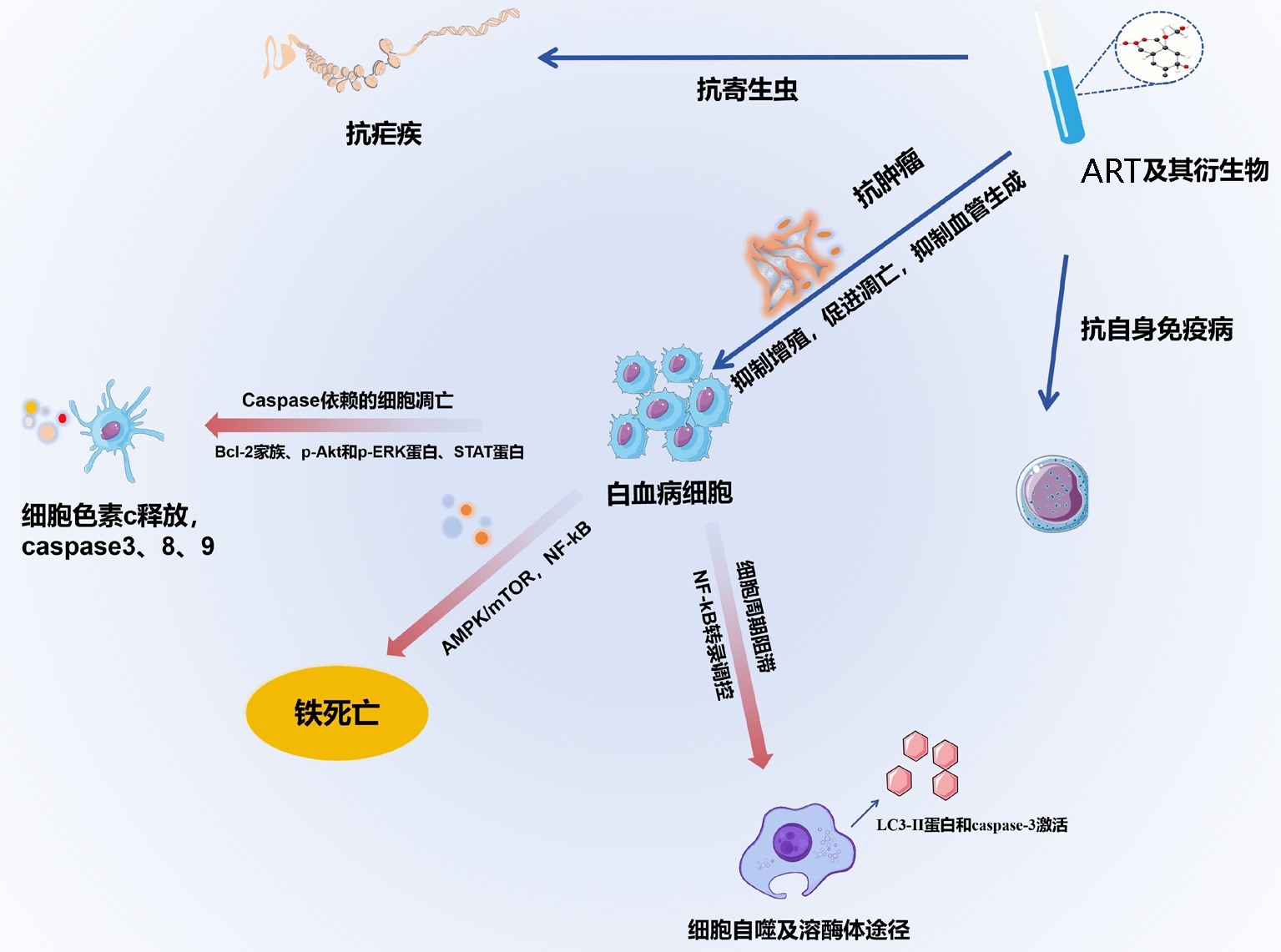
图1 ART及其衍生物抗白血病的机制
| [1] |
Huang P, Zhang J. Global leukemia burden and trends: A comprehensive analysis of temporal and spatial variations from 1990-2021 using GBD (Global Burden of Disease) data[J]. BMC Public Health, 2025, 25(1): 262. doi: 10.1186/s12889-025-21428-w.
pmid: 39838416 |
| [2] | Sun J, Zhang YC, Wei J, et al. Outcomes of allogeneic hematopoietic stem cell transplantation versus intensive chemotherapy in patients with myeloid sarcoma: A nationwide representative multicenter study[J]. Bone Marrow Transplant, 2025, 60(3): 319-325. doi: 10.1038/s41409-024-02485-y. |
| [3] | Guo X, Luo W, Wu L, et al. Natural products from herbal medicine self-assemble into advanced bioactive materials[J]. Adv Sci (Weinh), 2024, 11(35): e2403388. doi: 10.1002/advs.202403388. |
| [4] | Elbadawi M, Boulos JC, Dawood M, et al. The novel artemisinin dimer isoniazide ELI-XXIII-98-2 induces c-MYC inhibition, DNA damage, and autophagy in leukemia cells[J]. Pharmaceutics, 2023, 15(4):1107. doi: 10.3390/pharmaceutics15041107. |
| [5] |
Chen S, Gan S, Han L, et al. Retraction to artesunate induces apoptosis and inhibits the proliferation, stemness, and tumorigenesis of leukemia[J]. Ann Transl Med, 2022, 10(19): 1079. doi: 10.21037/atm-2022-29.
pmid: 36330398 |
| [6] |
Shang X, Dai L, Cao X, et al. Natural products in antiparasitic drug discovery: Advances, opportunities and challenges[J]. Nat Prod Rep, 2025, 42(9): 1419-1458. doi: 10.1039/d5np00007f.
pmid: 40501439 |
| [7] | Brown GD. The biosynthesis of artemisinin (Qinghaosu) and the phytochemistry of Artemisia annua L.(Qinghao)[J]. Molecules, 2010, 15(11): 7603-7698. doi: 10.3390/molecules15117603. |
| [8] | Wen L, Chan BC, Qiu MH, et al. Artemisinin and its derivatives as potential anticancer agents[J]. Molecules, 2024, 29(16):3886. doi: 10.3390/molecules29163886. |
| [9] | Cheong DHJ, Tan DWS, Wong FWS, et al. Anti-malarial drug, artemisinin and its derivatives for the treatment of respiratory diseases[J]. Pharmacol Res, 2020, 158:104901. doi: 10.1016/j.phrs.2020.104901. |
| [10] |
Herrmann L, Yaremenko IA, Çapcı A, et al. Synthesis and in vitro study of artemisinin/synthetic peroxide-based hybrid compounds against SARS-CoV-2 and cancer[J]. ChemMedChem, 2022, 17(9): e202200005. doi: 10.1002/cmdc.202200005.
pmid: 35187791 |
| [11] |
Huang Y, Yang Y, Liu G, et al. New clinical application prospects of artemisinin and its derivatives: A scoping review[J]. Infect Dis Poverty, 2023, 12(1): 115. doi: 10.1186/s40249-023-01152-6.
pmid: 38072951 |
| [12] | Agrawal PK, Agrawal C, Blunden G. Artemisia rxtracts and artemisinin-based antimalarials for COVID-19 management: Could these beeffective antivirals for COVID-19 treatment?[J]. Molecules, 2022, 27:3828.doi: 10.3390/molecules28217337. |
| [13] |
Lu X, Efferth T. Repurposing of artemisinin-type drugs for the treatment of acute leukemia[J]. Semin Cancer Biol, 2021, 68:291-312. doi: 10.1016/j.semcancer.2020.05.016.
pmid: 32485311 |
| [14] | Mancuso RI, Foglio MA, Olalla Saad ST. Artemisinin-type drugs for the treatment of hematological malignancies[J]. Cancer Chemother Pharmacol, 2021, 87(1): 1-22. doi: 10.1007/s00280-020-04170-5. |
| [15] | Ma Z, Woon CY, Liu CG, et al. Repurposing artemisinin and its derivatives as anticancer drugs: A chance or challenge?[J]. Front Pharmacol, 2021, 12:828856. doi: 10.3389/fphar.2021.828856. |
| [16] | Bhowmick S, Lee YJ. ER stress induced by artemisinin and its derivatives determines the susceptibility to their synergistic apoptotic killing with TRAIL[J]. Cancer Med, 2025, 14(12): e71001. doi: 10.1002/cam4.71001. |
| [17] | Xu Q, Deng H, Huang X, et al. Design, synthesis, and in vitro and in vivo biological evaluation of dihydroartemisinin derivatives as potent anti-cancer agents with ferroptosis-inducing and apoptosis-activating properties[J]. Eur J Med Chem, 2025, 281:117018. doi: 10.1016/j.ejmech.2024.117018. |
| [18] | Tan M, Rong Y, Su Q, et al. Artesunate induces apoptosis via inhibition of STAT3 in THP-1 cells[J]. Leuk Res, 2017, 62:98-103. doi: 10.1016/j.leukres.2017.09.022. |
| [19] | Witalisz-Siepracka A, Denk CM, Zdársky B, et al. STAT3 in acute myeloid leukemia facilitates natural killer cell-mediated surveillance[J]. Front Immunol, 2024, 15:1374068. doi: 10.3389/fimmu.2024.1374068. |
| [20] |
Pirali M, Taheri M, Zarei S, et al. Artesunate, as a HSP70 ATPase activity inhibitor, induces apoptosis in breast cancer cells[J]. Int J Biol Macromol, 2020, 164:3369-3375. doi: 10.1016/j.ijbiomac.2020.08.198.
pmid: 32861782 |
| [21] | Liu Y, Li H, Luo Z, et al. Artesunate, a new antimalarial clinical drug, exhibits potent anti-AML activity by targeting the ROS/Bim and TFRC/Fe(2+) pathways[J]. Br J Pharmacol, 2023, 180(6): 701-720. doi: 10.1111/bph.15986. |
| [22] | Posadino AM, Giordo R, Pintus G, et al. Medicinal and mechanistic overview of artemisinin in the treatment of human diseases[J]. Biomed Pharmacother, 2023, 163:114866. doi: 10.1016/j.biopha.2023.114866. |
| [23] |
Yang X, Zheng Y, Liu L, et al. Progress on the study of the anticancer effects of artesunate[J]. Oncol Lett, 2021, 22 (5): 750. doi: 10.3892/ol.2021.13011.
pmid: 34539854 |
| [24] |
Tang N, Liu X, Liu Y, et al. Dihydroartemisinin induces ferroptosis in T cell acute lymphoblastic leukemia cells by downregulating SLC7A11 and activating the ATF4-CHOP signaling pathway[J]. Oncol Lett, 2024, 28 (1): 337. doi: 10.3892/ol.2024.14470.
pmid: 38846431 |
| [25] | Ishikawa C, Senba M, Mori N. Evaluation of artesunate for the treatment of adult T-cell leukemia/lymphoma[J]. Eur J Pharmacol, 2020, 872: 172953. doi: 10.1016/j.ejphar.2020.172953. |
| [26] |
Yu Y, Yan Y, Niu F, et al. Ferroptosis: A cell death connecting oxidative stress, inflammation and cardiovascular diseases[J]. Cell Death Discov, 2021, 7(1): 193. doi: 10.1038/s41420-021-00579-w.
pmid: 34312370 |
| [27] | Chen YS, Chuang WC, Kung HN, et al. Pan-caspase inhibitor zVAD induces necroptotic and autophagic cell death in TLR3/4-stimulated macrophages[J]. Mol Cells, 2022, 45 (4): 257-272. doi: 10.14348/molcells.2021.0193. |
| [28] | 陈璨, 黄永芬, 苗雨青. 老年急性髓样白血病的治疗进展[J]. 临床荟萃, 2023, 38 (10): 954-960. doi: 10.3969/j.issn.1004-583X.2023.10.018. |
| [29] |
Grignano E, Cantero-Aguilar L, Tuerdi Z, et al. Dihydroartemisinin-induced ferroptosis in acute myeloid leukemia: Links to iron metabolism and metallothionein[J]. Cell Death Discov, 2023, 9 (1): 97. doi: 10.1038/s41420-023-01371-8.
pmid: 36928207 |
| [30] | Pan W, Shen Y, Luo B, et al. Dihydroartemisinin induces autophagic cell death in acute myeloid leukemia cells through oxidative stress[J]. Zhongguo Shi Yan Xue Ye Xue Za Zhi, 2022, 30 (4): 1011-1017. doi: 10.19746/j.cnki.issn.1009-2137.2022.04.006. |
| [31] |
Kudo Y, Hirota K, Tsuzuki H, et al. Inhibition of autophagy by Atg7 knockdown enhances chemosensitivity in gemcitabine/paclitaxel-resistant pancreatic cancer MIAPaCa2 cells[J]. J Biochem, 2025, 178 (1): 11-24. doi: 10.1093/jb/mvaf022.
pmid: 40329484 |
| [32] | Zhang X, Ai Z, Zhang Z, et al. Dihydroartemisinin triggers ferroptosis in multidrug-resistant leukemia cells[J]. DNA Cell Biol, 2022, 41 (8): 705-715. doi: 10.1089/dna.2021.1145. |
| [33] | Zhou X, Suo F, Haslinger K, et al. Artemisinin-type drugs in tumor cell death: Mechanisms, combination treatment with biologics and nanoparticle delivery[J]. Pharmaceutics, 2022, 14 (2):395. doi: 10.3390/pharmaceutics14020395. |
| [34] | Xu C, Zhang H, Mu L, et al. Artemisinins as anticancer drugs:novel therapeutic approaches, molecular mechanisms, andclinical trials[J]. Front Pharmacol, 2020, 11: 529881. doi: 10.3389/fphar.2020.529881. |
| [35] |
Jhade SK, Kalidoss K, Pathak PK, et al. Artemisinin's molecular symphony: Illuminating pathways for cancer therapy[J]. Mol Biol Rep, 2024, 52 (1): 95. doi: 10.1007/s11033-024-10202-7.
pmid: 39739138 |
| [36] |
Huang X, Yan H, Xu Z, et al. The inducible role of autophagy in cell death: Emerging evidence and future perspectives[J]. Cell Commun Signal, 2025, 23 (1): 151. doi: 10.1186/s12964-025-02135-w.
pmid: 40140912 |
| [37] | Lin L, Tang Z, Shi Z, et al. New insights into artesunate as a pleiotropic regulator of innate and adaptive immune cells[J]. J Immunol Res, 2022, 2022: 9591544. doi: 10.1155/2022/9591544. |
| [38] | Gao P, Shen S, Li X, et al. Dihydroartemisinin inhibits the proliferation of leukemia cells K562 by suppressing PKM2 and GLUT1 mediated aerobic glycolysis[J]. Drug Des Devel Ther, 2020, 14: 2091-2100. doi: 10.2147/dddt.S248872. |
| [39] |
Hu W, Chen SS, Zhang JL, et al. Dihydroartemisinin induces autophagy by suppressing NF-κB activation[J]. Cancer Lett, 2014, 343 (2): 239-248. doi: 10.1016/j.canlet.2013.09.035.
pmid: 24099910 |
| [40] | Zhou Z, Lei J, Fang J, et al. Dihydroartemisinin remodels tumor micro-environment and improves cancer immunotherapy through inhibiting cyclin-dependent kinases[J]. Int Immunopharmacol, 2024, 139: 112637. doi: 10.1016/j.intimp.2024.112637. |
| [41] | Liu J, Han X, Zhang T, et al. Reactive oxygen species (ROS) scavenging biomaterials for anti-inflammatory diseases: From mechanism to therapy[J]. J Hematol Oncol, 2023, 16 (1): 116. doi: 10.1186/s13045-023-01512-7. |
| [42] | Marchesi E, Perrone D, Navacchia ML. Molecular hybridization as a strategy for developing artemisinin-derived anticancer candidates[J]. Pharmaceutics, 2023, 15 (9):2185. doi: 10.3390/pharmaceutics15092185. |
| [1] | 赵雅静, 陶千山, 沈元元, 董毅. 地西他滨维持治疗对适合强化疗中低危急性髓细胞白血病患者生存的影响[J]. 临床荟萃, 2025, 40(5): 439-444. |
| [2] | 范桥珍, 康蕊, 张婷. 多参数流式细胞术识别与急性髓系白血病微小残留病具有类似表型的再生细胞[J]. 临床荟萃, 2024, 39(8): 716-727. |
| [3] | 张晓阳, 藏美荣, 锁静, 孟建波, 宋晓宁, 王金铠. 强直性脊柱炎合并急性早幼粒细胞白血病及弥散性血管内凝血1例并文献复习[J]. 临床荟萃, 2024, 39(4): 342-346. |
| [4] | 刘丽丽, 袁宇婷, 赖耿良, 田川, 蓝翔, 叶中绿. 儿童急性淋巴细胞白血病第15天微小残留与预后的关系[J]. 临床荟萃, 2024, 39(1): 47-52. |
| [5] | 董整荣, 陶千山, 沈元元, 董毅. 163例急性早幼粒细胞白血病患者随访结果分析[J]. 临床荟萃, 2023, 38(9): 813-818. |
| [6] | 吕丽丽, 翟满满, 丁小艳, 陈永清. 线粒体转录因子A介导的线粒体功能障碍在糖尿病心肌病中的作用[J]. 临床荟萃, 2023, 38(5): 465-468. |
| [7] | 杜佳宜, 刘丽丽, 何永忠, 田川, 蓝翔, 叶中绿. 儿童急性淋巴细胞白血病化疗期间严重不良事件临床观察[J]. 临床荟萃, 2023, 38(2): 149-154. |
| [8] | 陈璨, 黄永芬, 苗雨青. 老年急性髓样白血病的治疗进展[J]. 临床荟萃, 2023, 38(10): 954-960. |
| [9] | 张月月, 谢美芳, 孙艮. 类风湿关节炎合并T-细胞大颗粒淋巴细胞白血病1例及文献复习[J]. 临床荟萃, 2022, 37(8): 728-732. |
| [10] | 尹惠阳, 蔺雪峰, 韩轩茂. 蛋白激酶B通路、乙酰肝素酶、NADPH氧化酶在心肌缺血再灌注损伤中的作用及相互关系的研究进展[J]. 临床荟萃, 2022, 37(5): 459-462. |
| [11] | 尹玲玲, 吴文健, 朱锋. 急性髓系白血病转换为急性淋巴细胞白血病1例并文献复习[J]. 临床荟萃, 2022, 37(11): 1025-1030. |
| [12] | 叶蒙蒙, 李旎, 徐国栋, 邵国丰. miR-361在心血管疾病的研究进展[J]. 临床荟萃, 2021, 36(9): 843-849. |
| [13] | 刘建宁, 孙立, 牛志云, 温树鹏, 王颖, 张学军, 王福旭. PD-1在急性白血病异基因造血干细胞移植后T淋巴细胞的表达[J]. 临床荟萃, 2021, 36(3): 251-255. |
| [14] | 黄嘉惠, 叶中绿. 儿童白血病合并多重耐药菌感染的研究进展[J]. 临床荟萃, 2021, 36(2): 188-192. |
| [15] | 沈子园, 康海全, 桑威, 闫冬梅. 白血病合并感染患者细菌分布、耐药情况及死亡危险因素分析[J]. 临床荟萃, 2021, 36(12): 1092-1096. |
| 阅读次数 | ||||||
|
全文 |
|
|||||
|
摘要 |
|
|||||
