
临床荟萃 ›› 2026, Vol. 41 ›› Issue (10): 901-909.doi: 10.3969/j.issn.1004-583X.2026.10.005
王栋泽a, 王筱涵b, 王文远a, 张少儒a, 王彦永a( )
收稿日期:2026-10-04
出版日期:2026-10-20
发布日期:2026-10-10
通讯作者:
王彦永
E-mail:57600267@hebmu.edu.cn
基金资助:
Wang Dongzea, Wang Xiaohanb, Wang Wenyuana, Zhang Shaorua, Wang Yanyonga()
Received:2026-10-04
Online:2026-10-20
Published:2026-10-10
Contact:
Wang Yanyong
E-mail:57600267@hebmu.edu.cn
摘要:
目的 探讨白蛋白校正阴离子间隙(albumin-corrected anion gap,corrected AG)与美国老年人认知表现的关系。方法 纳入美国国家健康与营养调查(National Health and Nutrition Examination Survey,NHANES)2011-2014年≥60岁人群,采用复杂抽样加权回归、四分位及限制性立方样条分析corrected AG与整体及不同认知域表现的关系。结果 共纳入2 530人。corrected AG每升高1个标准差,整体认知Z评分降低0.055(95%CI:-0.083~-0.028,P<0.001);4项次要认知结局经假发现率校正后仍显著,未见非线性。结论 较高corrected AG与较差整体认知相关,需纵向研究验证。
中图分类号:
王栋泽, 王筱涵, 王文远, 张少儒, 王彦永. 白蛋白校正阴离子间隙与老年认知[J]. 临床荟萃, 2026, 41(10): 901-909.
Wang Dongze, Wang Xiaohan, Wang Wenyuan, Zhang Shaoru, Wang Yanyong. Albumin-corrected anion gap and cognitive function in older adults[J]. Clinical Focus, 2026, 41(10): 901-909.
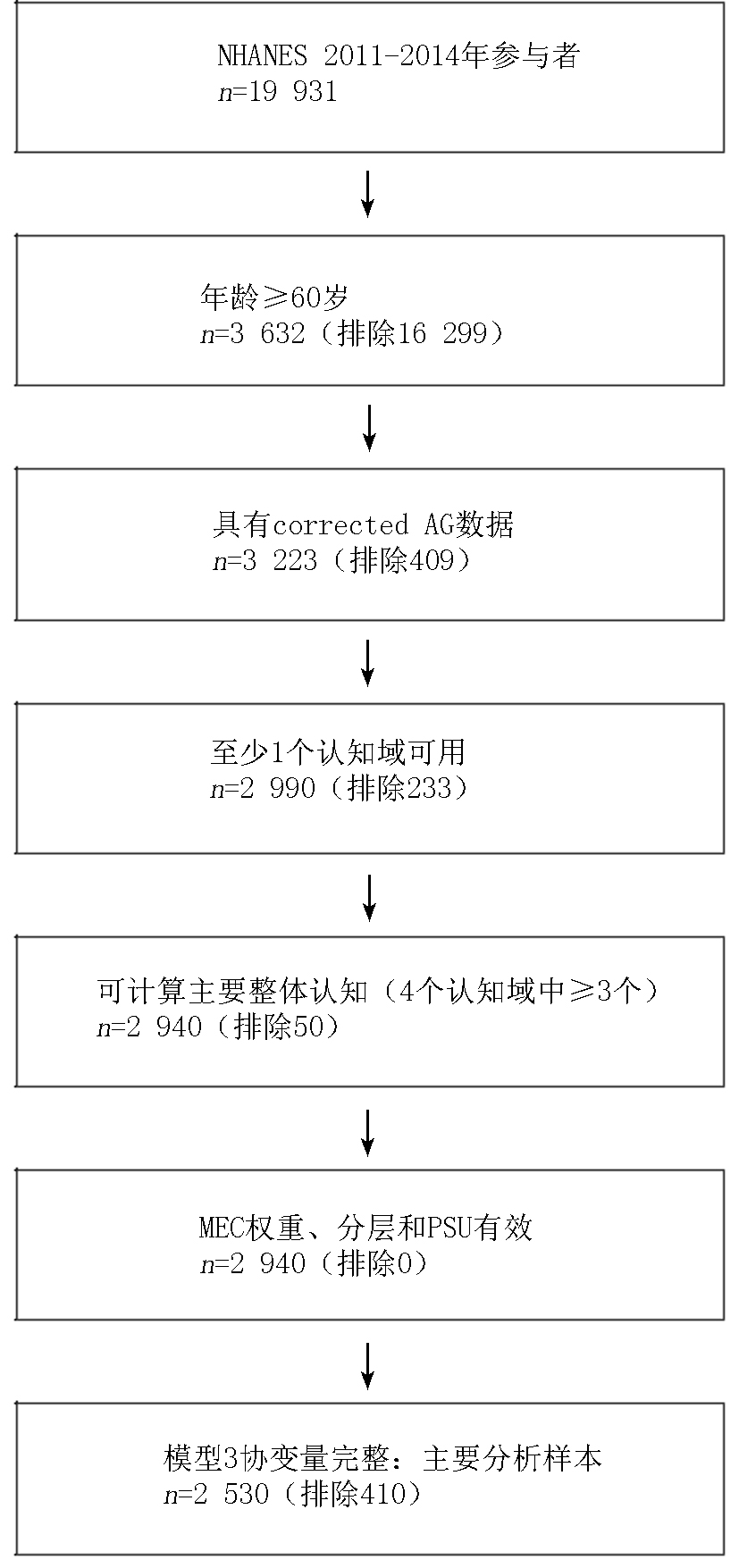
图1 研究对象筛选流程 主要整体认知评分要求4个认知域中至少3个有效
Fig.1 Flowchart of participant selection. A valid overall cognitive score required valid assessments in at least 3 of the 4 cognitive domains
| 变量 | Q1 | Q2 | Q3 | Q4 | F值 | P值 |
|---|---|---|---|---|---|---|
| 非加权样本量 | 669 | 594 | 645 | 622 | ||
| 加权代表人口(百万) | 12.99 | 11.18 | 12.02 | 10.69 | ||
| 年龄(岁) | 68.23±6.37 | 68.92±6.65 | 69.7±6.75 | 69.95±6.85 | 6.334 | 0.002 |
| PIR | 3.55±1.56 | 3.07±1.52 | 3.01±1.55 | 2.82±1.59 | 9.464 | <0.01 |
| BMI(kg/m2) | 27.79±5.55 | 28.83±5.71 | 29.43±6.57 | 30.5±7.03 | 6.880 | 0.001 |
| 体力活动(MET-min/周) | 1 577.74±2 771.25 | 1 541.51±3 000.77 | 1 342.92±2 558.77 | 1 195.82±2 614.45 | 1.982 | 0.139 |
| 平均收缩压(mmHg) | 130.58±17.8 | 130.87±18.62 | 131.52±19.02 | 133.03±19.54 | 1.579 | 0.216 |
| 平均舒张压(mmHg) | 69.96±12.18 | 67.67±13.74 | 68.19±12.44 | 66.89±14.47 | 2.592 | 0.072 |
| eGFR(ml·min-1·1.73 m-2) | 77.17±15.31 | 74.45±15.79 | 72.14±18.68 | 68.77±20.92 | 24.341 | <0.01 |
| log UACR | 2.41±0.88 | 2.47±1.03 | 2.58±0.98 | 2.90±1.30 | 14.551 | <0.01 |
| PHQ-9评分 | 2.42±3.39 | 2.47±3.39 | 3.03±4.16 | 3.56±4.63 | 11.570 | <0.01 |
| 白蛋白校正AG(mmol/L) | 7.66±0.80 | 9.13±0.28 | 10.22±0.35 | 12.29±1.28 | 3631.895 | <0.01 |
| 整体认知Z评分 | 0.46±0.76 | 0.26±0.75 | 0.26±0.76 | 0.07±0.78 | 16.335 | <0.01 |
| CERAD即刻回忆Z评分 | 0.40±0.91 | 0.22±0.93 | 0.21±0.95 | 0.01±0.94 | 12.444 | <0.01 |
| CERAD延迟回忆Z评分 | 0.30±0.92 | 0.19±0.99 | 0.17±0.94 | 0.03±0.99 | 7.975 | <0.01 |
| 动物命名流畅性Z评分 | 0.57±1.08 | 0.28±1.0 | 0.31±0.96 | 0.10±0.96 | 8.044 | <0.01 |
| DSST Z评分 | 0.59±0.94 | 0.39±0.89 | 0.40±0.94 | 0.17±0.97 | 11.553 | <0.01 |
| 性别(%)—男 | 50.5 | 49.2 | 44.8 | 39.3 | 4.332 | 0.008 |
| 性别(%)—女 | 49.5 | 50.8 | 55.2 | 60.7 | ||
| 种族/族裔(%)—墨西哥裔美国人 | 2.6 | 3.2 | 3.0 | 4.9 | 0.659 | 0.682 |
| 种族/族裔(%)—非西班牙裔亚裔 | 3.1 | 3.6 | 3.4 | 2.8 | ||
| 种族/族裔(%)—非西班牙裔黑人 | 7.7 | 7.6 | 7.9 | 9.2 | ||
| 种族/族裔(%)—非西班牙裔白人 | 82.1 | 79.4 | 80.4 | 77.7 | ||
| 种族/族裔(%)—其他西班牙裔 | 3.4 | 4.2 | 3.1 | 3.6 | ||
| 种族/族裔(%)—其他/多种族 | 1.1 | 2.1 | 2.2 | 1.9 | ||
| 教育水平(%)—低于高中 | 12.2 | 16.6 | 15.2 | 21.0 | 3.370 | 0.007 |
| 教育水平(%)—高中/GED | 18.2 | 20.9 | 24.7 | 22.3 | ||
| 教育水平(%)—大学及以上 | 69.6 | 62.5 | 60.1 | 56.7 | ||
| 婚姻状况(%)—已婚/同居 | 70.0 | 65.4 | 63.4 | 58.2 | 2.836 | 0.020 |
| 婚姻状况(%)—既往婚姻 | 25.5 | 28.7 | 33.2 | 37.9 | ||
| 婚姻状况(%)—从未结婚 | 4.5 | 5.9 | 3.4 | 3.9 | ||
| 吸烟状态(%)—从不 | 49.0 | 50.2 | 49.5 | 49.4 | 0.958 | 0.438 |
| 吸烟状态(%)—既往 | 42.6 | 38.1 | 38.0 | 37.5 | ||
| 吸烟状态(%)—当前 | 8.3 | 11.8 | 12.5 | 13.1 | ||
| 任一年度饮酒≥12杯史(%)—否 | 22.4 | 27.9 | 28.0 | 32.9 | 3.007 | 0.039 |
| 任一年度饮酒≥12杯史(%)—是 | 77.6 | 72.1 | 72.0 | 67.1 | ||
| 达到体力活动指南(%)—否 | 49.7 | 54.8 | 56.5 | 64.5 | 4.885 | 0.005 |
| 达到体力活动指南(%)—是 | 50.3 | 45.2 | 43.5 | 35.5 | ||
| 高血压(%)—否 | 42.6 | 37.1 | 26.2 | 23.4 | 12.083 | <0.01 |
| 高血压(%)—是 | 57.4 | 62.9 | 73.8 | 76.6 | ||
| 糖尿病(%)—否 | 88.1 | 85.5 | 79.3 | 70.4 | 16.497 | <0.01 |
| 糖尿病(%)—是 | 11.9 | 14.5 | 20.7 | 29.6 | ||
| 卒中史(%)—否 | 96.8 | 93.0 | 92.7 | 92.1 | 2.900 | 0.051 |
| 卒中史(%)—是 | 3.2 | 7.0 | 7.3 | 7.9 | ||
| 心血管疾病(%)—否 | 85.5 | 84.0 | 79.7 | 79.3 | 2.127 | 0.131 |
| 心血管疾病(%)—是 | 14.5 | 16.0 | 20.3 | 20.7 |
表1 corrected AG四分位组的基线特征
Tab.1 Baseline characteristics according to quartiles of albumin-corrected AG
| 变量 | Q1 | Q2 | Q3 | Q4 | F值 | P值 |
|---|---|---|---|---|---|---|
| 非加权样本量 | 669 | 594 | 645 | 622 | ||
| 加权代表人口(百万) | 12.99 | 11.18 | 12.02 | 10.69 | ||
| 年龄(岁) | 68.23±6.37 | 68.92±6.65 | 69.7±6.75 | 69.95±6.85 | 6.334 | 0.002 |
| PIR | 3.55±1.56 | 3.07±1.52 | 3.01±1.55 | 2.82±1.59 | 9.464 | <0.01 |
| BMI(kg/m2) | 27.79±5.55 | 28.83±5.71 | 29.43±6.57 | 30.5±7.03 | 6.880 | 0.001 |
| 体力活动(MET-min/周) | 1 577.74±2 771.25 | 1 541.51±3 000.77 | 1 342.92±2 558.77 | 1 195.82±2 614.45 | 1.982 | 0.139 |
| 平均收缩压(mmHg) | 130.58±17.8 | 130.87±18.62 | 131.52±19.02 | 133.03±19.54 | 1.579 | 0.216 |
| 平均舒张压(mmHg) | 69.96±12.18 | 67.67±13.74 | 68.19±12.44 | 66.89±14.47 | 2.592 | 0.072 |
| eGFR(ml·min-1·1.73 m-2) | 77.17±15.31 | 74.45±15.79 | 72.14±18.68 | 68.77±20.92 | 24.341 | <0.01 |
| log UACR | 2.41±0.88 | 2.47±1.03 | 2.58±0.98 | 2.90±1.30 | 14.551 | <0.01 |
| PHQ-9评分 | 2.42±3.39 | 2.47±3.39 | 3.03±4.16 | 3.56±4.63 | 11.570 | <0.01 |
| 白蛋白校正AG(mmol/L) | 7.66±0.80 | 9.13±0.28 | 10.22±0.35 | 12.29±1.28 | 3631.895 | <0.01 |
| 整体认知Z评分 | 0.46±0.76 | 0.26±0.75 | 0.26±0.76 | 0.07±0.78 | 16.335 | <0.01 |
| CERAD即刻回忆Z评分 | 0.40±0.91 | 0.22±0.93 | 0.21±0.95 | 0.01±0.94 | 12.444 | <0.01 |
| CERAD延迟回忆Z评分 | 0.30±0.92 | 0.19±0.99 | 0.17±0.94 | 0.03±0.99 | 7.975 | <0.01 |
| 动物命名流畅性Z评分 | 0.57±1.08 | 0.28±1.0 | 0.31±0.96 | 0.10±0.96 | 8.044 | <0.01 |
| DSST Z评分 | 0.59±0.94 | 0.39±0.89 | 0.40±0.94 | 0.17±0.97 | 11.553 | <0.01 |
| 性别(%)—男 | 50.5 | 49.2 | 44.8 | 39.3 | 4.332 | 0.008 |
| 性别(%)—女 | 49.5 | 50.8 | 55.2 | 60.7 | ||
| 种族/族裔(%)—墨西哥裔美国人 | 2.6 | 3.2 | 3.0 | 4.9 | 0.659 | 0.682 |
| 种族/族裔(%)—非西班牙裔亚裔 | 3.1 | 3.6 | 3.4 | 2.8 | ||
| 种族/族裔(%)—非西班牙裔黑人 | 7.7 | 7.6 | 7.9 | 9.2 | ||
| 种族/族裔(%)—非西班牙裔白人 | 82.1 | 79.4 | 80.4 | 77.7 | ||
| 种族/族裔(%)—其他西班牙裔 | 3.4 | 4.2 | 3.1 | 3.6 | ||
| 种族/族裔(%)—其他/多种族 | 1.1 | 2.1 | 2.2 | 1.9 | ||
| 教育水平(%)—低于高中 | 12.2 | 16.6 | 15.2 | 21.0 | 3.370 | 0.007 |
| 教育水平(%)—高中/GED | 18.2 | 20.9 | 24.7 | 22.3 | ||
| 教育水平(%)—大学及以上 | 69.6 | 62.5 | 60.1 | 56.7 | ||
| 婚姻状况(%)—已婚/同居 | 70.0 | 65.4 | 63.4 | 58.2 | 2.836 | 0.020 |
| 婚姻状况(%)—既往婚姻 | 25.5 | 28.7 | 33.2 | 37.9 | ||
| 婚姻状况(%)—从未结婚 | 4.5 | 5.9 | 3.4 | 3.9 | ||
| 吸烟状态(%)—从不 | 49.0 | 50.2 | 49.5 | 49.4 | 0.958 | 0.438 |
| 吸烟状态(%)—既往 | 42.6 | 38.1 | 38.0 | 37.5 | ||
| 吸烟状态(%)—当前 | 8.3 | 11.8 | 12.5 | 13.1 | ||
| 任一年度饮酒≥12杯史(%)—否 | 22.4 | 27.9 | 28.0 | 32.9 | 3.007 | 0.039 |
| 任一年度饮酒≥12杯史(%)—是 | 77.6 | 72.1 | 72.0 | 67.1 | ||
| 达到体力活动指南(%)—否 | 49.7 | 54.8 | 56.5 | 64.5 | 4.885 | 0.005 |
| 达到体力活动指南(%)—是 | 50.3 | 45.2 | 43.5 | 35.5 | ||
| 高血压(%)—否 | 42.6 | 37.1 | 26.2 | 23.4 | 12.083 | <0.01 |
| 高血压(%)—是 | 57.4 | 62.9 | 73.8 | 76.6 | ||
| 糖尿病(%)—否 | 88.1 | 85.5 | 79.3 | 70.4 | 16.497 | <0.01 |
| 糖尿病(%)—是 | 11.9 | 14.5 | 20.7 | 29.6 | ||
| 卒中史(%)—否 | 96.8 | 93.0 | 92.7 | 92.1 | 2.900 | 0.051 |
| 卒中史(%)—是 | 3.2 | 7.0 | 7.3 | 7.9 | ||
| 心血管疾病(%)—否 | 85.5 | 84.0 | 79.7 | 79.3 | 2.127 | 0.131 |
| 心血管疾病(%)—是 | 14.5 | 16.0 | 20.3 | 20.7 |
| 结局 | 例数 | 模型1 | 模型2 | 模型3 | BH- FDR q | ||||||||
|---|---|---|---|---|---|---|---|---|---|---|---|---|---|
| β | 95%CI | P | β | 95%CI | P | β | 95%CI | P | |||||
| 整体认知Z评分 | 2 530 | -0.108 | -0.137, -0.080 | <0.01 | -0.078 | -0.108, -0.048 | <0.01 | -0.055 | -0.083, -0.028 | <0.01 | |||
| CERAD即刻回忆Z评分 | 2 533 | -0.107 | -0.150, -0.065 | <0.01 | -0.083 | -0.130, -0.036 | 0.01 | -0.068 | -0.114, -0.021 | 0.006 | 0.023 | ||
| CERAD延迟回忆Z评分 | 2 530 | -0.073 | -0.116,-0.030 | 0.002 | -0.055 | -0.099, -0.011 | 0.016 | -0.043 | -0.083, -0.004 | 0.032 | 0.032 | ||
| 动物命名流畅性Z评分 | 2 520 | -0.126 | -0.184, -0.067 | <0.01 | -0.092 | -0.143, -0.040 | 0.001 | -0.064 | -0.114, -0.013 | 0.015 | 0.023 | ||
| DSST Z评分 | 2 463 | -0.126 | -0.165, -0.087 | <0.01 | -0.081 | -0.120, -0.042 | <0.01 | -0.045 | -0.081, -0.008 | 0.017 | 0.023 | ||
表2 corrected AG每升高1 SD与认知结局的调查加权线性回归
Tab.2 Survey-weighted linear regression analysis of the associations between each 1-SD (standard deviation) increase in corrected AG and cognitive outcomes
| 结局 | 例数 | 模型1 | 模型2 | 模型3 | BH- FDR q | ||||||||
|---|---|---|---|---|---|---|---|---|---|---|---|---|---|
| β | 95%CI | P | β | 95%CI | P | β | 95%CI | P | |||||
| 整体认知Z评分 | 2 530 | -0.108 | -0.137, -0.080 | <0.01 | -0.078 | -0.108, -0.048 | <0.01 | -0.055 | -0.083, -0.028 | <0.01 | |||
| CERAD即刻回忆Z评分 | 2 533 | -0.107 | -0.150, -0.065 | <0.01 | -0.083 | -0.130, -0.036 | 0.01 | -0.068 | -0.114, -0.021 | 0.006 | 0.023 | ||
| CERAD延迟回忆Z评分 | 2 530 | -0.073 | -0.116,-0.030 | 0.002 | -0.055 | -0.099, -0.011 | 0.016 | -0.043 | -0.083, -0.004 | 0.032 | 0.032 | ||
| 动物命名流畅性Z评分 | 2 520 | -0.126 | -0.184, -0.067 | <0.01 | -0.092 | -0.143, -0.040 | 0.001 | -0.064 | -0.114, -0.013 | 0.015 | 0.023 | ||
| DSST Z评分 | 2 463 | -0.126 | -0.165, -0.087 | <0.01 | -0.081 | -0.120, -0.042 | <0.01 | -0.045 | -0.081, -0.008 | 0.017 | 0.023 | ||
| 结局 | 例数 | 趋势P | Q2 vs Q1 | Q3 vs Q1 | Q4 vs Q1 | |||||||||
|---|---|---|---|---|---|---|---|---|---|---|---|---|---|---|
| β | 95%CI | P | β | 95%CI | P | β | 95%CI | P | ||||||
| 整体认知Z评分 | 2 530 | <0.01 | -0.090 | -0.206, 0.025 | 0.121 | -0.041 | -0.127, 0.045 | 0.337 | -0.169 | -0.253, -0.084 | <0.01 | |||
| CERAD即刻回忆Z评分 | 2 533 | 0.002 | -0.095 | -0.239, 0.049 | 0.187 | -0.069 | -0.188, 0.049 | 0.243 | -0.227 | -0.351, -0.103 | <0.01 | |||
| CERAD延迟回忆Z评分 | 2 530 | 0.025 | -0.048 | -0.217, 0.122 | 0.569 | -0.026 | -0.157, 0.104 | 0.683 | -0.134 | -0.251, -0.016 | 0.027 | |||
| 动物命名流畅性Z评分 | 2 520 | 0.034 | -0.169 | -0.320, -0.019 | 0.029 | -0.081 | -0.224, 0.061 | 0.253 | -0.202 | -0.357, -0.047 | 0.012 | |||
| DSST Z评分 | 2 463 | 0.152 | -0.062 | -0.185, 0.061 | 0.312 | 0.014 | -0.080, 0.109 | 0.761 | -0.104 | -0.210, 0.002 | 0.053 | |||
表3 corrected AG四分位与认知结局的完全调整关联
Tab.3 Fully adjusted associations between corrected AG quartiles and cognitive outcomes
| 结局 | 例数 | 趋势P | Q2 vs Q1 | Q3 vs Q1 | Q4 vs Q1 | |||||||||
|---|---|---|---|---|---|---|---|---|---|---|---|---|---|---|
| β | 95%CI | P | β | 95%CI | P | β | 95%CI | P | ||||||
| 整体认知Z评分 | 2 530 | <0.01 | -0.090 | -0.206, 0.025 | 0.121 | -0.041 | -0.127, 0.045 | 0.337 | -0.169 | -0.253, -0.084 | <0.01 | |||
| CERAD即刻回忆Z评分 | 2 533 | 0.002 | -0.095 | -0.239, 0.049 | 0.187 | -0.069 | -0.188, 0.049 | 0.243 | -0.227 | -0.351, -0.103 | <0.01 | |||
| CERAD延迟回忆Z评分 | 2 530 | 0.025 | -0.048 | -0.217, 0.122 | 0.569 | -0.026 | -0.157, 0.104 | 0.683 | -0.134 | -0.251, -0.016 | 0.027 | |||
| 动物命名流畅性Z评分 | 2 520 | 0.034 | -0.169 | -0.320, -0.019 | 0.029 | -0.081 | -0.224, 0.061 | 0.253 | -0.202 | -0.357, -0.047 | 0.012 | |||
| DSST Z评分 | 2 463 | 0.152 | -0.062 | -0.185, 0.061 | 0.312 | 0.014 | -0.080, 0.109 | 0.761 | -0.104 | -0.210, 0.002 | 0.053 | |||
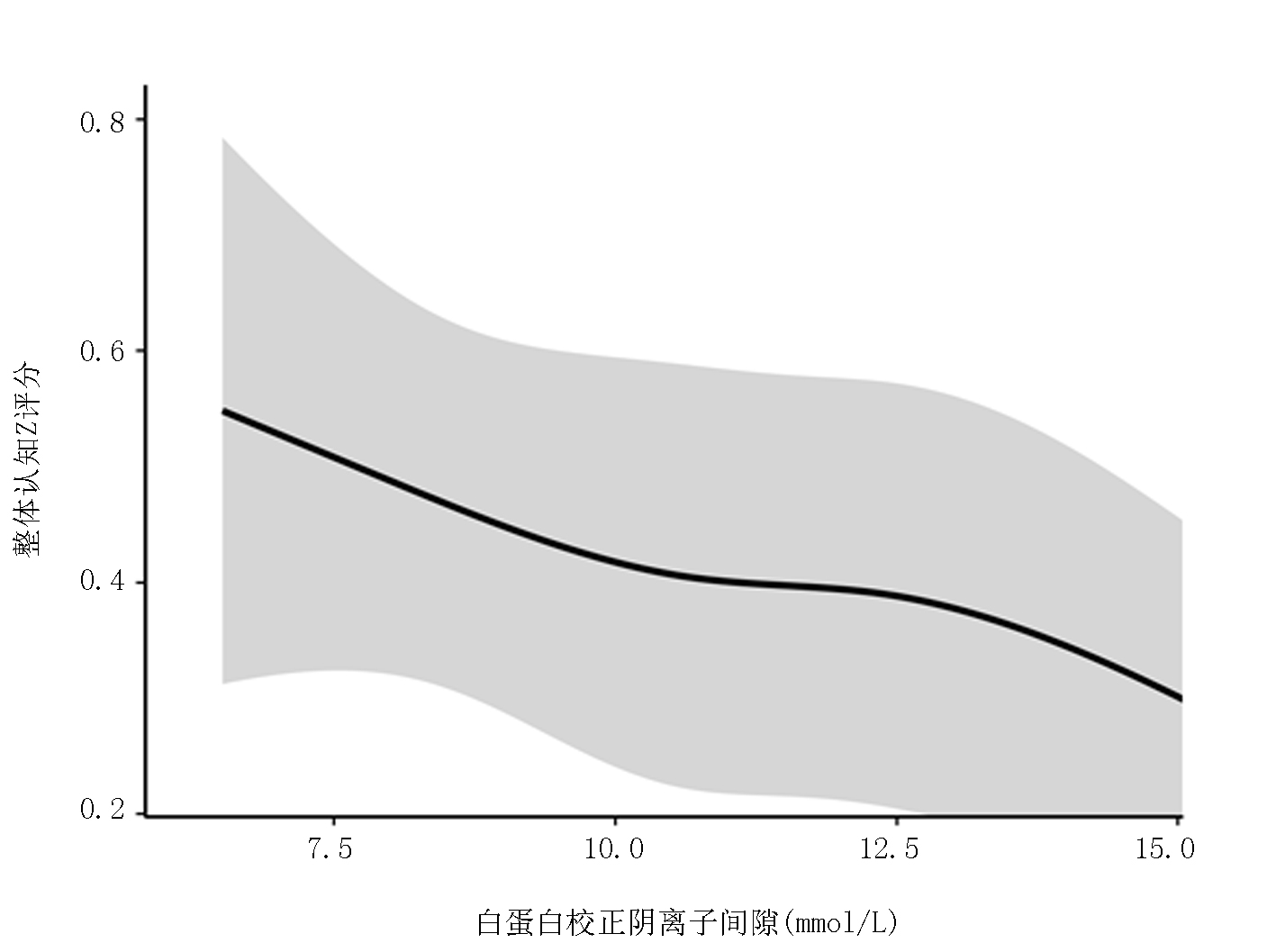
图2 corrected AG与整体认知Z评分的调查加权限制性立方样条。实线为预测值,阴影为95%CI;节点位于加权第5、35、65和95百分位。总体P=0.041,非线性P=0.595。
Fig.2 Survey-weighted restricted cubic spline analysis of the association between corrected AG and the global cognitive Z-score. The solid line represents the predicted value, and the shaded area represents the 95%CI; knots were placed at the weighted 5th, 35th, 65th, and 95th percentiles. Overall P=0.041; nonlinear P=0.595.
| 结局 | 总体P值 | 非线性P值 |
|---|---|---|
| 整体认知Z评分 | 0.041 | 0.595 |
| CERAD即刻回忆Z评分 | 0.092 | 0.832 |
| CERAD延迟回忆Z评分 | 0.234 | 0.698 |
| 动物命名流畅性Z评分 | 0.158 | 0.605 |
| DSST Z评分 | 0.085 | 0.129 |
表4 4节点限制性立方样条总体及非线性检验
Tab.4 Overall and nonlinear tests using restricted cubic splines with four knots
| 结局 | 总体P值 | 非线性P值 |
|---|---|---|
| 整体认知Z评分 | 0.041 | 0.595 |
| CERAD即刻回忆Z评分 | 0.092 | 0.832 |
| CERAD延迟回忆Z评分 | 0.234 | 0.698 |
| 动物命名流畅性Z评分 | 0.158 | 0.605 |
| DSST Z评分 | 0.085 | 0.129 |
| 分析 | 例数 | 效应类型 | 估计值(95%CI) | P值 |
|---|---|---|---|---|
| 核心协变量模型 | 2530 | β | -0.070 (-0.100, -0.040) | <0.01 |
| 排除卒中者 | 2352 | β | -0.050 (-0.080, -0.020) | 0.002 |
| 低整体认知Logistic模型 | 2530 | OR | 1.171 (1.063, 1.291) | 0.002 |
| 未校正AG每1 SD | 2530 | β | -0.040 (-0.067, -0.013) | 0.004 |
| 碳酸氢盐每1 SD | 2530 | β | 0.053 (0.018, 0.088) | 0.004 |
| 血清渗透压每1 SD | 2530 | β | 0.054 (0.016, 0.092) | 0.007 |
| 整体认知要求4域完整 | 2406 | β | -0.057 (-0.087, -0.028) | <0.01 |
| 调查加权成分Z评分 | 2530 | β | -0.056 (-0.085, -0.028) | <0.01 |
| 排除eGFR<30 | 2472 | β | -0.049 (-0.074, -0.024) | <0.01 |
| corrected AG限第1~99百分位 | 2483 | β | -0.058 (-0.085, -0.031) | <0.01 |
| 2021无种族系数CKD-EPI eGFR | 2530 | β | -0.055 (-0.083, -0.027) | <0.01 |
| corrected AG+血清白蛋白调整 | 2530 | β | -0.052 (-0.081, -0.023) | <0.01 |
| 未校正AG+血清白蛋白调整 | 2530 | β | -0.051 (-0.080, -0.023) | <0.01 |
| 血清白蛋白每1 SD | 2530 | β | 0.034 (-0.003, 0.071) | 0.068 |
表5 主要整体认知结局的敏感性分析
Tab.5 Sensitivity analysis of the primary global cognitive outcome
| 分析 | 例数 | 效应类型 | 估计值(95%CI) | P值 |
|---|---|---|---|---|
| 核心协变量模型 | 2530 | β | -0.070 (-0.100, -0.040) | <0.01 |
| 排除卒中者 | 2352 | β | -0.050 (-0.080, -0.020) | 0.002 |
| 低整体认知Logistic模型 | 2530 | OR | 1.171 (1.063, 1.291) | 0.002 |
| 未校正AG每1 SD | 2530 | β | -0.040 (-0.067, -0.013) | 0.004 |
| 碳酸氢盐每1 SD | 2530 | β | 0.053 (0.018, 0.088) | 0.004 |
| 血清渗透压每1 SD | 2530 | β | 0.054 (0.016, 0.092) | 0.007 |
| 整体认知要求4域完整 | 2406 | β | -0.057 (-0.087, -0.028) | <0.01 |
| 调查加权成分Z评分 | 2530 | β | -0.056 (-0.085, -0.028) | <0.01 |
| 排除eGFR<30 | 2472 | β | -0.049 (-0.074, -0.024) | <0.01 |
| corrected AG限第1~99百分位 | 2483 | β | -0.058 (-0.085, -0.031) | <0.01 |
| 2021无种族系数CKD-EPI eGFR | 2530 | β | -0.055 (-0.083, -0.027) | <0.01 |
| corrected AG+血清白蛋白调整 | 2530 | β | -0.052 (-0.081, -0.023) | <0.01 |
| 未校正AG+血清白蛋白调整 | 2530 | β | -0.051 (-0.080, -0.023) | <0.01 |
| 血清白蛋白每1 SD | 2530 | β | 0.034 (-0.003, 0.071) | 0.068 |
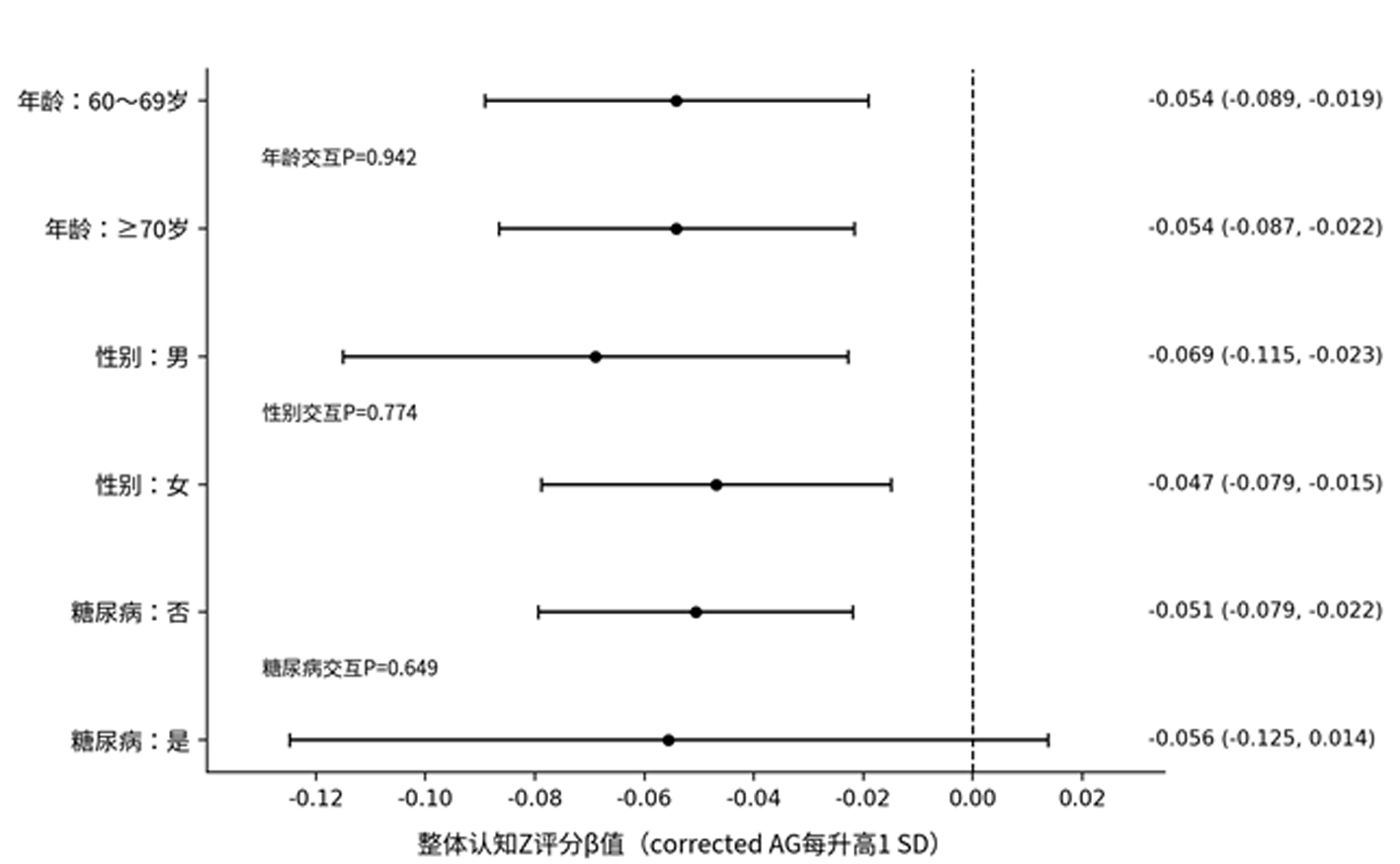
图3 corrected AG与整体认知的亚组分析。效应为corrected AG每升高1 SD的β值及95%CI;年龄、性别和糖尿病交互作用P值分别为0.942、0.774和0.649。
Fig.3 Subgroup analysis of the association between corrected AG and global cognition. The effect estimate represents the β coefficient and 95% CI per 1-SD increase in corrected AG; P values for interactions with age, sex, and diabetes were 0.942, 0.774, and 0.649, respectively.
| [1] |
Li T, Hu Z, Qiao L, et al. Chronic kidney disease and cognitive performance: NHANES 2011-2014[J]. BMC Geriatr, 2024, 24(1):351. doi: 10.1186/s12877-024-04917-2.
pmid: 38637739 |
| [2] | Zhang J, Wu L, Wang P, et al. Prevalence of cognitive impairment and its predictors among chronic kidney disease patients: A systematic review and meta-analysis[J]. PLoS One, 2024, 19(6):e0304762. doi: 10.1371/journal.pone.0304762. |
| [3] | Bolignano D, Simeoni M, Hafez G, et al. Cognitive impairment in CKD patients: A guidance document by the CONNECT network[J]. Clin Kidney J, 2025, 18(2):sfae294. doi: 10.1093/ckj/sfae294. |
| [4] | Merlino L, Rainone F, Chinnadurai R, et al. Health outcomes in chronic kidney disease patients with cognitive impairment or dementia: A global collaborative analysis[J]. Clin Kidney J, 2025, 18(1):sfae401. doi: 10.1093/ckj/sfae401. |
| [5] | Cheung KL, Arce Renteria M, Callas PW, et al. Kidney Function, cognitive impairment, and trajectories: A longitudinal biracial study[J]. J Gen Intern Med, 2025, 40(14):3403-3412. doi: 10.1007/s11606-025-09366-0. |
| [6] |
Otobe Y. Current status of the cognitive impairment in chronic kidney disease[J]. Phys Ther Res, 2024, 27(3):115-120.doi: 10.1298/ptr.R0033.
pmid: 39866390 |
| [7] | Yan Q, Liu M, Xie Y, et al. Kidney-brain axis in the pathogenesis of cognitive impairment[J]. Neurobiol Dis, 2024, 200:106626. doi: 10.1016/j.nbd.2024.106626. |
| [8] | Wagner CA, Massy ZA, Capasso G, et al. Translational research on cognitive impairment in chronic kidney disease[J]. Nephrol Dial Transplant, 2025, 40(4):621-631. doi: 10.1093/ndt/gfae229. |
| [9] | Andrews TD, Day GS, Irani SR, et al. Uremic toxins, CKD, and cognitive dysfunction[J]. J Am Soc Nephrol, 2025, 36(6):1208-1226. doi: 10.1681/ASN.0000000675. |
| [10] |
Bossola M, Picconi B. Uremic toxins and the brain in chronic kidney disease[J]. J Nephrol, 2024, 37(5):1391-1395. doi: 10.1007/s40620-024-01929-4.
pmid: 38625502 |
| [11] | Zimmermann S, Mathew A, Bondareva O, et al. Chronic kidney disease leads to microglial potassium efflux and inflammasome activation in the brain[J]. Kidney Int, 2024, 106(6):1101-1116. doi: 10.1016/j.kint.2024.06.028. |
| [12] |
Bobot M, Guedj E, Resseguier N, et al. Increased blood-brain barrier permeability and cognitive impairment in patients With ESKD[J]. Kidney Int Rep, 2024, 9(10):2988-2995. doi: 10.1016/j.ekir.2024.07.021.
pmid: 39430169 |
| [13] | Rački V, Vujičić B, Komen V, et al. The kidney-brain axis in chronic kidney disease: Uremic toxins, cognitive decline, mechanistic pathways, biomarkers and therapeutic perspectives[J]. Biomedicines, 2026, 14(7):1579. doi: 10.3390/biomedicines14071579. |
| [14] | Alter DN, Zha L. The anion gap as a predictive tool for morbidity and mortality[J]. Crit Rev Clin Lab Sci, 2025, 62(8):568-584. doi: 10.1080/10408363.2025.2526346. |
| [15] | Ni ZB, Zhang HB, Huang LZ, et al. Albumin-corrected anion gap and risk of mortality among US adults[J]. Arch Public Health, 2025, 83:263. doi: 10.1186/s13690-025-01752-8. |
| [16] |
Chen Y, You MY, Chu L. Association of albumin-corrected anion gap with severe consciousness disorders and outcomes in ischemic stroke: A retrospective MIMIC analysis[J]. Sci Rep, 2024, 14:26006. doi: 10.1038/s41598-024-76324-x.
pmid: 39472602 |
| [17] | Wang R, Rong J, Xu J, et al. A prognostic model incorporating the albumin-corrected anion gap in patients with aneurysmal subarachnoid hemorrhage[J]. Front Neurol, 2024, 15:1361888. doi: 10.3389/fneur.2024.1361888. |
| [18] |
Figge J, Jabor A, Kazda A, et al. Anion gap and hypoalbuminemia[J]. Crit Care Med, 1998, 26(11):1807-1810.doi: 10.1097/00003246-199811000-00019.
pmid: 9824071 |
| [19] | Dobre M, Gaussoin SA, Bates JT, et al. Serum bicarbonate concentration and cognitive function in hypertensive adults[J]. Clin J Am Soc Nephrol, 2018, 13(4):596-603. doi: 10.2215/CJN.07050717. |
| [20] |
Brody DJ, Kramarow EA, Taylor CA, et al. Cognitive performance in adults aged 60 and over: National Health and Nutrition Examination Survey, 2011-2014[J]. Natl Health Stat Report, 2019, (126):1-23.
pmid: 31751207 |
| [21] |
Morris JC, Heyman A, Mohs RC, et al. The Consortium to Establish a Registry for Alzheimer's Disease (CERAD). Part I. Clinical and neuropsychological assessment of Alzheimer's disease[J]. Neurology, 1989, 39(9):1159-1165. doi: 10.1212/WNL.39.9.1159.
pmid: 2771064 |
| [22] |
Jaeger J. Digit symbol substitution test: The case for sensitivity over specificity in neuropsychological testing[J]. J Clin Psychopharmacol, 2018, 38(5):513-519. doi: 10.1097/JCP.0000000000000941.
pmid: 30124583 |
| [23] |
Levey AS, Stevens LA, Schmid CH, et al. A new equation to estimate glomerular filtration rate[J]. Ann Intern Med, 2009, 150(9):604-612. doi: 10.7326/0003-4819-150-9-200905050-00006.
pmid: 19414839 |
| [24] | Inker LA, Eneanya ND, Coresh J, et al. New creatinine- and cystatin C-based equations to estimate GFR without race[J]. N Engl J Med, 2021, 385(19):1737-1749. doi: 10.1056/NEJMoa2102953. |
| [25] |
Kroenke K, Spitzer RL, Williams JBW. The PHQ-9: Validity of a brief depression severity measure[J]. J Gen Intern Med, 2001, 16(9):606-613. doi: 10.1046/j.1525-1497.2001.016009606.x.
pmid: 11556941 |
| [26] | Lumley T. Analysis of complex survey samples[J]. J Stat Softw, 2004, 9(8):1-19. doi: 10.18637/jss.v009.i08. |
| [27] | von Elm E, Altman DG, Egger M, et al. The Strengthening the Reporting of Observational Studies in Epidemiology (STROBE) statement: Guidelines for reporting observational studies[J]. Lancet, 2007, 370(9596):1453-1457. doi: 10.1016/S0140-6736(07)61602-X. |
| [28] | Lee KGR, Ghadge A, Raut B, et al. Cognitive impairment and health outcomes in non-dialysis chronic kidney disease: A systematic review and meta-analysis[J]. Clin Kidney J, 2025, 18(6):sfaf150.doi: 10.1093/ckj/sfaf150. |
| [1] | 李永婧, 苏怀义, 王鑫源, 张金龙, 宋淑华. 不同运动类型改善青少年抑制、认知灵活性及工作记忆疗效的网状meta分析[J]. 临床荟萃, 2026, 41(9): 773-786. |
| [2] | 梅柏豪, 李颖, 杨星宇, 高照渝. 中老年人视力障碍的风险因素及预测模型构建与验证:基于CHARLS数据库[J]. 临床荟萃, 2026, 41(9): 812-817. |
| [3] | 宋旭芳, 陈飞飞, 王林风. 慢性肾脏病5期血液透析患者认知功能障碍的影响因素分析及风险预测模型开发[J]. 临床荟萃, 2026, 41(8): 716-724. |
| [4] | 姜少利, 闫国胜, 李丽丽. 终末期维持性血液透析患者营养不良-炎症复合综合征发生情况及其危险因素[J]. 临床荟萃, 2026, 41(4): 312-317. |
| [5] | 赵玲艳, 史雪玲, 鲜彦彦, 李静静. 老年慢性心力衰竭患者生活质量下降的轨迹剖面分析及风险因素识别[J]. 临床荟萃, 2026, 41(2): 128-134. |
| [6] | 杨思怡, 刘艳斌, 马丽华, 贺海燕. 对话式人工智能在老年人孤独感干预中的研究进展[J]. 临床荟萃, 2026, 41(10): 943-947. |
| [7] | 向喻欣, 钟宇豪. 认知行为疗法对2型糖尿病患者抑郁症状干预效果的meta分析[J]. 临床荟萃, 2026, 41(1): 5-11. |
| [8] | 肖慧敏. 脓毒症相关肾损伤临床预后的影响因素研究进展[J]. 临床荟萃, 2026, 41(1): 78-83. |
| [9] | 鲍书敏, 张国娟. 药物性肾损伤机制、危险因素与创新预测技术的研究进展[J]. 临床荟萃, 2026, 41(1): 84-90. |
| [10] | 孙楠, 杨凯琦, 唐亚赛, 谢小华, 吕佩源, 董艳红. 帕金森病认知障碍的治疗新进展[J]. 临床荟萃, 2025, 40(8): 748-752. |
| [11] | 苏桂婷, 康雅红, 陈梓琼, 刘芳. 经颅直流电刺激对脑卒中后轻中度认知障碍患者认知功能康复效果的系统评价与meta分析[J]. 临床荟萃, 2025, 40(7): 581-588. |
| [12] | 刘佳, 杨丰宇, 郭梦雅, 吴卓威, 张瀚文, 王译萱, 陈春红, 张芳. 低剂量利伐沙班用于肾功能不全的高龄心房颤动患者的安全性和有效性[J]. 临床荟萃, 2025, 40(6): 509-512. |
| [13] | 赵世亮, 牛艳国, 赵燕民, 李俊青, 洪丽, 王献. 颅内动脉瘤介入术后认知功能障碍的因素探讨:基于PSM法[J]. 临床荟萃, 2025, 40(4): 320-324. |
| [14] | 马晓亮, 王凯婷. 奥氮平联合计算机认知矫正对精神分裂症患者的疗效[J]. 临床荟萃, 2025, 40(12): 1098-1103. |
| [15] | 刘静, 李海鑫, 赵银霞. 儿童Papillorenal综合征2例临床特征并文献复习[J]. 临床荟萃, 2025, 40(11): 1027-1030. |
| 阅读次数 | ||||||
|
全文 |
|
|||||
|
摘要 |
|
|||||
