
临床荟萃 ›› 2026, Vol. 41 ›› Issue (1): 44-50.doi: 10.3969/j.issn.1004-583X.2026.01.007
刘三娇, 任桦( ), 郭伊凡
收稿日期:2025-09-11
出版日期:2026-01-20
发布日期:2026-02-02
通讯作者:
任桦
E-mail:281609557@qq.com
基金资助:
Liu Sanjiao, Ren Hua(), Guo Yifan
Received:2025-09-11
Online:2026-01-20
Published:2026-02-02
Contact:
Ren Hua
E-mail:281609557@qq.com
摘要:
目的 对类风湿关节炎患者恐动症的发生现状、评估工具、影响因素和干预措施进行范围综述,为临床实践及后续研究提供科学依据和参考。方法 采用范围综述法,采取主题词和自由词相结合的方法,系统检索中国知网、中国生物医学文献数据库、万方数据知识服务平台、维普中文科技期刊数据库、PubMed、Embase、Cochrane Library、Web of Science、PsycInfo、CINAHL、Scopus数据库发表的相关文献。检索时限为建库至2025年1月25日,由2名研究者独立对文献数据进行汇总、归类及分析。 结果 最终纳入14篇文献,研究结果显示,类风湿关节炎患者恐动症的发生率为44.97%~77.40%,普遍较高。评估工具种类多,但总体上缺乏特异性评估工具,研究中较为常用的工具为坦帕运动恐惧症量表;影响因素方面主要包括社会人口学因素、疾病特异性因素及心理社会因素;干预措施包括运动锻炼、沙疗法以及认知行为疗法。结论 类风湿关节炎患者恐动症发生率较高,受社会人口学因素、疾病特异性因素、心理社会因素多重影响。评估工具缺乏特异性,还需要加强在类风湿关节炎患者中的本土化测评工具研究,并结合机器学习、人工智能等先进技术构建预测工具,及时识别运动恐惧。干预方式主要有认知行为疗法、沙疗法,运动锻炼,干预场所尚停留在医院、家庭等,未来有待在社区、互联网技术层面发展和完善。
中图分类号:
刘三娇, 任桦, 郭伊凡. 类风湿关节炎患者恐动症研究的范围综述[J]. 临床荟萃, 2026, 41(1): 44-50.
Liu Sanjiao, Ren Hua, Guo Yifan. A scoping review of kinesiophobia in patients with rheumatoid arthritis[J]. Clinical Focus, 2026, 41(1): 44-50.
| 步骤 | 检索式 |
|---|---|
| #1 | Arthritis, Rheumatoid[MeSH Terms] OR arthritis, rheumatoid[Title/Abstract] OR rheumatoid arthritis[Title/Abstract] OR Arthritis Rheumatism[Title/Abstract] OR rheumatism[Title/Abstract] OR chronic articular rheumatism[Title/Abstract] OR rheumarthritis[Title/Abstract] OR rheumat* arthritis[Title/Abstract] OR rheumat* polyarthritis[Title/Abstract] OR arthritis[Title/Abstract] OR RA [Title/Abstract] |
| #2 | Kinesophobia[MeSH Terms] OR Kinesophobia[Title/Abstract] OR Pain Related Activity Avoid*[Title/Abstract] OR Avoidance Movement Phobia[Title/Abstract] OR Fear of Movement[Title/Abstract] OR Movement Fear[Title/Abstract] OR Kinetophobia[Title/Abstract] OR Phobia, Movement[Title/Abstract] OR Fear Avoidance[Title/Abstract] OR Fear of activity[Title/Abstract] OR activity avoidance[Title/Abstract] |
| #3 | #1 AND #2 |
表1 PubMed检索策略
Tab.1 PubMed search strategy
| 步骤 | 检索式 |
|---|---|
| #1 | Arthritis, Rheumatoid[MeSH Terms] OR arthritis, rheumatoid[Title/Abstract] OR rheumatoid arthritis[Title/Abstract] OR Arthritis Rheumatism[Title/Abstract] OR rheumatism[Title/Abstract] OR chronic articular rheumatism[Title/Abstract] OR rheumarthritis[Title/Abstract] OR rheumat* arthritis[Title/Abstract] OR rheumat* polyarthritis[Title/Abstract] OR arthritis[Title/Abstract] OR RA [Title/Abstract] |
| #2 | Kinesophobia[MeSH Terms] OR Kinesophobia[Title/Abstract] OR Pain Related Activity Avoid*[Title/Abstract] OR Avoidance Movement Phobia[Title/Abstract] OR Fear of Movement[Title/Abstract] OR Movement Fear[Title/Abstract] OR Kinetophobia[Title/Abstract] OR Phobia, Movement[Title/Abstract] OR Fear Avoidance[Title/Abstract] OR Fear of activity[Title/Abstract] OR activity avoidance[Title/Abstract] |
| #3 | #1 AND #2 |
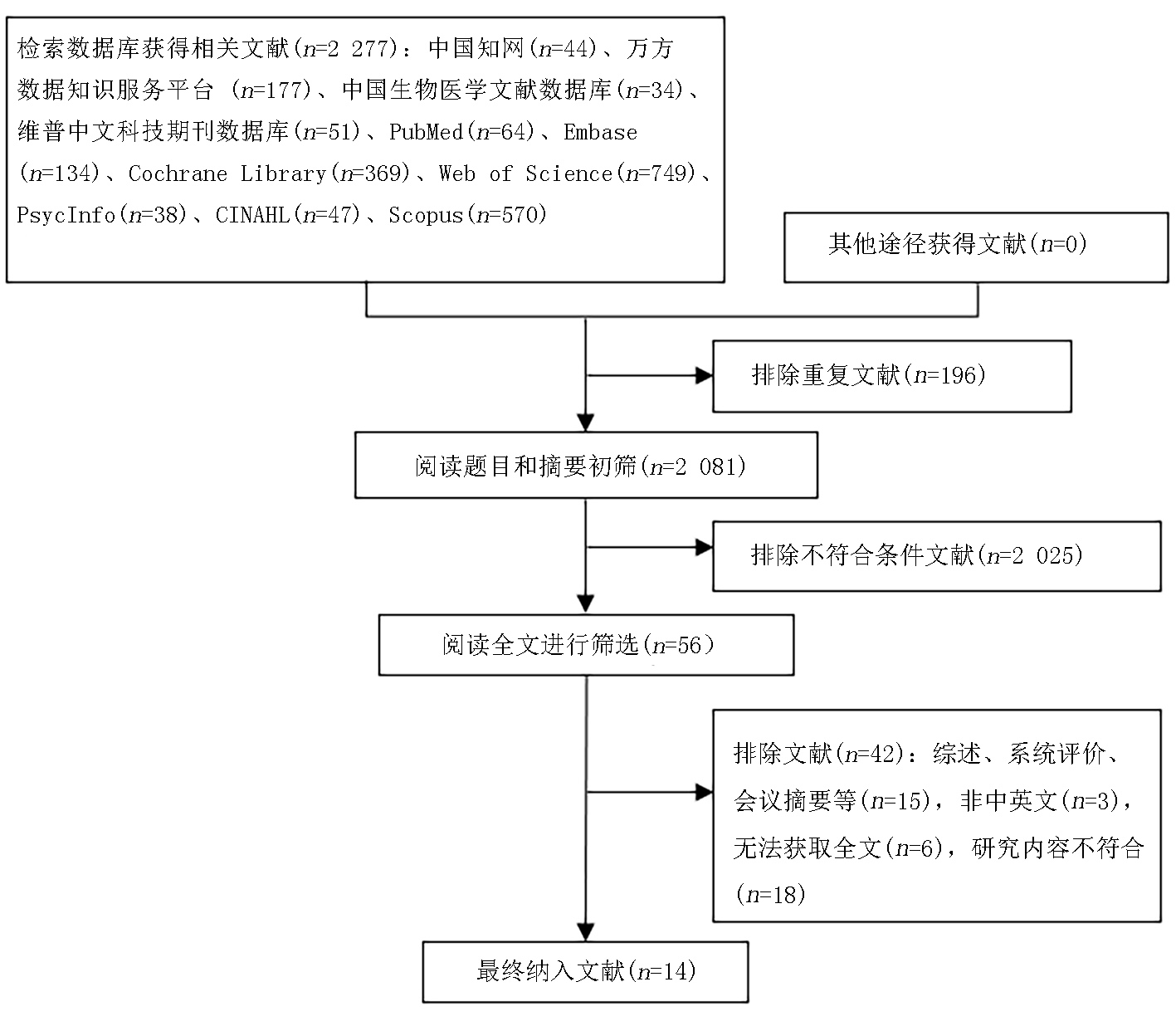
图1 文献筛选流程图
Fig.1 Literature screening flow
| 第一作者 | 年份 | 地区 | 研究类型 | 样本量 (例) | 恐动症发生率 (%) | 评估工具 | 影响因素 |
|---|---|---|---|---|---|---|---|
| Lööf[ | 2015 | 瑞典 | A | 2 351 | - | mFABQ | ②③⑥⑲ |
| Demmelmaier[ | 2018 | 瑞典 | B | 2 569 | - | mFABQ | ①②③⑭㉒㉓ |
| Xueying[ | 2025 | 中国 | A | 350 | 70.86 | TSK | ②④⑥⑯㉒ |
| Kinikli[ | 2018 | 土耳其 | A | 88 | - | TSK | ⑧⑮ |
| Yildirim[ | 2023 | 土耳其 | A | 124 | 77.40 | TSK | ⑬ |
| Baysalhan Öztürk[ | 2021 | 土耳其 | A | 100 | 70.00 | TSK | ⑥⑪⑫⑬⑭⑰ |
| Baday-Keskin[ | 2022 | 土耳其 | A | 88 | - | TSK | ⑤㉓ |
| Reinoso-Cobo[ | 2023 | 西班牙 | A | 124 | - | TSK-11 | ⑤⑦ |
| 孙学菁[ | 2024 | 中国 | A | 216 | - | TSK-11 | ⑲㉑ |
| 叶菁菁[ | 2024 | 中国 | A | 160 | 66.25 | TSK | ⑥⑨⑪⑳㉔ |
| 梁嘉卿[ | 2024 | 中国 | A | 169 | 44.97 | TSK | ④⑥⑩⑱ |
| 黄英[ | 2023 | 中国 | C | 150 | - | TSK | - |
| Mahmoud[ | 2023 | 埃及 | C | 24 | - | TSK | - |
| Hishikawa[ | 2023 | 日本 | D | - | - | TSK | - |
表2 纳入文献的基本特征(n=14)
Tab.2 Basic characteristics of the included literatures (n=14)
| 第一作者 | 年份 | 地区 | 研究类型 | 样本量 (例) | 恐动症发生率 (%) | 评估工具 | 影响因素 |
|---|---|---|---|---|---|---|---|
| Lööf[ | 2015 | 瑞典 | A | 2 351 | - | mFABQ | ②③⑥⑲ |
| Demmelmaier[ | 2018 | 瑞典 | B | 2 569 | - | mFABQ | ①②③⑭㉒㉓ |
| Xueying[ | 2025 | 中国 | A | 350 | 70.86 | TSK | ②④⑥⑯㉒ |
| Kinikli[ | 2018 | 土耳其 | A | 88 | - | TSK | ⑧⑮ |
| Yildirim[ | 2023 | 土耳其 | A | 124 | 77.40 | TSK | ⑬ |
| Baysalhan Öztürk[ | 2021 | 土耳其 | A | 100 | 70.00 | TSK | ⑥⑪⑫⑬⑭⑰ |
| Baday-Keskin[ | 2022 | 土耳其 | A | 88 | - | TSK | ⑤㉓ |
| Reinoso-Cobo[ | 2023 | 西班牙 | A | 124 | - | TSK-11 | ⑤⑦ |
| 孙学菁[ | 2024 | 中国 | A | 216 | - | TSK-11 | ⑲㉑ |
| 叶菁菁[ | 2024 | 中国 | A | 160 | 66.25 | TSK | ⑥⑨⑪⑳㉔ |
| 梁嘉卿[ | 2024 | 中国 | A | 169 | 44.97 | TSK | ④⑥⑩⑱ |
| 黄英[ | 2023 | 中国 | C | 150 | - | TSK | - |
| Mahmoud[ | 2023 | 埃及 | C | 24 | - | TSK | - |
| Hishikawa[ | 2023 | 日本 | D | - | - | TSK | - |
| 名称 | 内容 | 临界值 | 条目数 | 评分方式 | 适用人群 | 使用频率(篇) |
|---|---|---|---|---|---|---|
| TSK | 病理性躯体关注、活动回避 | 有 | 17 | Likert4 | 慢性疼痛患者 | 10 |
| TSK-11 | 病理性躯体关注、活动回避 | 无 | 11 | Likert4 | 腰背痛患者 | 2 |
| mFABQ | 身体活动回避 | 无 | 4 | Likert7 | 腰背痛患者 | 2 |
表3 纳入文献使用的恐动症评估工具
Tab.3 Assessment tools for kinesiophobia in the included literatures
| 名称 | 内容 | 临界值 | 条目数 | 评分方式 | 适用人群 | 使用频率(篇) |
|---|---|---|---|---|---|---|
| TSK | 病理性躯体关注、活动回避 | 有 | 17 | Likert4 | 慢性疼痛患者 | 10 |
| TSK-11 | 病理性躯体关注、活动回避 | 无 | 11 | Likert4 | 腰背痛患者 | 2 |
| mFABQ | 身体活动回避 | 无 | 4 | Likert7 | 腰背痛患者 | 2 |
| 干预方式 | 干预效果 | 适用人群 | 实施条件 |
|---|---|---|---|
| 运动锻炼 | 增强关节功能与身体活动能力,提高整体生理机能,降低恐动症水平 | 轻中度RA患者,无关节畸形者 | 家庭即可实施,对患者依从性要求较高 |
| 沙疗法 | 提高疼痛阈值,减轻疼痛程度,降低恐动症水平 | 能耐受沙疗环境的患者,无皮肤破损,需无相关禁忌症 | 需在具备特定沙疗设施的专业中心或场地进行,受地理和资源限制,可及性相对较低 |
| 认知行为疗法 | 减轻焦虑、抑郁,改善睡眠,纠正非理性认知,降低恐动症水平 | 适用于伴有显著灾难化认知、焦虑、抑郁等心理困扰的患者 | 医院可实施,由专业心理治疗师或经过培训的医护人员主导实施 |
表4 纳入文献的恐动症干预措施比较分析
Tab.4 Comparison of interventions for kinesiophobia in included literatures
| 干预方式 | 干预效果 | 适用人群 | 实施条件 |
|---|---|---|---|
| 运动锻炼 | 增强关节功能与身体活动能力,提高整体生理机能,降低恐动症水平 | 轻中度RA患者,无关节畸形者 | 家庭即可实施,对患者依从性要求较高 |
| 沙疗法 | 提高疼痛阈值,减轻疼痛程度,降低恐动症水平 | 能耐受沙疗环境的患者,无皮肤破损,需无相关禁忌症 | 需在具备特定沙疗设施的专业中心或场地进行,受地理和资源限制,可及性相对较低 |
| 认知行为疗法 | 减轻焦虑、抑郁,改善睡眠,纠正非理性认知,降低恐动症水平 | 适用于伴有显著灾难化认知、焦虑、抑郁等心理困扰的患者 | 医院可实施,由专业心理治疗师或经过培训的医护人员主导实施 |
| [1] | Smith MH, Berman JR. What is rheumatoid arthritis?[J]. JAMA, 2022, 327(12): 1194. doi: 10.1001/jama.2022.0786. |
| [2] | Global, regional, and national burden of rheumatoid arthritis, 1990-2020, and projections to 2050: A systematic analysis of the Global Burden of Disease Study 2021[J]. Lancet Rheumatol, 2023, 5(10): e594-e610. doi: 10.1016/S2665-9913(23)00211-4. |
| [3] | Zhou Y, Wang X, An Y, et al. Disability and health-related quality of life in Chinese patients with rheumatoid arthritis: A cross-sectional study[J]. Int J Rheum Dis, 2018, 21(9): 1709-1715. doi: 10.1111/1756-185X.13345. |
| [4] | England BR, Smith BJ, Baker NA, et al. 2022 American College of Rheumatology guideline for exercise, rehabilitation, diet, and additional integrative interventions for rheumatoid arthritis[J]. Arthritis Rheumatol, 2023, 75(8): 1299-1311. doi: 10.1002/art.42507. |
| [5] | Coskun Benlidayi I. Exercise therapy for improving cardiovascular health in rheumatoid arthritis[J]. Rheumatol Int, 2024, 44(1): 9-23. doi: 10.1007/s00296-023-05492-2. |
| [6] | Sul B, Lee KB, Joo YB, et al. Twelve weeks of strengthening exercise for patients with rheumatoid arthritis: A prospective intervention study[J]. J Clin Med, 2020, 9(9): 2792. doi: 10.3390/jcm9092792. |
| [7] | van Wissen MAT, Teuwen MMH, van den Ende CHM, et al. Effectiveness and cost-effectiveness of longstanding exercise therapy versus usual care in patients with axial spondyloarthritis or rheumatoid arthritis and severe limitations: The protocols of two parallel randomized controlled trials[J]. Physiother Res Int, 2022, 27(1): e1933. doi: 10.1002/pri.1933. |
| [8] | 邢颖, 刘玉培, 陈红, 等. 类风湿关节炎患者久坐行为现状及影响因素研究[J]. 护士进修杂志, 2024, 39(8): 888-893. doi: 10.16821/j.cnki.hsjx.2024.08.019. |
| [9] | Baxter S, Smith C, Treharne G, et al. What are the perceived barriers, facilitators and attitudes to exercise for women with rheumatoid arthritis? A qualitative study[J]. Disabil Rehabil, 2016, 38(8): 773-780. doi: 10.3109/09638288.2015.1061602. |
| [10] | Luque-Suarez A, Martinez-Calderon J, Falla D. Role of kinesiophobia on pain, disability and quality of life in people suffering from chronic musculoskeletal pain: A systematic review[J]. Br J Sports Med, 2019, 53(9): 554-559. doi: 10.1136/bjsports-2017-098673. |
| [11] | Felício DC, Elias FJ, Pereira DS, et al. The effect of kinesiophobia in older people with acute low back pain: Longitudinal data from Back Complaints in the Elders (BACE)[J]. Cad Saude Publica, 2021, 37(12): e00232920. doi: 10.1590/0102-311X00232920. |
| [12] | Peters M, Marnie C, Tricco AC, et al. Updated methodological guidance for the conduct of scoping reviews[J]. JBI Evid Synth, 2020, 18(10): 2119-2126. doi: 10.11124/JBIES-20-00167. |
| [13] | Li L, Sun Y, Qin H, et al. A scientometric analysis and visualization of kinesiophobia research from 2002 to 2022: A review[J]. Medicine (Baltimore), 2023, 102(44): e35872. doi: 10.1097/MD.0000000000035872. |
| [14] | Arnett FC, Edworthy SM, Bloch DA, et al. The American Rheumatism Association 1987 revised criteria for the classification of rheumatoid arthritis[J]. Arthritis Rheum, 1988, 31(3): 315-324. doi: 10.1002/art.1780310302. |
| [15] | Aletaha D, Neogi T, Silman AJ, et al. 2010 Rheumatoid arthritis classification criteria: An American College of Rheumatology/European League Against Rheumatism collaborative initiative[J]. Arthritis Rheum, 2010, 62(9): 2569-2581. doi: 10.1002/art.27584. |
| [16] | Lööf H, Demmelmaier I, Henriksson EW, et al. Fear-avoidance beliefs about physical activity in adults with rheumatoid arthritis[J]. Scand J Rheumatol, 2015, 44(2): 93-99. doi:10.3109/03009742.2014.932432. |
| [17] | Demmelmaier I, Björk A, Dufour AB, et al. Trajectories of fear-avoidance beliefs on physical activity over two years in people with rheumatoid arthritis[J]. Arthritis Care Res (Hoboken), 2018, 70(5): 695-702. doi: 10.1002/acr.23419. |
| [18] | Xueying S, Yanli Y, Wei X, et al. Influence of kinesiophobia on activity, function, and anxiety levels in patients with rheumatoid arthritis[J]. Front Med (Lausanne), 2025, 11: 1514088. doi: 10.3389/fmed.2024.1514088. |
| [19] | Kinikli GI, Deniz HG, Karahan S, et al. Predictors of fear of movement in patients with rheumatoid arthritis[J]. Turk J Physiother Rehabil, 2018, 29(2): 11-17. doi: 10.21653/tjpr.453714. |
| [20] | Yildirim N. Comparison of kinesiophobia in patients with rheumatoid arthritis and systemic lupus erythematosus[J]. Eur Rev Med Pharmacol Sci, 2023, 27(23): 11508-11516. doi: 10.26355/eurrev_202312_34589. |
| [21] | Baysalhan Öztürk $\dot{I}$, Garip N, Sivas F, et al. Kinesiophobia in rheumatoid arthritis patients: Relationship with quadriceps muscle strength, fear of falling, functional status, disease activity, and quality of life[J]. Arch Rheumatol, 2021, 36(3): 427-434. doi: 10.46497/ArchRheumatol.2021.8535. |
| [22] | Baday-Keskin D, Ekinci B. The relationship between kinesiophobia and health-related quality of life in patients with rheumatoid arthritis: A controlled cross-sectional study[J]. Joint Bone Spine, 2022, 89(2): 105275. doi: 10.1016/j.jbspin.2021.105275. |
| [23] | Reinoso-Cobo A, Ortega-Avila AB, Ramos-Petersen L, et al. Relationship between kinesiophobia, foot pain and foot function, and disease activity in patients with rheumatoid arthritis: A cross-sectional study[J]. Medicina (Kaunas), 2023, 59(1): 147. doi: 10.3390/medicina59010147. |
| [24] | 孙学菁, 王丽芹, 高兆虹, 等. 类风湿关节炎患者运动自我效能在社会支持与运动恐惧间的中介效应分析[J]. 预防医学, 2024, 36(5): 378-382. doi: 10.19485/j.cnki.issn2096-5087.2024.05.003. |
| [25] | 叶菁菁. 类风湿关节炎患者恐动症现状及影响因素分析[D]. 沈阳: 中国医科大学, 2024. doi: 10.27652/d.cnki.gzyku.2024.001815. |
| [26] | 梁嘉卿. 类风湿关节炎患者恐动症与自我效能感、自我管理相关性研究[D]. 锦州: 锦州医科大学, 2024. doi: 10.27812/d.cnki.glnyx.2024.000380. |
| [27] | 黄英, 朱雅洁. 认知行为疗法在类风湿关节炎患者恐动症中的应用[J]. 湘南学院学报(医学版), 2023, 25(1): 60-65. doi: 10.16500/j.cnki.1673-498x.2023.01.014. |
| [28] | Mahmoud NF, Fouda HA, Omara II, et al. Exposure time as an influencing factor among rheumatoid arthritis patients subjected to traditional Siwan therapy[J]. Medicine (Baltimore), 2023, 102(37): e35105. doi: 10.1097/MD.0000000000035105. |
| [29] | Hishikawa N, Toyama S, Shimahara N, et al. A home-based low-intensity resistance exercise programme with supervision for secondary sarcopenia in a patient with established rheumatoid arthritis: A case report[J]. Mod Rheumatol Case Rep, 2023, 7(2): 354-358. doi: 10.1093/mrcr/rxad018. |
| [30] | Knapik A, Saulicz E, Gnat R. Kinesiophobia-introducing a new diagnostic tool[J]. J Hum Kinet, 2011, 28: 25-31. doi: 10.2478/v10078-011-0019-8. |
| [31] | Zheng LX, Li KX, Hong FF, et al. Pain and bone damage in rheumatoid arthritis: Role of leukotriene B4[J]. Clin Exp Rheumatol. 2019, 37(5): 872-878. |
| [32] | Baerwald C, Stemmler E, Gnüchtel S, et al. Predictors for severe persisting pain in rheumatoid arthritis are associated with pain origin and appraisal of pain[J]. Ann Rheum Dis, 2024, 83(10): 1381-1388. doi: 10.1136/ard-2023-225414. |
| [33] | Studenic P, Aletaha D, de Wit M, et al. American College of Rheumatology/EULAR remission criteria for rheumatoid arthritis: 2022 revision[J]. Ann Rheum Dis, 2023, 82(1): 74-80. doi: 10.1136/ard-2022-223413. |
| [34] | 北京协和医院国家皮肤与免疫疾病临床医学研究中心, 中国医师协会风湿免疫专科医师分会, 中国康复医学会风湿免疫病康复专业委员会, 等. 2024中国类风湿关节炎诊疗指南[J]. 中华内科杂志, 2024, 63(11):1059-1077. doi: 10.3760/cma.j.cn112138-20240531-00360. |
| [35] | Berrichi I, Taik FZ, Haddani F, et al. Prevalence and associated factors of central sensitization in patients with chronic inflammatory rheumatic disease[J]. Curr Rheumatol Rev, 2025, 21(4): 418-423. doi: 10.2174/0115733971309885241011105213. |
| [36] | Lwin MN, Serhal L, Holroyd C, et al. Rheumatoid arthritis: The impact of mental health on disease: A narrative review[J]. Rheumatol Ther, 2020, 7(3): 457-471. doi: 10.1007/s40744-020-00217-4. |
| [37] | Murillo C, Galán-Martín MÁ, Montero-Cuadrado F, et al. Reductions in kinesiophobia and distress after pain neuroscience education and exercise lead to favourable outcomes: A secondary mediation analysis of a randomized controlled trial in primary care[J]. Pain, 2023, 164(10): 2296-2305. doi: 10.1097/j.pain.0000000000002929. |
| [38] | Saracoglu I, Leblebicier MA, Yaman F, et al. Pain neuroscience education combined with usual treatment for fibromyalgia syndrome: A randomized controlled trial[J]. Int J Rheum Dis, 2021, 24(11): 1409-1418. doi: 10.1111/1756-185X.14223. |
| [39] | 武满丽, 汪张毅, 郝淑云, 等. 虚拟现实技术在慢性疼痛恐动症患者中的应用进展[J]. 中华现代护理杂志, 2024, 30(4): 545-549. doi: 10.3760/cma.j.cn115682-20230725-00191. |
| [1] | 郭伊凡, 任桦, 白婧, 刘三娇, 李燕娟. 类风湿关节炎患者睡眠障碍发生率及影响因素的meta分析[J]. 临床荟萃, 2025, 40(8): 677-683. |
| [2] | 沈雪娇, 王挺, 王媛, 李燕, 魏佳琪. 肌骨超声在血清学阴性类风湿关节炎早期诊断中的作用[J]. 临床荟萃, 2025, 40(8): 705-710. |
| [3] | 祝昌昊, 张洪鹏. 炎症相关信号通路在类风湿关节炎中的研究进展[J]. 临床荟萃, 2025, 40(5): 477-480. |
| [4] | 詹雅萍, 张科, 李文根, 何春媚, 杨大山. 血清DKK-1检测对类风湿关节炎患者颈动脉内中膜增厚的临床价值[J]. 临床荟萃, 2025, 40(2): 138-142. |
| [5] | 张雪, 王俊祥. 类风湿关节炎共病的研究进展[J]. 临床荟萃, 2025, 40(1): 86-89. |
| [6] | 刘彤, 王俊祥. 类风湿关节炎潜伏性结核感染激活的研究进展[J]. 临床荟萃, 2024, 39(12): 1135-1140. |
| [7] | 董泓, 李振彬, 马旭, 罗亚萍, 焦爱军, 张旭飞, 孙彩霞. 类风湿关节炎合并失眠的多中心横断面调查[J]. 临床荟萃, 2024, 39(10): 882-888. |
| [8] | 宋怡静, 李健, 宋芹, 邵莉. CRP联合TyG指数对类风湿关节炎患者发生冠心病风险的预测价值[J]. 临床荟萃, 2024, 39(6): 506-511. |
| [9] | 左腾, 王俊祥. 血清阴性类风湿关节炎发病机制的研究进展[J]. 临床荟萃, 2023, 38(8): 753-756. |
| [10] | 孙佳宁, 崔轶霞. 类风湿关节炎与抑郁症共病的研究进展[J]. 临床荟萃, 2023, 38(7): 663-667. |
| [11] | 邹琳, 崔轶霞, 张娜娜, 陈思荣. 类风湿关节炎合并骨质疏松症发病机制和相关治疗药物对骨质疏松症影响的研究进展[J]. 临床荟萃, 2023, 38(3): 279-284. |
| [12] | 张月月, 谢美芳, 孙艮. 类风湿关节炎合并T-细胞大颗粒淋巴细胞白血病1例及文献复习[J]. 临床荟萃, 2022, 37(8): 728-732. |
| [13] | 胡芳芳, 钟世玲, 狄亚珍, 吴菱. 幼年特发性关节炎患儿血管内皮功能的系统评价和meta分析[J]. 临床荟萃, 2022, 37(3): 204-210. |
| [14] | 林长艺, 宋明辉, 吴培埕. 缓解性血清阴性对称性滑膜炎伴凹陷性水肿综合征与血清阴性类风湿性关节炎患者临床和实验室特征比较[J]. 临床荟萃, 2022, 37(3): 262-265. |
| [15] | 曹阳, 李崇巍. 儿童原发性干燥综合征合并肾损害的研究进展[J]. 临床荟萃, 2022, 37(2): 188-192. |
| 阅读次数 | ||||||
|
全文 |
|
|||||
|
摘要 |
|
|||||
