临床荟萃 ›› 2026, Vol. 41 ›› Issue (9): 824-830.doi: 10.3969/j.issn.1004-583X.2026.09.007

• 论著 • 上一篇    下一篇

急性缺血性脑卒中患者继发卒中后情感障碍影响因素logistic回归模型的构建及验证

张帅杰(), 何春磊, 曹爱华   

  1. 漯河医学高等专科学校第二附属医院 神经内科, 河南 漯河 462000
  • 收稿日期:2026-04-03 出版日期:2026-09-20 发布日期:2026-09-17
  • 通讯作者: 张帅杰 E-mail:zshuaijie669@163.com

Development and validation of a logistic regression model for factors influencing post-stroke emotional disorders after acute ischemic stroke

Zhang Shuaijie(), He Chunlei, Cao Aihua   

  1. Department of Neurology, the Second Affiliated Hospital of Luohe Medical College, Luohe 462000, China
  • Received:2026-04-03 Online:2026-09-20 Published:2026-09-17
  • Contact: Zhang Shuaijie E-mail:zshuaijie669@163.com

摘要:

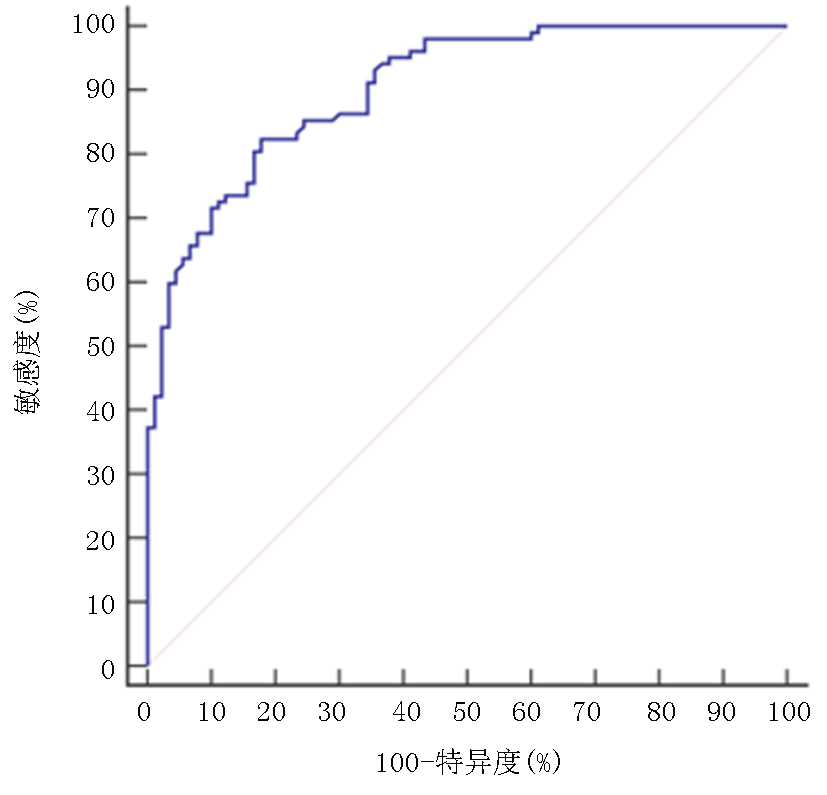
目的 探讨急性缺血性脑卒中(AIS)患者继发卒中后情感障碍(PSED)的影响因素,并构建logistic回归模型,以筛选高危患者,指导临床制定个体化干预方案。方法 选取2022年11月-2024年11月于本院诊治的AIS患者200例,均接受静脉溶栓治疗,依据治疗后1年内(失访8例)是否继发PSED将其分为发生组102例、未发生组90例。比较两组临床资料,并分析AIS患者继发PSED的影响因素。基于多因素分析结果构建logistic回归模型,并验证该模型对AIS患者继发PSED的预测价值。结果 多因素logistic回归分析显示入院时NIHSS评分升高、人均月收入<3 000元、日常生活自理能力差、睡眠障碍、社会支持度低、家庭关怀度差及皮质醇、同型半胱氨酸(Hcy)、氧化还原蛋白1 (PRDX1)、神经胶质原纤维酸性蛋白(GFAP)水平升高为AIS患者继发PSED的独立危险因素(P<0.05);logistic回归模型预测AIS患者继发PSED的曲线下面积为0.904,敏感度、特异度分别为82.35%、82.22%,Hosmer-Lemeshow该模型拟合度良好(χ2=5.542,P=0.129),Bootstrap显示该模型具有良好区分度(一致性指数为0.938);临床决策曲线显示,当风险阈值在0.10~0.90时使用该模型具有良好的临床净获益。结论 入院时NIHSS评分升高、人均月收入<3 000元、日常生活自理能力差、睡眠障碍、社会支持度低、家庭关怀度差及皮质醇、Hcy、PRDX1、GFAP水平升高为AIS患者继发PSED的独立危险因素,基于上述因素构建的logistic回归模型对AIS患者继发PSED具有一定预测价值,临床应采取针对性干预措施,以降低PSED发生风险。

关键词: 卒中, 情感障碍, 影响因素, 预测

Abstract:

Objective To investigate the factors influencing post-stroke emotional disorder (PSED) in patients with acute ischemic stroke (AIS) and to construct a logistic regression model for identifying high-risk patients and guiding individualized clinical interventions. Methods A total of 200 patients with AIS treated at our hospital from November 2022 to November 2024 were enrolled, all of whom received intravenous thrombolysis. According to whether PSED occurred within 1 year after treatment (8 patients lost to follow-up), the patients were divided into a PSED group (102 cases) and a non-PSED group (90 cases). Clinical characteristics were compared between the two groups, and the factors influencing PSED after AIS were analyzed. Based on the multivariate analysis results, a logistic regression model was constructed and its predictive value for PSED after AIS was validated. Results Multivariate logistic regression analysis showed that higher National Institutes of Health Stroke Scale (NIHSS) score at admission, per capita monthly income <3000 yuan, poor ability to perform activities of daily living independently, sleep disorders, low social support, poor family care, and elevated cortisol, homocysteine (Hcy), peroxiredoxin 1 (PRDX1), and glial fibrillary acidic protein (GFAP) levels were independent risk factors for PSED after AIS (P<0.05). The logistic regression model yielded an area under the curve (AUC) of 0.904 for predicting PSED after AIS, with sensitivity and specificity of 82.35% and 82.22%, respectively. The Hosmer-Lemeshow test indicated good model fit (χ2=5.542, P=0.129). Bootstrap validation showed good discrimination, with a concordance index of 0.938. Decision curve analysis showed that the model provided good clinical net benefit when the risk threshold ranged from 0.10 to 0.90. Conclusion Higher NIHSS score at admission, per capita monthly income <3, 000 yuan, poor ability to perform activities of daily living independently, sleep disorders, low social support, poor family care, and elevated cortisol, Hcy, PRDX1, and GFAP levels are independent risk factors for PSED after AIS. The logistic regression model constructed on the basis of these factors has a certain predictive value for PSED after AIS. Clinically, targeted interventions should be implemented to reduce the risk of PSED.

Key words: stroke, mood disorders, influencing factors, prediction

中图分类号: