临床荟萃 ›› 2026, Vol. 41 ›› Issue (5): 399-405.doi: 10.3969/j.issn.1004-583X.2026.05.002

• 论著 • 上一篇    下一篇

血清FABP5、SII、VEGF水平与肝癌患者预后的关系分析

王天慧1(), 吕慧1, 冯利菲1, 陈亚杰2   

  1. 1 安阳钢铁集团有限责任公司职工总医院 医学检验科, 河南 安阳 455000
    2 安阳市肿瘤医院 检验科, 河南 安阳 455000
  • 收稿日期:2026-04-16 出版日期:2026-05-20 发布日期:2026-05-26
  • 通讯作者: 王天慧,Email:

Relationship between serum FABP5, SII, and VEGF levels and prognosis in patients with liver cancer

Wang Tianhui1(), Lyu Hui1, Feng Lifei1, Chen Yajie2   

  1. 1 Department of Laboratory Medicine, Angang General Hospital, Anyang 455000, China
    2 Department of Laboratory Medicine, Anyang Tumour Hospital, Anyang 455000, China
  • Received:2026-04-16 Online:2026-05-20 Published:2026-05-26
  • Contact: Wang Tianhui,Email:

摘要:

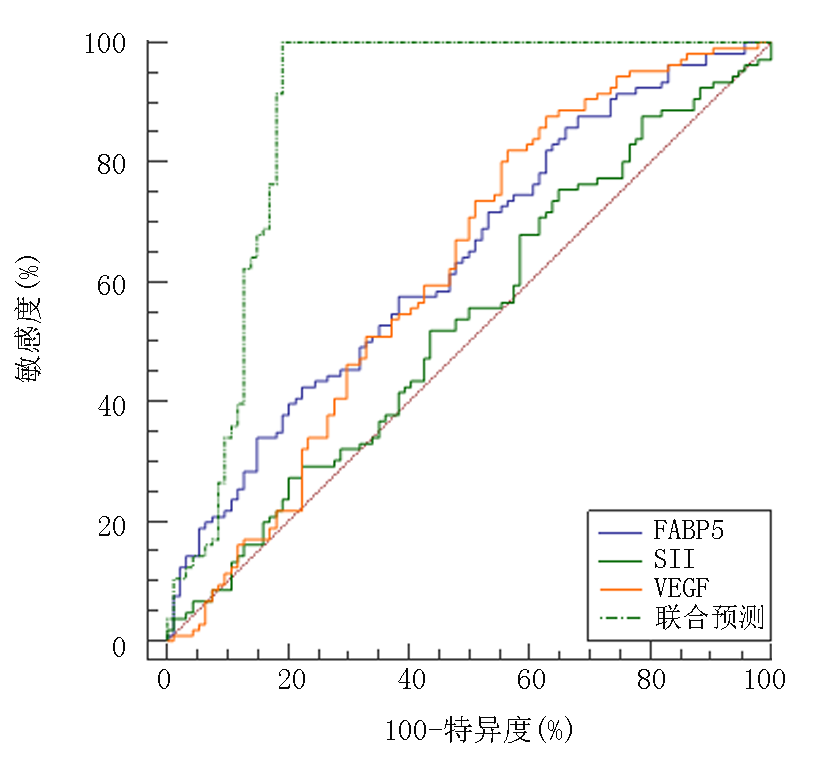
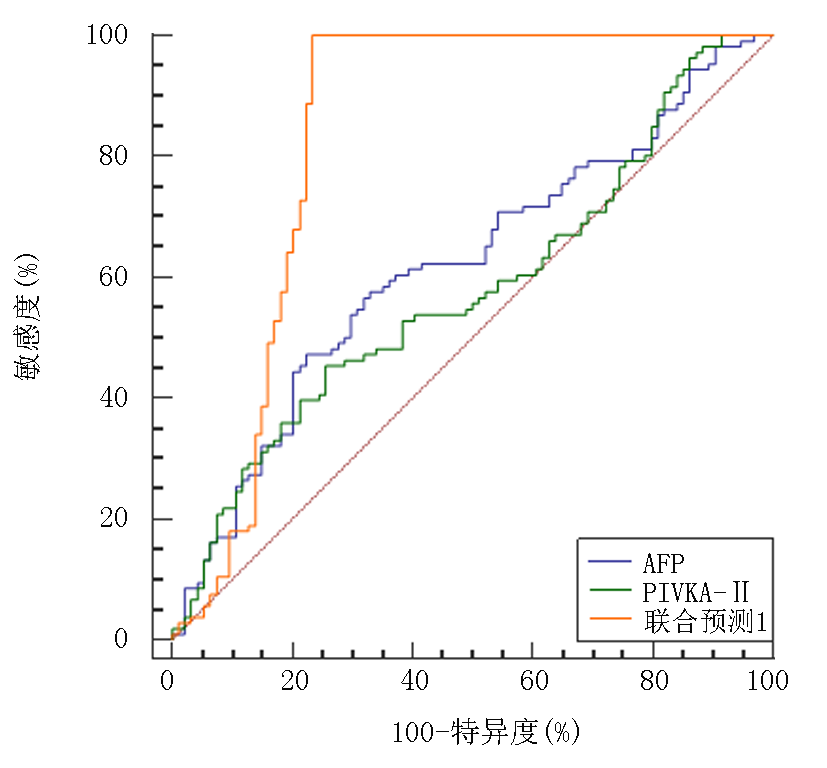
目的 探究血清脂肪酸结合蛋白5(fatty acid binding protein 5,FABP5)、系统免疫炎症指数(systemic immune inflammatory index,SII)、血管内皮生长因子(vascular endothelial growth factor,VEGF)水平与肝癌患者预后的关系。方法 回顾性纳入2021年3月-2024年3月安阳钢铁集团有限责任公司职工总医院和安阳市肿瘤医院收治的200例肝癌患者为观察组,另选取同期肝硬化或慢性肝炎患者200例为对照组。统计两组临床资料并对比两组血清FABP5、SII、VEGF水平。对观察组进行治疗后1年的随访,统计其预后情况。将转移、复发、死亡患者纳入预后不良组(n=94),将病情稳定或好转患者纳入预后良好组(n=106)。对比不同预后患者血清FABP5、SII、VEGF水平差异;采用多因素Cox回归分析影响肝癌患者预后的危险因素;并以受试者工作曲线(receiver operating curve,ROC)分析血清FABP5、SII、VEGF对肝癌患者预后的预测效能。结果 观察组血清FABP5(14.51±3.41)μg/L、SII(323.45±31.52)、VEGF(381.52±40.56) ng/L水平均高于对照组[(7.85±2.86) μg/L、(198.64±25.68)、(205.64±27.86) ng/L],差异具有统计学意义(P<0.05);预后良好组肿瘤TNM分期Ⅰ~Ⅱ期占比72.64%高于预后不良组31.91%,血清甲胎蛋白(alpha-fetoprotein,AFP)(277.65±36.53)μg/L、异常凝血酶原-Ⅱ(protein induced by vitamin K absence or antagonist-Ⅱ,PIVKA-Ⅱ)(315.68±58.64)μg/L以及FABP5(11.33±2.86)μg/L、SII(291.64±36.45)、VEGF(316.53±38.49) ng/L水平低于预后不良组[(291.47±40.37) μg/L、(336.55±62.49) μg/L、(17.85±2.68) μg/L、(342.56±40.15)、(457.68±52.11) ng/L],差异均具有统计学意义(P<0.05);TNM Ⅲ~Ⅳ期患者的血清FABP5(15.48±3.05)μg/L、SII(349.56±43.97)、VEGF(429.68±66.54) ng/L水平均显著高于Ⅰ~Ⅱ期患者[FABP5(13.50±2.61) μg/L、SII(281.68±38.67)、VEGF(320.45±55.18) ng/L],且在TNM Ⅰ~Ⅱ期、Ⅲ~Ⅳ期患者亚组中,预后不良组的血清FABP5、SII、VEGF、AFP及PIVKA-Ⅱ水平均显著高于预后良好组,差异均具有统计学意义(P<0.05)。血清FABP5、SII、VEGF联合预测肝癌患者预后的曲线下面积(area under the curve,AUC)0.879高于各指标单一预测值(0.637、0.534、0.619),而血清AFP、PIVKA-Ⅱ联合预测肝癌患者预后的AUC为0.835,血清FABP5、SII、VEGF联合预测效能更好;Cox回归分析结果显示,FABP5≥14.96 μg/L、SII≥308.00、VEGF≥380.72 ng/L、肿瘤TNM分期Ⅲ~Ⅳ期为肝癌患者预后的危险因素(P<0.05)。结论 血清FABP5、SII、VEGF在肝癌患者中呈特异性升高表达,且其水平与患者的预后呈现显著相关性。

关键词: 肝肿瘤, 血清脂肪酸结合蛋白5, 系统免疫炎症指数, 血管内皮生长因子, 预后

Abstract:

Objective To investigate the relationship between serum fatty acid binding protein 5 (FABP5), systemic immune inflammatory index (SII), vascular endothelial growth factor (VEGF) levels, and prognosis in patients with liver cancer. Methods A total of 200 patients with liver cancer admitted to Anyang General Hospital and Anyang Cancer Hospital from March 2021 to March 2024 were retrospectively enrolled as the observation group. In addition, 200 patients with cirrhosis or chronic hepatitis during the same period were selected as the control group. Clinical data were collected and serum FABP5, SII, and VEGF levels were compared between the two groups. Patients in the observation group were followed up for 1 year after treatment, and prognostic outcomes were recorded. Patients with metastasis, recurrence, or death were assigned to the poor prognosis group (n=94), whereas patients with stable or improved disease were assigned to the good prognosis group (n=106). Serum FABP5, SII, and VEGF levels were compared between the two prognostic groups. Multivariate Cox regression analysis was used to identify risk factors affecting prognosis in patients with liver cancer. The receiver operating curve (ROC) was used to evaluate the predictive performance of serum FABP5, SII, and VEGF for prognosis in patients with liver cancer. Results Serum FABP5 ([14.51±3.41]μg/L), SII (323.45±31.52), and VEGF ([381.52±40.56] ng/L) levels in the observation group were all higher than those in the control group ([7.85±2.86] μg/L, [198.64±25.68], and [205.64±27.86] ng/L, respectively), with statistically significant differences (P<0.05). The proportion of patients with TNM stage Ⅰ-Ⅱ disease was 72.64% in the good prognosis group, which was higher than 31.91% in the poor prognosis group. Serum alpha-fetoprotein (AFP) ([277.65±36.53]μg/L], PIVKA-Ⅱ ([315.68±58.64]μg/L), FABP5 ([11.33±2.86] μg/L), SII (291.64±36.45), and VEGF ([316.53±38.49] ng/L) levels were lower than those in the poor prognosis group ([291.47±40.37] μg/L, [336.55±62.49] μg/L, [17.85±2.68]μg/L, [342.56±40.15], and [457.68±52.11] ng/L, respectively), with statistically significant differences (P<0.05). Serum FABP5 ([15.48±3.05]μg/L), SII (349.56±43.97), and VEGF ([429.68±66.54] ng/L) levels in patients with TNM stage Ⅲ-Ⅳ disease were significantly higher than those in patients with stage Ⅰ-Ⅱ disease (FABP5 [13.50±2.61]μg/L, SII [281.68±38.67], and VEGF [320.45±55.18] ng/L). In addition, within the TNM stage Ⅰ-Ⅱ and Ⅲ-Ⅳ subgroups, serum FABP5, SII, VEGF, AFP, and PIVKA-Ⅱ levels were all significantly higher in the poor prognosis group than in the good prognosis group, with statistically significant differences (all P<0.05). The area under the curve (AUC) for combined prediction of prognosis using serum FABP5, SII, and VEGF was 0.879, which was higher than the individual AUC values for each marker (0.637, 0.534, and 0.619, respectively). The AUC for combined prediction using serum AFP and PIVKA-Ⅱ was 0.835, indicating better predictive performance for the combined serum FABP5, SII, and VEGF model. Cox regression analysis showed that FABP5≥14.96 μg/L, SII≥308.00, VEGF≥380.72 ng/L, and TNM stage Ⅲ-Ⅳ were risk factors for prognosis in patients with liver cancer (P<0.05). Conclusion Serum FABP5, SII, and VEGF are specifically elevated in patients with liver cancer, and their levels are significantly associated with prognosis.

Key words: liver neoplasms, serum fatty acid binding protein 5, systemic immune inflammation index, vascular endothelial growth factor, prognosis

中图分类号: