
临床荟萃 ›› 2026, Vol. 41 ›› Issue (4): 293-300.doi: 10.3969/j.issn.1004-583X.2026.04.001
• 循证研究 • 下一篇
朱瑞罡, 李浩强, 王友昆, 郭继东, 王强( )
)
收稿日期:2026-02-27
出版日期:2026-04-20
发布日期:2026-04-24
通讯作者:
王强,Email: wangq2090@126.com
Zhu Ruigang, Li Haoqiang, Wang Youkun, Guo Jidong, Wang Qiang()
Received:2026-02-27
Online:2026-04-20
Published:2026-04-24
Contact:
Wang Qiang,Email: wangq2090@126.com
摘要:
目的 分析评估罗莫珠单抗治疗骨质疏松症患者的临床疗效及安全性。方法 系统检索PubMed、Embase、Web of Science、Medline、the Cochrane Library、美国临床试验注册平台、CNKI、万方、维普、SinoMed等数据库,检索时间为建库起至2025年12月31日,收集有关罗莫珠单抗与安慰剂(或其他抗骨质疏松药物)对照治疗骨质疏松症的随机对照试验(RCT),提取文献有效数据及质量评价后,应用RevMan 5.3软件进行meta分析。结果 共纳入11篇RCT,共计15 719例患者。Meta分析结果显示:在疗效方面,与安慰剂相比,罗莫珠单抗能显著提高骨质疏松症患者的腰椎骨密度[MD=11.75,95%CI(9.07,14.42),P<0.01]、全髋关节骨密度[MD=3.31,95%CI(1.19,5.42),P=0.002];降低新发椎体骨折发生率[RR=0.25,95%CI(0.16,0.40),P<0.01];但在提高股骨颈骨密度方面,组间差异无统计学意义。安全性方面,与安慰剂组相比,罗莫珠单抗组不良事件发生率显著更低[RR=0.97,95%CI(0.96,0.99),P=0.003];与特立帕肽组相比,两组不良事件发生率差异无统计学意义[RR=1.11,95%CI(1.00,1.23),P=0.05];与阿仑膦酸钠组不良事件发生率相近,差异无统计学意义[RR=1.00,95%CI(0.93,1.08),P=0.95]。罗莫珠单抗组与安慰剂、特立帕肽和阿仑膦酸钠严重不良事件发生率相近,差异无统计学意义。结论 罗莫珠单抗可显著提高骨质疏松患者的腰椎骨密度和全髋关节骨密度水平,降低新发椎体骨折发生率,安全性良好,不良事件发生率未增加。
中图分类号:
朱瑞罡, 李浩强, 王友昆, 郭继东, 王强. 罗莫珠单抗治疗骨质疏松症疗效和安全性的meta分析[J]. 临床荟萃, 2026, 41(4): 293-300.
Zhu Ruigang, Li Haoqiang, Wang Youkun, Guo Jidong, Wang Qiang. A meta-analysis of the efficacy and safety of romosozumab in the treatment of osteoporosis[J]. Clinical Focus, 2026, 41(4): 293-300.
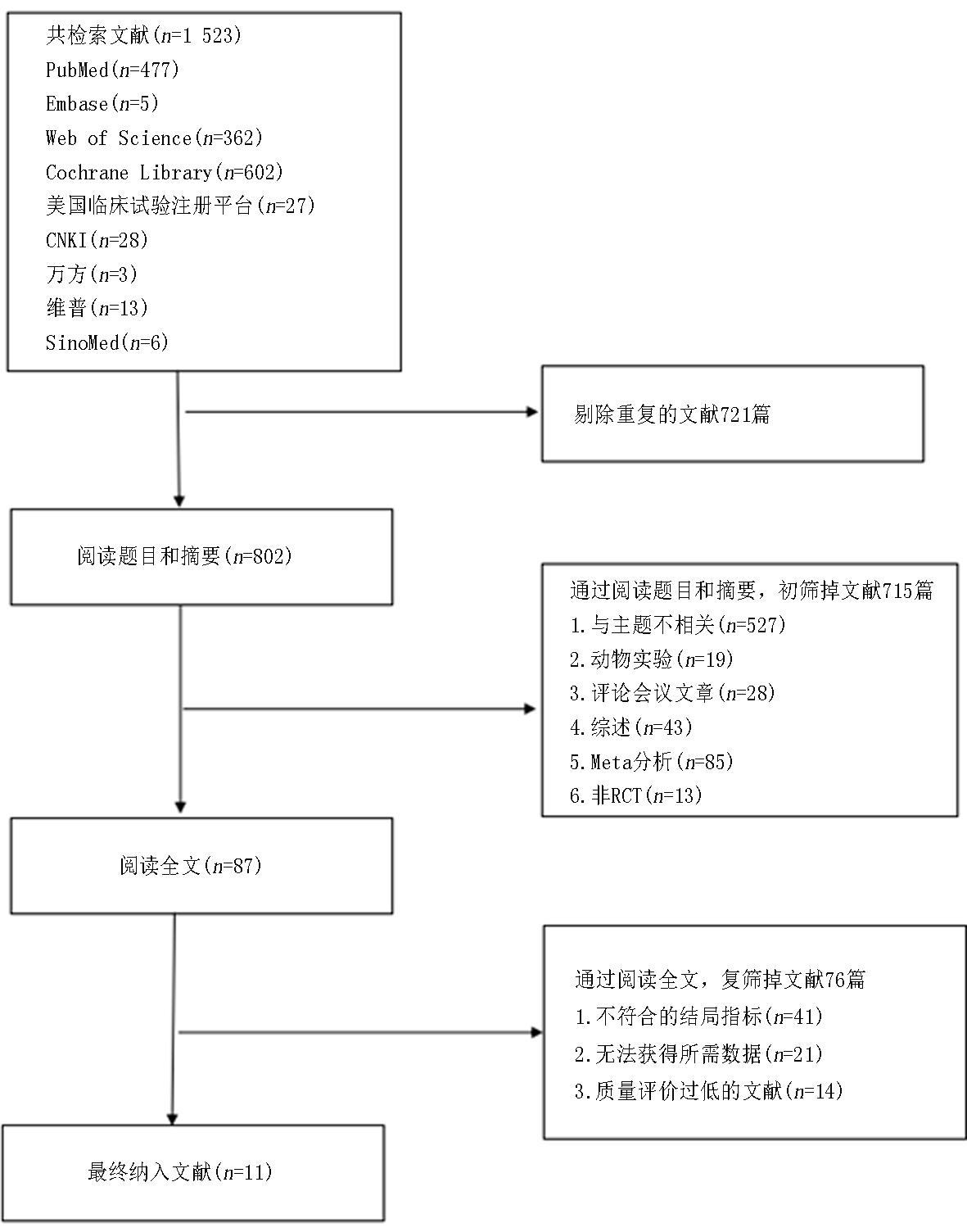
图1 文献筛选流程
Fig.1 Literature screening flowchart
| 第一作者及发表年限 | 组别 | 例数 | 年龄(岁) | 干预措施 | 疗程 | 结局指标 |
|---|---|---|---|---|---|---|
| Lau[ | 试验组 对照组 | 146 129 | 75.2±7.0 74.0±6.7 | 罗莫珠单抗210 mg 阿仑膦酸钠 | 12个月 | ⑤⑥ |
| Bente[ | 试验组 对照组 | 1 494 1 519 | 70.4±7.1 70.4±6.9 | 罗莫珠单抗210 mg 安慰剂 | 12个月 | ④⑤⑥ |
| Cosman[ | 试验组 对照组 | 3 589 3 591 | 70.9±7.0 70.8±6.9 | 罗莫珠单抗210 mg 安慰剂 | 12个月 | ①②③④⑤⑥ |
| Baek[ | 试验组 对照组 | 34 33 | 66.7±7.6 68.4±7.2 | 罗莫珠单抗210 mg 安慰剂 | 6个月 | ①②③⑤ |
| Ishibashi[ | 试验组 对照组 | 63 63 | 68.3±5.9 67.8±7.2 | 罗莫珠单抗210 mg 安慰剂 | 12个月 | ①②③⑤⑥ |
| Mcclung[ | 试验组 | 52 | 66.3±6.5 | 罗莫珠单抗210 mg | ||
| 51 | 67.1±5.8 | 阿仑膦酸钠 | 12个月 | ①②③⑤⑥ | ||
| 55 | 66.8±5.7 | 特立帕肽 | ||||
| 对照组 | 52 | 67.0±6.5 | 安慰剂 | |||
| Padhi[ | 试验组 对照组 | 36 12 | 58.6±8.7 59.1±5.6 | 罗莫珠单抗 安慰剂 | 13个月 | ⑤⑥ |
| Lewiecki[ | 试验组 对照组 | 163 82 | 72.4±7.4 71.5±6.9 | 罗莫珠单抗210 mg 安慰剂 | 12个月 | ⑤⑥ |
| Saag[ | 试验组 对照组 | 2 046 2 047 | 74.4±7.5 74.2±7.5 | 罗莫珠单抗210 mg 阿仑磷酸盐70 mg | 12个月 | ①②③⑤⑥ |
| Padhi[ | 试验组 对照组 | 12 14 | 50.2±4.0 52.8±4.8 | 罗莫珠单抗 安慰剂 | 3个月 | ⑤⑥ |
| Langdahl[ | 试验组 对照组 | 218 218 | 71.8±7.4 71.2±7.7 | 罗莫珠单抗210 mg 特立帕肽 | 12个月 | ⑤⑥ |
表1 研究的基本特征
Tab. 1 Baseline characteristics of the included studies
| 第一作者及发表年限 | 组别 | 例数 | 年龄(岁) | 干预措施 | 疗程 | 结局指标 |
|---|---|---|---|---|---|---|
| Lau[ | 试验组 对照组 | 146 129 | 75.2±7.0 74.0±6.7 | 罗莫珠单抗210 mg 阿仑膦酸钠 | 12个月 | ⑤⑥ |
| Bente[ | 试验组 对照组 | 1 494 1 519 | 70.4±7.1 70.4±6.9 | 罗莫珠单抗210 mg 安慰剂 | 12个月 | ④⑤⑥ |
| Cosman[ | 试验组 对照组 | 3 589 3 591 | 70.9±7.0 70.8±6.9 | 罗莫珠单抗210 mg 安慰剂 | 12个月 | ①②③④⑤⑥ |
| Baek[ | 试验组 对照组 | 34 33 | 66.7±7.6 68.4±7.2 | 罗莫珠单抗210 mg 安慰剂 | 6个月 | ①②③⑤ |
| Ishibashi[ | 试验组 对照组 | 63 63 | 68.3±5.9 67.8±7.2 | 罗莫珠单抗210 mg 安慰剂 | 12个月 | ①②③⑤⑥ |
| Mcclung[ | 试验组 | 52 | 66.3±6.5 | 罗莫珠单抗210 mg | ||
| 51 | 67.1±5.8 | 阿仑膦酸钠 | 12个月 | ①②③⑤⑥ | ||
| 55 | 66.8±5.7 | 特立帕肽 | ||||
| 对照组 | 52 | 67.0±6.5 | 安慰剂 | |||
| Padhi[ | 试验组 对照组 | 36 12 | 58.6±8.7 59.1±5.6 | 罗莫珠单抗 安慰剂 | 13个月 | ⑤⑥ |
| Lewiecki[ | 试验组 对照组 | 163 82 | 72.4±7.4 71.5±6.9 | 罗莫珠单抗210 mg 安慰剂 | 12个月 | ⑤⑥ |
| Saag[ | 试验组 对照组 | 2 046 2 047 | 74.4±7.5 74.2±7.5 | 罗莫珠单抗210 mg 阿仑磷酸盐70 mg | 12个月 | ①②③⑤⑥ |
| Padhi[ | 试验组 对照组 | 12 14 | 50.2±4.0 52.8±4.8 | 罗莫珠单抗 安慰剂 | 3个月 | ⑤⑥ |
| Langdahl[ | 试验组 对照组 | 218 218 | 71.8±7.4 71.2±7.7 | 罗莫珠单抗210 mg 特立帕肽 | 12个月 | ⑤⑥ |
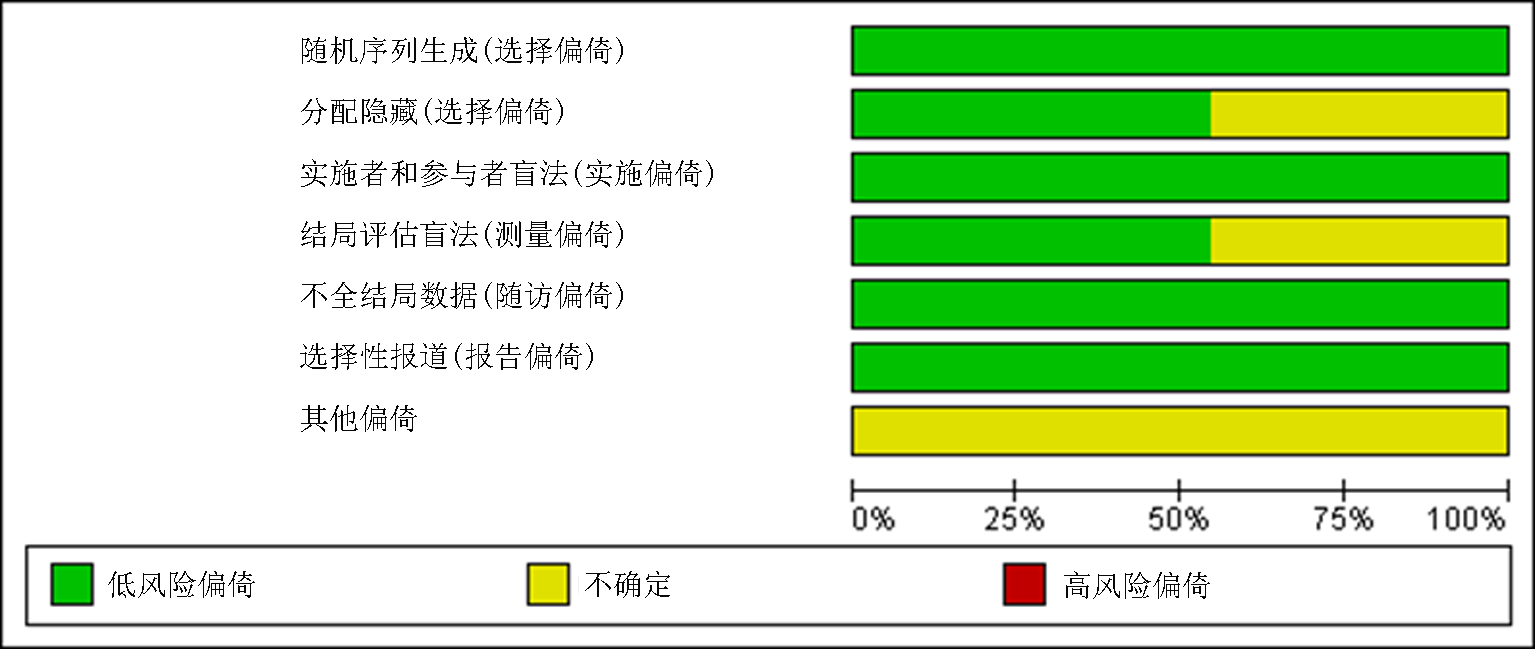
图2 偏倚风险条形图
Fig. 2 Risk-of-bias bar chart
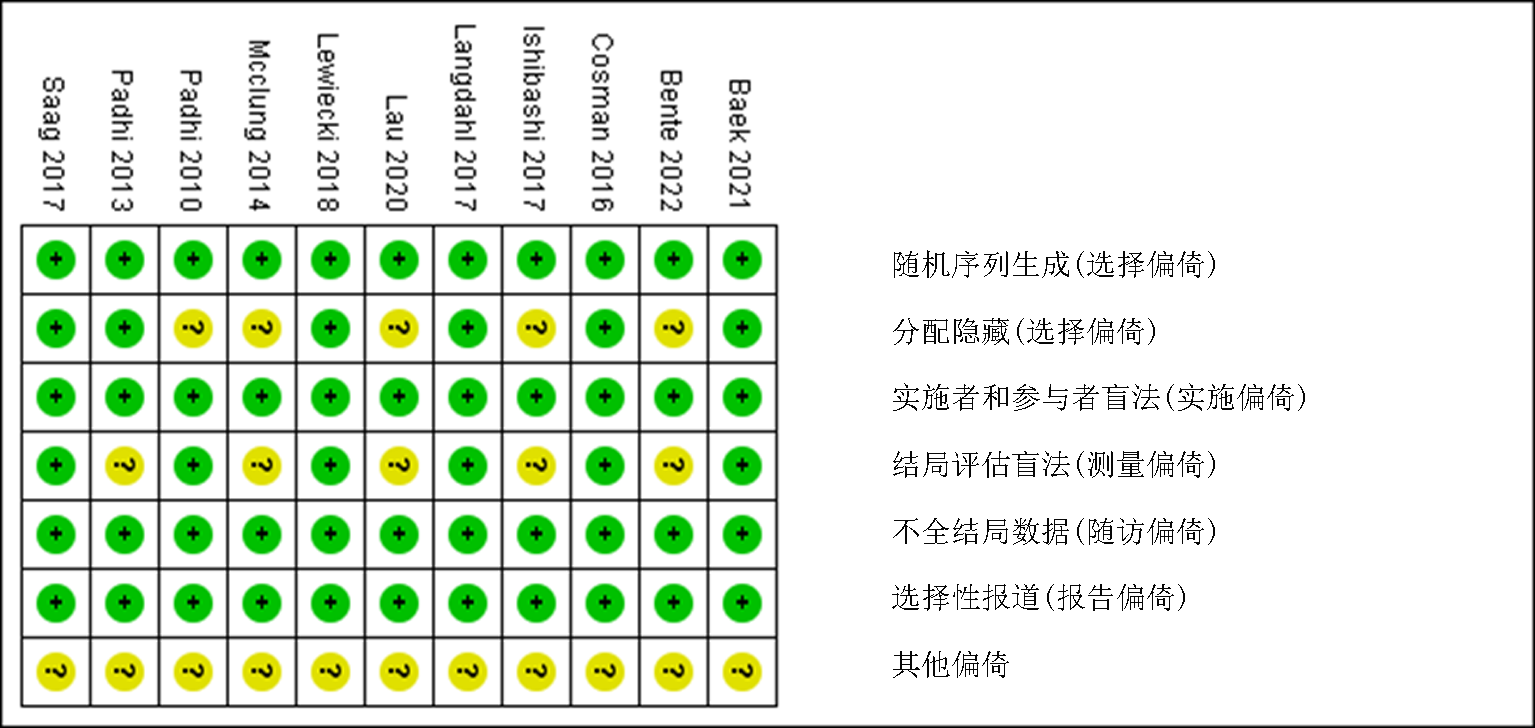
图3 偏倚风险总图
Fig. 3 Risk-of-bias summary plot
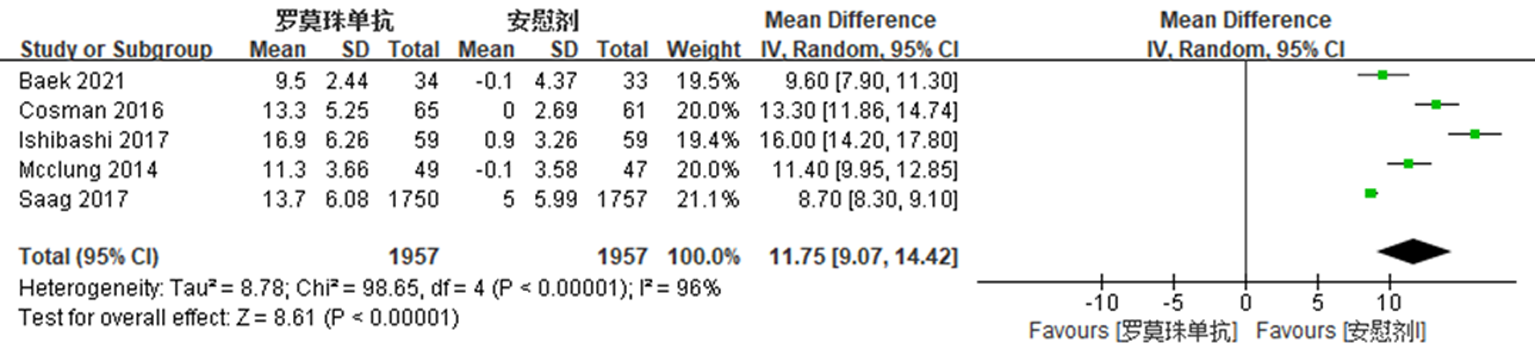
图4 腰椎骨密度水平的meta分析
Fig. 4 Meta-analysis of lumbar spine bone mineral density
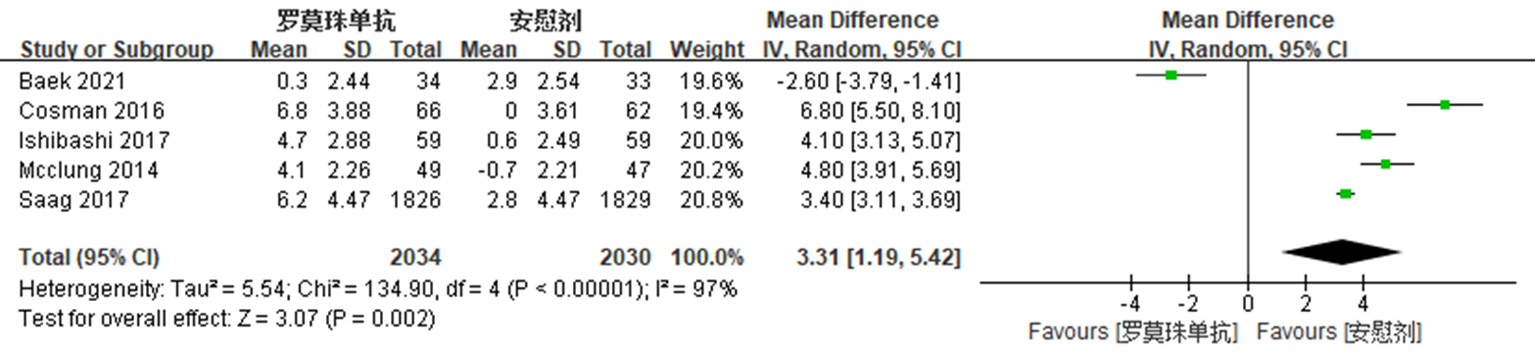
图5 全髋关节骨密度水平的meta分析
Fig. 5 Meta-analysis of total hip bone mineral density
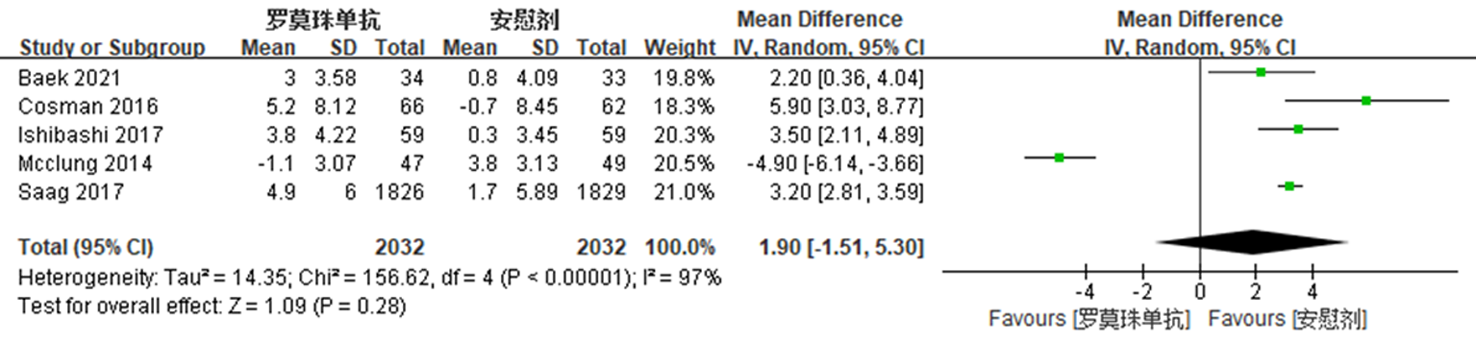
图6 股骨颈骨密度水平的meta分析
Fig. 6 Meta-analysis of femoral neck bone mineral density
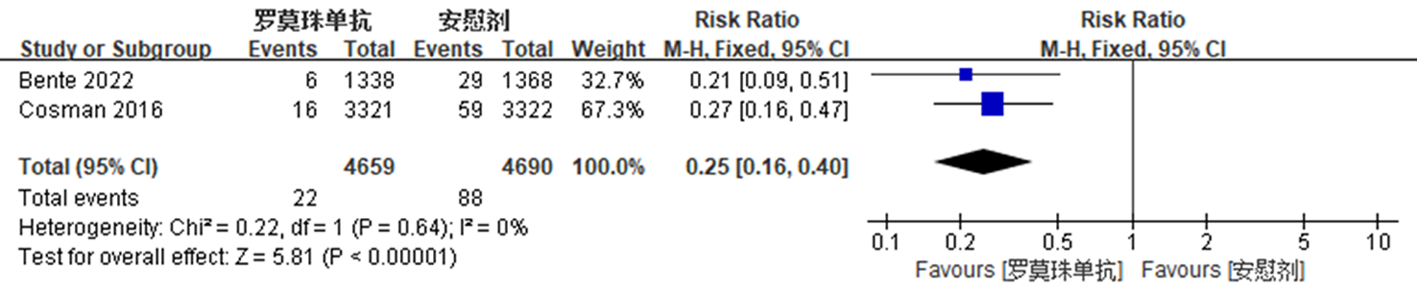
图7 新发椎体骨折发生率的meta分析
Fig.7 Meta-analysis of the incidence of new vertebral fractures
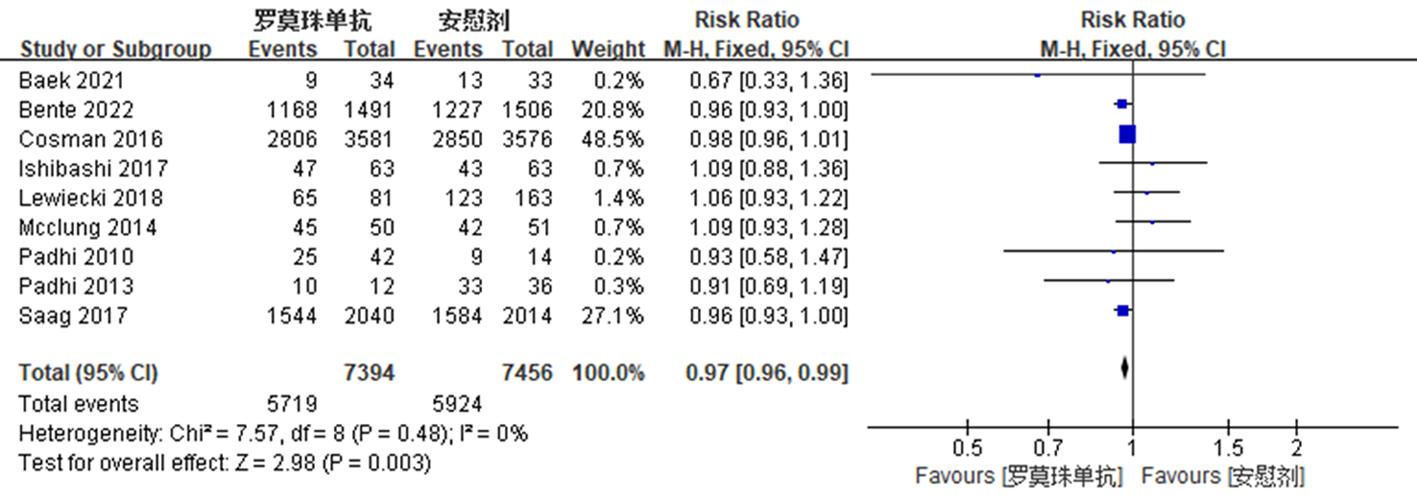
图8 罗莫珠单抗组和安慰剂组不良事件发生率的meta分析
Fig.8 Meta-analysis of adverse event incidence in the romosozumab and placebo groups
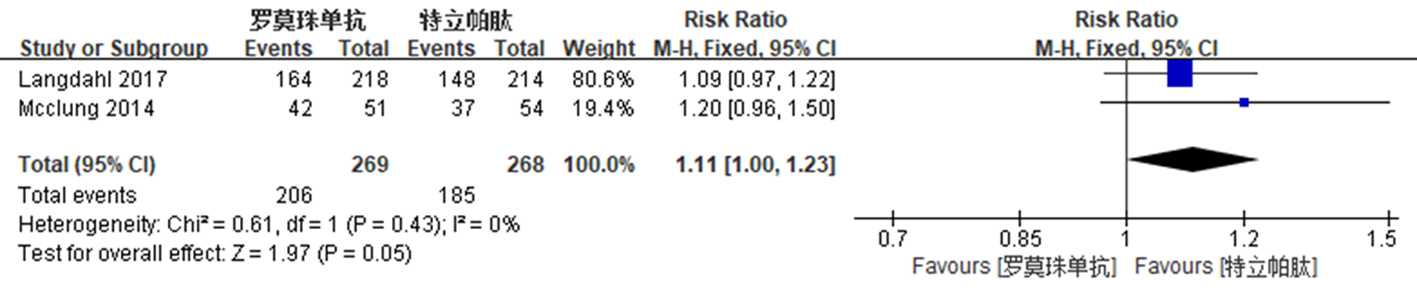
图9 罗莫珠单抗组和特立帕肽组不良事件发生率的meta分析
Fig. 9 Meta-analysis of adverse event incidence in the romosozumab and teriparatide groups
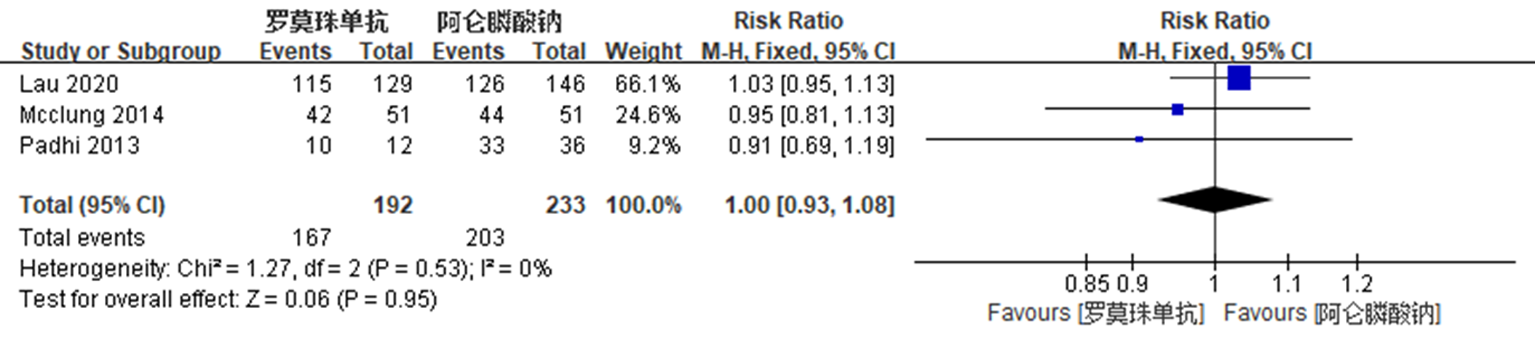
图10 罗莫珠单抗组和阿仑膦酸钠组不良事件发生率的meta分析
Fig.10 Meta-analysis of adverse event incidence in the romosozumab and alendronate groups
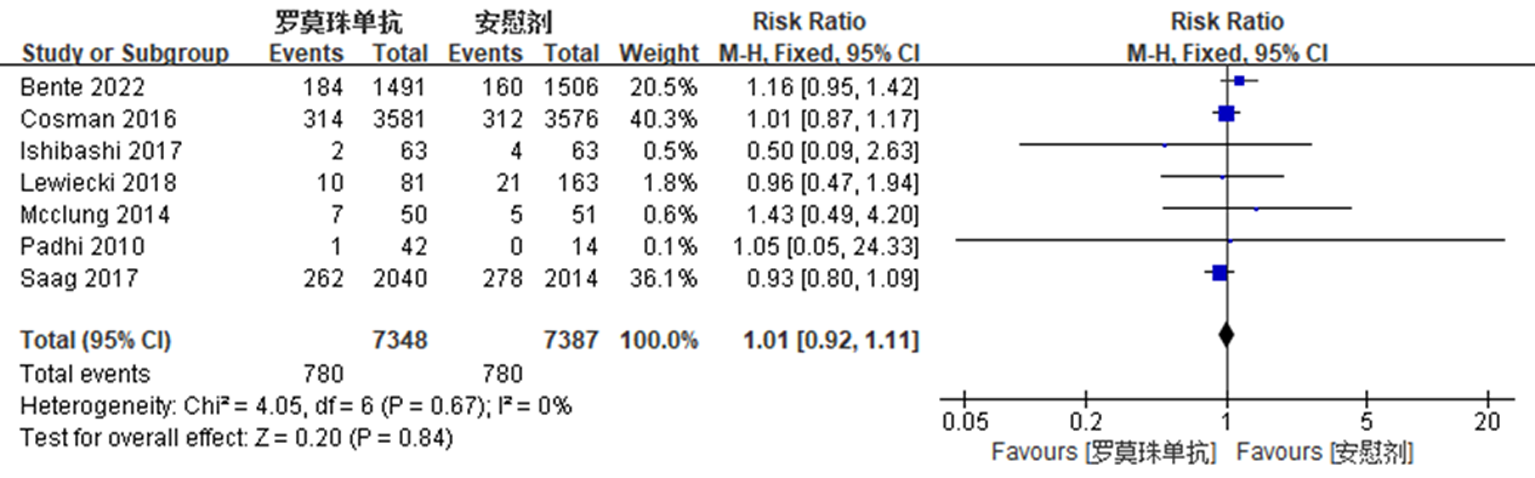
图11 罗莫珠单抗组和安慰剂组严重不良事件发生率的meta分析
Fig.11 Meta-analysis of serious adverse event incidence in the romosozumab and placebo
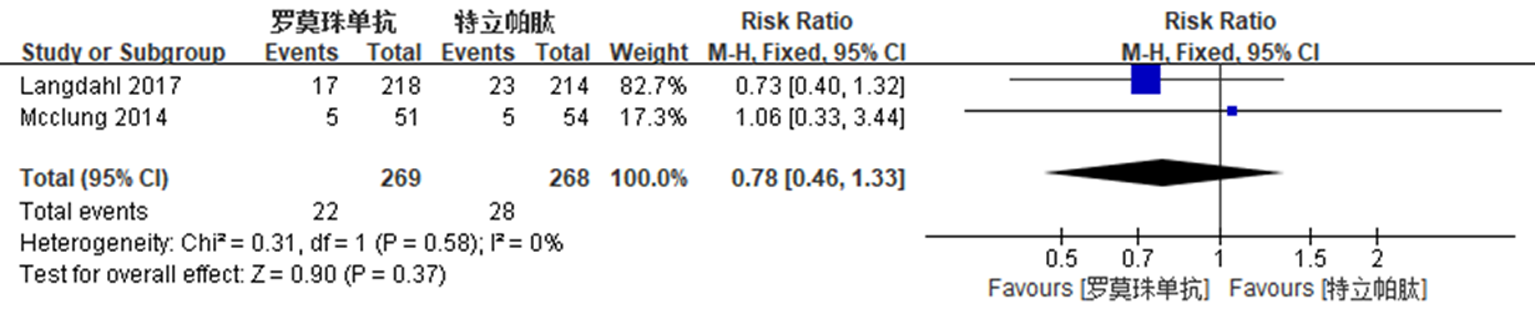
图12 罗莫珠单抗组和特立帕肽组严重不良事件发生率的meta分析
Fig.12 Meta-analysis of serious adverse event incidence in the romosozumab and teriparatide groups
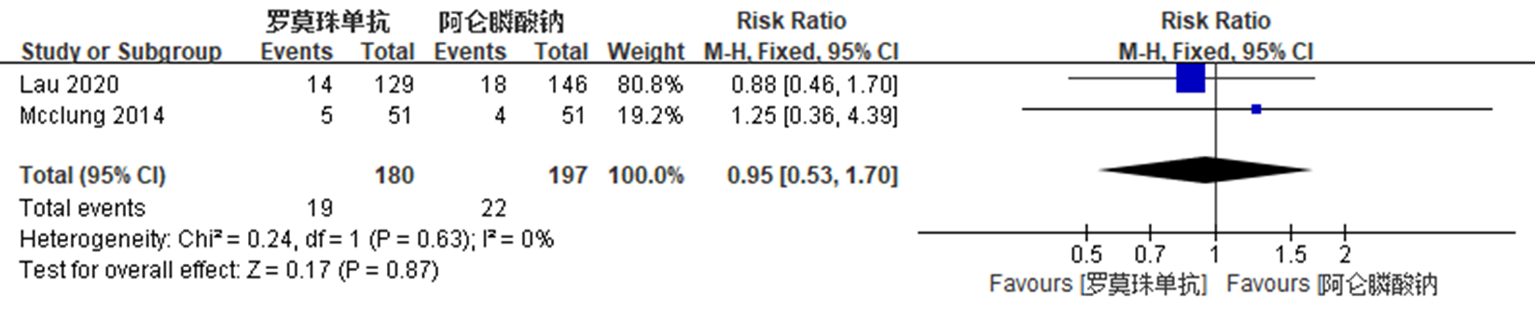
图13 罗莫珠单抗组和阿仑膦酸钠组严重不良事件发生率的meta分析
Fig.13 Meta-analysis of serious adverse event incidence in the romosozumab and alendronate groups
| 结局指标 | 随机效应模型 | 固定效应模型 | 去除权重大的研究 | 去除权重小的研究 | |||||||
|---|---|---|---|---|---|---|---|---|---|---|---|
| 腰椎骨密度 | 11.75[9.07, 14.42] | <0.01 | 9.47[9.11, 9.83] | <0.01 | 12.56[10.09, 15.03] | <0.01 | 10.71[8.45, 12.97] | <0.01 | |||
| 不良事件发生率 | 0.98[0.96, 0.99] | 0.004 | 0.97[0.96, 0.99] | 0.003 | 0.97[0.94, 0.99] | 0.005 | 0.97[0.96, 0.99] | 0.003 | |||
表2 敏感性分析
Tab. 2 Sensitivity analysis
| 结局指标 | 随机效应模型 | 固定效应模型 | 去除权重大的研究 | 去除权重小的研究 | |||||||
|---|---|---|---|---|---|---|---|---|---|---|---|
| 腰椎骨密度 | 11.75[9.07, 14.42] | <0.01 | 9.47[9.11, 9.83] | <0.01 | 12.56[10.09, 15.03] | <0.01 | 10.71[8.45, 12.97] | <0.01 | |||
| 不良事件发生率 | 0.98[0.96, 0.99] | 0.004 | 0.97[0.96, 0.99] | 0.003 | 0.97[0.94, 0.99] | 0.005 | 0.97[0.96, 0.99] | 0.003 | |||
| [1] | 中华医学会物理医学与康复学分会. 骨质疏松症康复治疗指南(2024版)[J]. 中国循证医学杂志, 2024, 24: 626-636.doi:10.7507/1672-2531.202403173. |
| [2] | Tian L, Yu X. Fat, Sugar, and bone health: A complex relationship[J]. Nutrients, 2017, 9(5): 506.doi:10.3390/nu9050506. |
| [3] | 黄彦钧, 黄诚, 沈砚主, 等. 罗莫佐单抗在骨质疏松症治疗中的应用[J]. 中华骨质疏松和骨矿盐疾病杂志, 2024, 17: 81-87.doi:10.3969/j.issn.1674-2591.2024.01.011. |
| [4] |
Lau E, Dinavahi R, Woo YC, et al. Romosozumab or alendronate for fracture prevention in East Asian patients: A subanalysis of the phase III, randomized ARCH study[J]. Osteoporos Int, 2020, 31(4): 677-685.doi:10.1007/s00198-020-05324-0.
pmid: 32047951 |
| [5] | Bente L, Lorenz CH, Serge F, et al. Romosozumab efficacy and safety in European patients enrolled in the FRAME trial[J]. Osteoporos Int, 2022, 33(12): 2527-2536.doi:10.1007/s00198-022-06544-2. |
| [6] | Cosman F, Crittenden DB, Adachi JD, et al. Romosozumab Treatment in Postmenopausal Women with Osteoporosis[J]. N Engl J Med, 2016, 375(16): 1532-1543.doi:10.1056/NEJMoa1607948. |
| [7] | Baek KH, Chung YS, Koh JM, et al. Romosozumab in Postmenopausal Korean Women with Osteoporosis: A Randomized, Double-Blind, Placebo-Controlled Efficacy and Safety Study[J]. Endocrinol Metab, 2021, 36(1): 60-69.doi:10.3803/EnM.2020.848. |
| [8] | Ishibashi H, Crittenden DB, Miyauchi A, et al. Romosozumab increases bone mineral density in postmenopausal Japanese women with osteoporosis: A phase 2 study[J]. Bone, 2017, 103(63): 209-215.doi:10.1016/j.bone.2017.07.005. |
| [9] | Mcclung MR, Grauer A, Boonen S, et al. Romosozumab in Postmenopausal Women with Low Bone Mineral Density[J]. N Engl J Med, 2014, 370(5): 412-420.doi:10.1056/NEJMoa1305224. |
| [10] | Padhi D, Allison M, Kivitz A, et al. Multiple doses of sclerostin antibody romosozumab in healthy men and postmenopausal women with low bone mass: A randomized, double-blind, placebo-controlled study[J]. J Clin Pharmacol, 2013, 54(2): 168-178.doi:10.1002/jcph.239. |
| [11] |
Lewiecki EM, Tomasz B, Stefan G, et al. A Phase III Randomized Placebo-Controlled Trial to Evaluate Efficacy and Safety of Romosozumab in Men With Osteoporosis[J]. J Clin Endocrinol Metab, 2018, 103(9): 3183-3193.doi:10.1210/jc.2017-02163.
pmid: 29931216 |
| [12] | Saag KG, Petersen J, Brandi ML, et al. Romosozumab or Alendronate for Fracture Prevention in Women with Osteoporosis[J]. N Engl J Med, 2017, 377(15): 1417-1427.doi:10.1056/NEJMoa1708322. |
| [13] | Padhi D, Jang G, Stouch B, et al. Single-dose, placebo-controlled, randomized study of AMG 785, a sclerostin monoclonal antibody[J]. J Bone Miner Res, 2010, 26(1): 19-26.doi:10.1002/jbmr.173. |
| [14] |
Langdahl B, Libanati C, Crittenden DB, et al. Romosozumab (sclerostin monoclonal antibody) versus teriparatide in postmenopausal women with osteoporosis transitioning from oral bisphosphonate therapy: A randomised, open-label, phase 3 trial[J]. Lancet, 2017, 390(10102): 1585-1594.doi:10.1016/S0140-6736(17)31613-6.
pmid: 28755782 |
| [15] | U.S. Food and Drug Administration. (2019, April 9). FDA approves EVENITYTM (romosozumab-aqqg) for the treatment of osteoporosis in postmenopausal women at high risk for fracture[EB/OL]. https://www.multivu.com/players/English/8490251-amgen-evenity-postmenopausal-osteoporosis/,2025-11-30. |
| [16] |
Canalis E. Wnt signalling in osteoporosis: Mechanisms and novel therapeutic approaches[J]. Nat Rev Endocrinol, 2013, 9(10): 575-583.doi:10.1038/nrendo.2013.154.
pmid: 23938284 |
| [17] | Michael SO, Qing-Tian N, Chaoyang L, et al. Tissue-level mechanisms responsible for the increase in bone formation and bone volume by sclerostin antibody[J]. J Bone Miner Res, 2013, 29(6): 1424-1430.doi:10.1002/jbmr.2152. |
| [18] |
Ke HZ, Richards WG, Li X, et al. Sclerostin and dickkopf-1 as therapeutic targets in bone diseases[J]. Endocr Rev, 2012, 33(5): 747-783.doi:10.1210/er.2011-1060.
pmid: 22723594 |
| [19] | Cristiano AFZ, Vera Lúcia S, Abergaria BH, et al. Incidence of hip fracture in Brazil and the development of a FRAX model[J]. Arch Osteoporos, 2015, 10(1): 11657.doi:10.1007/s11657-015-0224-5. |
| [20] |
Cosman F, Crittenden DB, Ferrari S, et al. FRAME study: The foundation effect of building bone with 1 year of romosozumab leads to continued lower fracture risk after transition to denosumab[J]. J Bone Miner Res, 2018, 33(7): 1219-1226.doi:10.1002/jbmr.3427.
pmid: 29573473 |
| [21] | Kim DH, Rogers JR, Fulchino LA, et al. Bisphosphonates and risk of cardiovascular events: A meta-analysis[J]. PLoS One, 2015, 10(4): 1-13.doi:10.1371/journal.pone.0122646. |
| [22] | Miyauchi A, Dinavahi R, Crittenden DB, et al. Increased bone mineral density for 1year of romosozumab, vs placebo, followed by 2years of denosumab in the Japanese subgroup of the pivotal FRAME trial and extension[J]. Arch Osteoporos, 2019, 14(1): 1-13.doi:10.1007/s11657-019-0608-z. |
| [1] | 曹焕峥, 任芊羽, 张凯茜, 王子涵, 李昊儒, 金杨瑜, 张力辉, 王静. 胰岛移植与胰岛联合干细胞移植治疗1型糖尿病的有效性和安全性的meta分析[J]. 临床荟萃, 2026, 41(7): 581-589. |
| [2] | 刘东斐, 姜昱成, 王占峰. 运动对中国睡眠障碍青少年睡眠质量干预效果的meta分析[J]. 临床荟萃, 2026, 41(5): 389-398. |
| [3] | 王鹏, 余玲, 胥力川, 庞敏, 李果, 郑洪锟, 张全波, 青玉凤. 原发性痛风患者发生骨质疏松症的危险因素分析及预测模型构建[J]. 临床荟萃, 2026, 41(4): 323-327. |
| [4] | 汤思颖, 贾君萍, 唐雨婷, 郑玉琴, 孔悦. 膳食炎症指数与肺癌风险相关性的meta分析[J]. 临床荟萃, 2026, 41(3): 197-204. |
| [5] | 王鑫汇, 张家梦, 刘跟莉. 双胎妊娠早产危险因素的meta分析[J]. 临床荟萃, 2026, 41(2): 101-107. |
| [6] | 向喻欣, 钟宇豪. 认知行为疗法对2型糖尿病患者抑郁症状干预效果的meta分析[J]. 临床荟萃, 2026, 41(1): 5-11. |
| [7] | 鲜奇男, 徐弋雯, 李鑫, 孙妍. 虚拟现实技术对颈部慢性疼痛患者干预效果的meta分析[J]. 临床荟萃, 2025, 40(9): 773-780. |
| [8] | 郭伊凡, 任桦, 白婧, 刘三娇, 李燕娟. 类风湿关节炎患者睡眠障碍发生率及影响因素的meta分析[J]. 临床荟萃, 2025, 40(8): 677-683. |
| [9] | 叶倩, 刘申香. H1抗组胺药与接受免疫检查点抑制剂治疗的肿瘤患者预后关系的meta分析[J]. 临床荟萃, 2025, 40(8): 684-688. |
| [10] | 苏桂婷, 康雅红, 陈梓琼, 刘芳. 经颅直流电刺激对脑卒中后轻中度认知障碍患者认知功能康复效果的系统评价与meta分析[J]. 临床荟萃, 2025, 40(7): 581-588. |
| [11] | 陈敏, 宋心荣, 马博戬, 牛慧敏. 对比增强超声评估颈动脉斑块稳定性与缺血性脑卒中相关性的meta分析[J]. 临床荟萃, 2025, 40(6): 492-497. |
| [12] | 苏芮, 王存凯, 王鼎鑫, 蔡聪会, 张建, 侯洪涛, 白云. 肝硬化患者抗凝治疗有效性和安全性的meta分析[J]. 临床荟萃, 2025, 40(4): 293-303. |
| [13] | 谢飞飞, 张维健. 替尔泊肽对2型糖尿病患者血脂影响的meta分析[J]. 临床荟萃, 2025, 40(12): 1061-1067. |
| [14] | 陈梓琼, 康雅红, 刘芳, 陈秋华. 芳香疗法对老年痴呆患者精神行为症状和生活质量影响的系统评价和meta分析[J]. 临床荟萃, 2025, 40(11): 965-972. |
| [15] | 李永婧, 高春刚, 张金龙, 宋淑华. 不同运动疗法改善轻度认知障碍老年人综合认知及执行功能的网状meta分析[J]. 临床荟萃, 2025, 40(10): 874-892. |
| 阅读次数 | ||||||
|
全文 |
|
|||||
|
摘要 |
|
|||||
